
India has moved from a prescriptive fire code to a performance-oriented standard. That single shift changes what “compliant” means — and it favours intelligent, early, demonstrable detection.
On 30 April 2026, the Bureau of Indian Standards gazette-notified the National Building Construction Standards 2026 (SP 7:2026), replacing NBC 2016 and moving India from a prescriptive fire code to a performance-oriented framework. In a regime that asks you to demonstrate the life-safety outcome rather than just tick prescribed boxes, wireless addressable AIoT systems like NFire — fast to deploy, capable of early multi-criteria detection, and engineered to comply with IS/ISO 7240 and EN 54 — align naturally with both the new national standard and global benchmarks.
For more than a decade, designing a fire alarm system in India largely meant reproducing a checklist. The code told you what to install; you installed it; the Fire NOC followed. That world ended quietly on a single date.
On 30 April 2026, the Bureau of Indian Standards (BIS) notified the National Building Construction Standards 2026 (SP 7:2026) through the Gazette of India, withdrawing the National Building Code of India 2016 with immediate effect and no transition period. The most consequential change is not any single clause. It is the philosophy: NBCS 2026 shifts India from a prescriptive regime, where the code specified exactly what to build, to a performance-oriented one, where designers and specifiers must show that the finished building achieves the required fire and life-safety outcome.
This reframing matters far beyond paperwork. When the question becomes “can you demonstrate that your detection layer actually performs?” rather than “did you fit the prescribed devices?”, the systems best positioned to answer are those that are intelligent, supervised, and data-rich by design. That is precisely the territory of wireless addressable AIoT fire detection — and it is why we believe systems built on this architecture, such as NFire, represent where Indian fire safety is heading.
Before discussing technology, it is worth being precise about the regulation, because accuracy here is non-negotiable. NBCS 2026 is now the national reference standard, in force since 30 April 2026. But fire and life safety remains a state subject in India. The standard is enforced in practice through state and municipal building bye-laws and the Fire NOC process, which states typically align with the national framework. Adoption will move at different speeds across the 28 states and 8 union territories. So “in force as the national reference, enforced through state bye-laws and the NOC process” is the honest description — not a blanket national mandate, and not, as some early commentary suggested, merely advisory.
Within Part F (Fire and Life Safety), three things stand out for anyone responsible for detection and alarm.
NBCS 2026 states that its fire and life safety provisions apply not only to new construction but whenever a building is altered over a floor area of 1,000 m² or more, or when there is a change of occupancy (Clause 1.3, read with Section 3.3). Section 3.3 adds a crucial condition: any alteration must be carried out so that it does not bring the level of fire and life safety below what existed earlier. In other words, a major renovation is no longer an opportunity to defer a fire system upgrade — it is a moment that pulls the full weight of the current standard onto the project. For India’s vast stock of occupied, operating buildings, this is the single most actionable hook in the new code.
Section 5.2 (Fire Detection and Alarm System), read with Clause 4.9, points to the accepted standards IS 2189:2026 and the IS/ISO 7240 series. The text expects fire alarm panels to be connected in a peer-to-peer network or with redundant cabling run in separate shafts, with each panel able to operate standalone and in master–slave architecture where required. It expects the panel to monitor water levels in tanks, hydrant and sprinkler pressures, pump on/off status, and isolation valve states. It calls for voice evacuation in English, Hindi and vernacular languages, integrated with the fire alarm panel, and visual strobes for occupants with hearing impairment.
Just as telling is what the code now explicitly names as legitimate detection methods: video-based fire detection, aspiration high-sensitivity smoke detection, multi-criteria point detectors, flame and gas detection, and more. A standard that catalogues these technologies is a standard written for a world of intelligent, early, networked sensing — not a world of standalone bells.
Because the regime is performance-oriented, the burden of proof now sits with whoever specifies and signs off the design. The lowest-cost device with an old test certificate is no longer the safe default; the properly engineered, recently certified, demonstrable system is. Detection that can produce a clear audit trail of its own health and behaviour is suddenly a professional asset, not a luxury.
To see why wireless addressable architecture matters, it helps to step through the generations of fire detection plainly.
| System Type | How It Locates a Fire | Practical Limitation |
|---|---|---|
| Conventional | Identifies the affected zone (a group of detectors on one circuit) | You know the zone, but not the exact detector — slower to pinpoint the fire source. |
| Wired Addressable | Every detector has its own unique address for precise identification. | Accurate device-level location, but requires extensive cabling, civil works, and disruptive installation. |
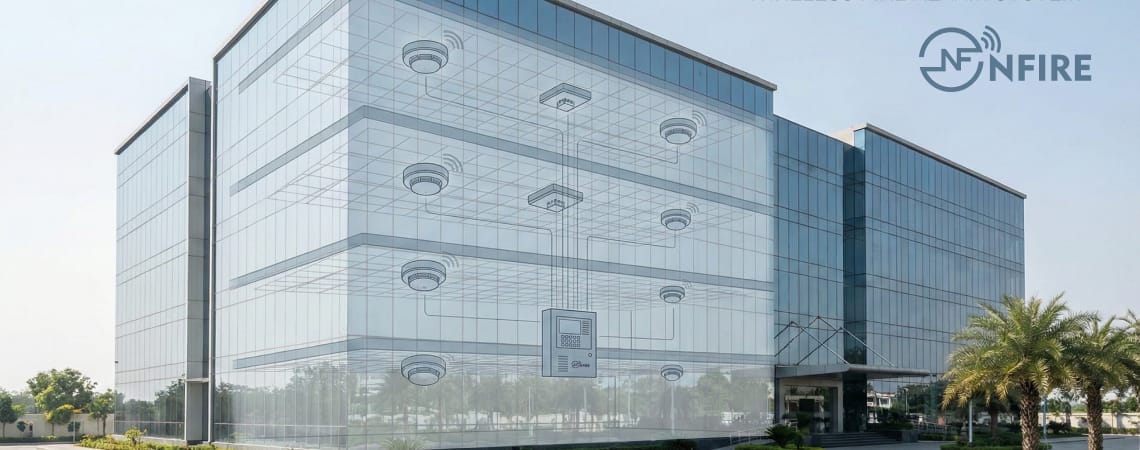
| Wireless Addressable | Every detector has its own unique address and reports events wirelessly. | ✔ Precise device-level location with minimal cabling, rapid installation, and minimal disruption. |
Now overlay the 1,000 m² alteration trigger. Most of the buildings that will need to act under NBCS 2026 are already occupied: hospitals running clinics, hotels with guests, offices, malls, factories. Re-wiring a working building for a wired addressable system means cable trays through finished ceilings, chasing walls, downtime, and dust — in environments where downtime carries real cost. Wireless addressable detection removes most of that friction. NFire reports deployment in hours rather than the days or weeks a comparable wired loop can take, precisely because there is no detection cabling to pull.
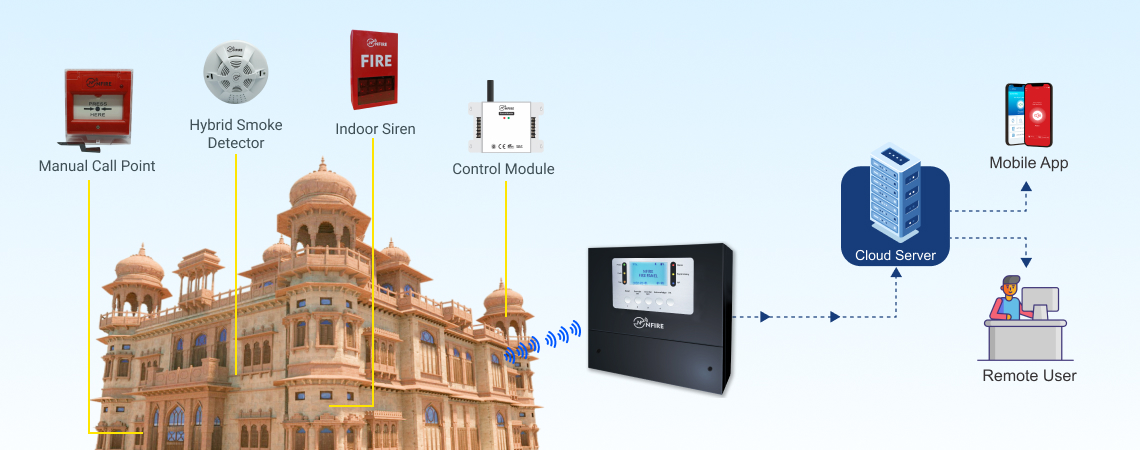
“Is wireless reliable?” is the fair and obvious objection, and the answer lies in the architecture rather than the marketing. NFire connects each sensor directly to a sensor control module — it does not depend on a daisy-chained mesh where one weak hop can degrade a path. Wireless devices report to a Wireless Sensor Control Module (WSCM); the Hybrid Sensor Control Module (HSCM) offers a middle path where a wired loop delivers power and continuously monitors the loop for faults, while signalling remains wireless. This distributed loop-power approach keeps the modularity of wireless with the reliability of wired loop power, and it is not a legacy-wiring retrofit.
Every device is supervised and addressable, so a missing or faulty unit is detected and annunciated rather than silently lost. Communications are secured with AES-256 encryption and TLS 1.3. And because Atigo began its R&D in 2009 specifically to build sensors that survive Indian conditions — sustained 40°C-plus heat and 90 percent humidity that defeated many imported units — the platform is engineered for the environment it operates in, not adapted to it after the fact.
Wireless addressing solves the installation and location problem. AIoT solves the harder one the performance regime cares about: detecting earlier, deciding better, and proving it.
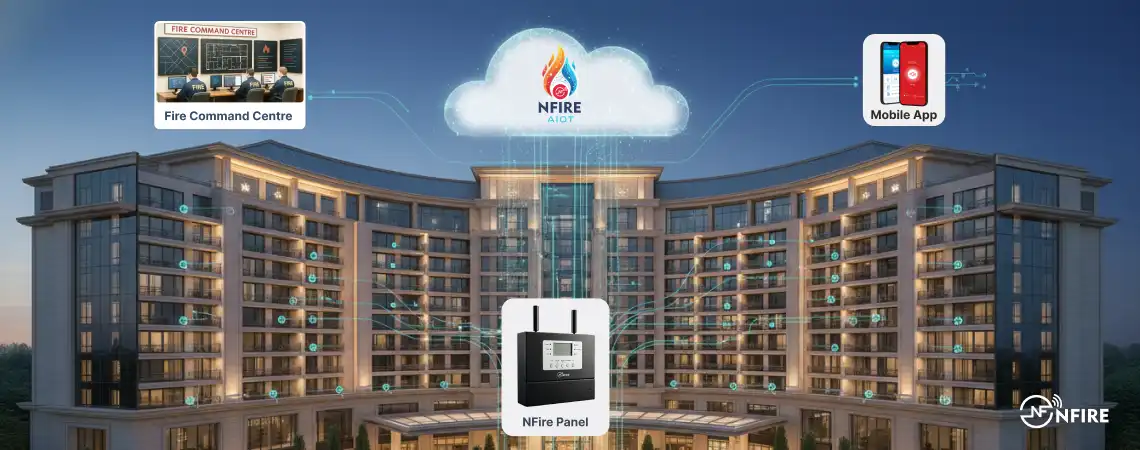
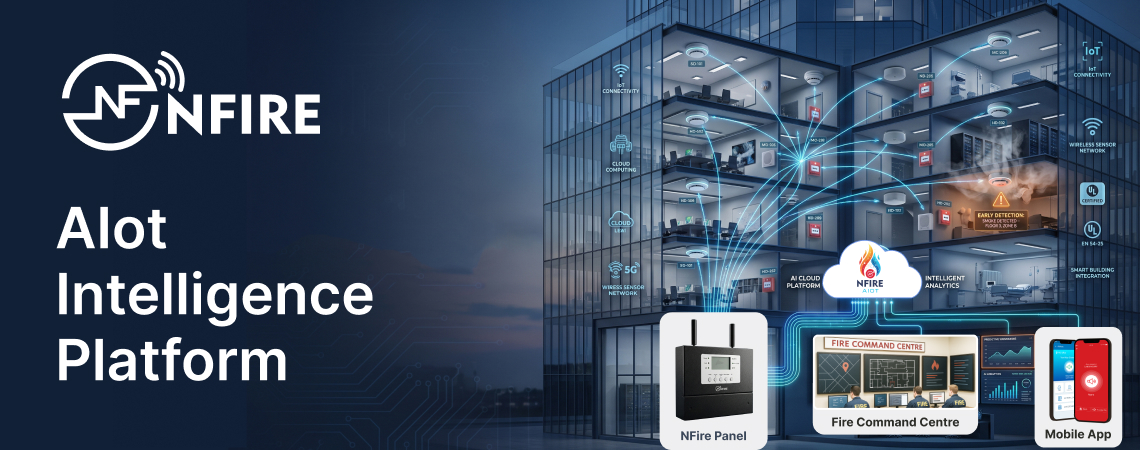
NFire pairs an AI core with IoT-connected multi-sensor detectors — smoke, heat, gas, and carbon monoxide. Rather than reacting to a single threshold being crossed, the system reasons across real-time sensor data, learned zone thresholds, and stored history to deliver three things conventional systems struggle with:
Critically for the new code, AIoT systems are auditable. They produce a continuous record of device health, environmental conditions, and events — exactly the kind of evidence a performance-oriented framework expects a specifier to be able to put on the table. The platform also integrates with wider building systems over Modbus, BACnet/IP and TCP/IP, so fire detection becomes part of a coordinated building response rather than an island.
A point that reassures both Indian authorities and international clients: the standards NBCS 2026 leans on for detection are themselves international. The code references the IS/ISO 7240 series — the same family of fire detection and alarm standards recognised globally — alongside IS 2189:2026.
If you are a consultant, architect, or MEP specifier, treat any alteration of 1,000 m² or more and any change of occupancy as a fire-detection compliance event, and specify a system whose performance you can demonstrate and document. If you are a building owner or operator, the same trigger is your prompt: the next major renovation is when your detection layer will be measured against the current standard, not the one in force when the building was first occupied.
None of this should be oversold. NBCS 2026 does not mandate AIoT, wireless, or any specific brand. It is deliberately technology-neutral. What it does is reward the qualities that intelligent wireless addressable systems happen to have in abundance: early detection, supervised reliability, clean integration, and demonstrable, auditable performance. And it places the responsibility for delivering those outcomes squarely on the people who design and approve the building.
The state-by-state enforcement reality also means timelines will vary. The smart move is not to wait for your local authority to formally catch up, but to specify to the national standard now — both because it is the direction of travel and because a system aligned with IS/ISO 7240 and EN 54 will satisfy whichever bye-law eventually applies.
The future of fire safety in India is not a louder bell. It is a system that sees the fire forming, locates it to the device, tells the right people instantly, and can prove every step of how it did so. That is the future NFire was built for.
Talk to the NFire team about how wireless addressable AIoT detection fits your next project, retrofit, or Fire NOC submission.
NBCS 2026 (SP 7:2026) was gazette-notified by BIS on 30 April 2026 and is now the national reference standard for building construction, fire and life safety, replacing NBC 2016. Fire and life safety is a state subject, so it is enforced in practice through state and municipal building bye-laws and the Fire NOC process, which most states align with the national framework. Adoption pace varies across the 28 states and 8 union territories.
No. NBCS 2026 is technology-neutral and performance-oriented. It does not mandate a specific detection technology; it requires that the building demonstrably achieves the required fire and life-safety outcome, and references accepted standards such as IS 2189:2026 and the IS/ISO 7240 series. Wireless addressable AIoT systems align well with this regime because they support early multi-criteria detection, supervised addressable monitoring, and documentable performance.
The fire and life safety provisions apply when a building is altered over a floor area of 1,000 m² or more, or when there is a change of occupancy. Section 3.3 also requires that any alteration must not reduce fire and life safety below the level that existed earlier, making major renovations a live compliance event.
NFire is engineered to comply with IS/ISO 7240 (the Indian and international fire detection and alarm standard) and EN 54 (the European benchmark), and carries CE marking. This dual alignment reflects the same standards NBCS 2026 cross-references for detection and alarm, supporting both domestic compliance and international deployment.
Modern wireless addressable systems are supervised: each device reports status and location continuously, and faults are detected and annunciated. NFire connects sensors directly to a sensor control module rather than relying on a daisy-chained mesh, and its hybrid mode uses a wired loop for power and loop-fault monitoring while signalling stays wireless. Communications are secured with AES-256 encryption and TLS 1.3, and the sensors were developed for Indian operating conditions.
This article is for general information and does not constitute regulatory or legal advice. NBCS 2026 is enforced through state and local building bye-laws and the Fire NOC process, which vary by jurisdiction and continue to evolve. Always confirm the specific requirements applicable to your project with your local fire authority and a qualified fire safety consultant.