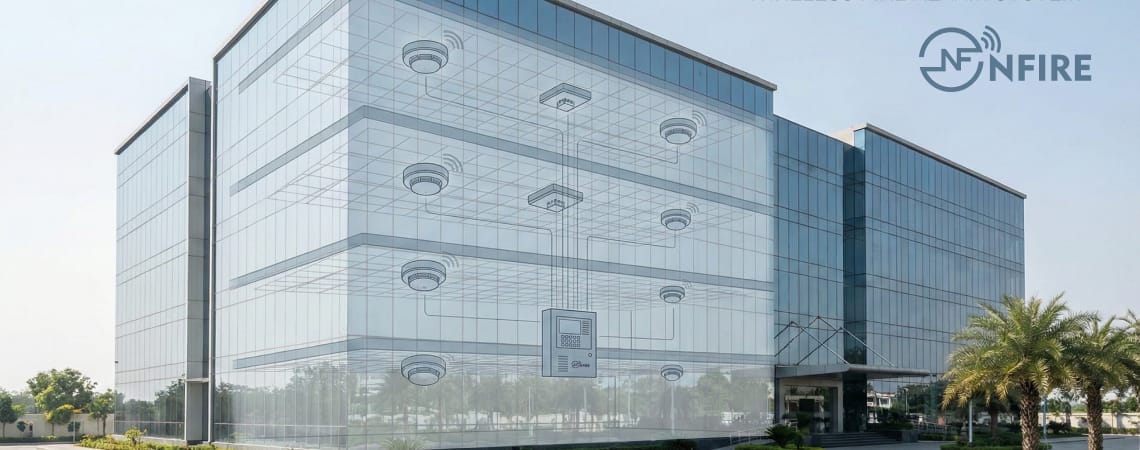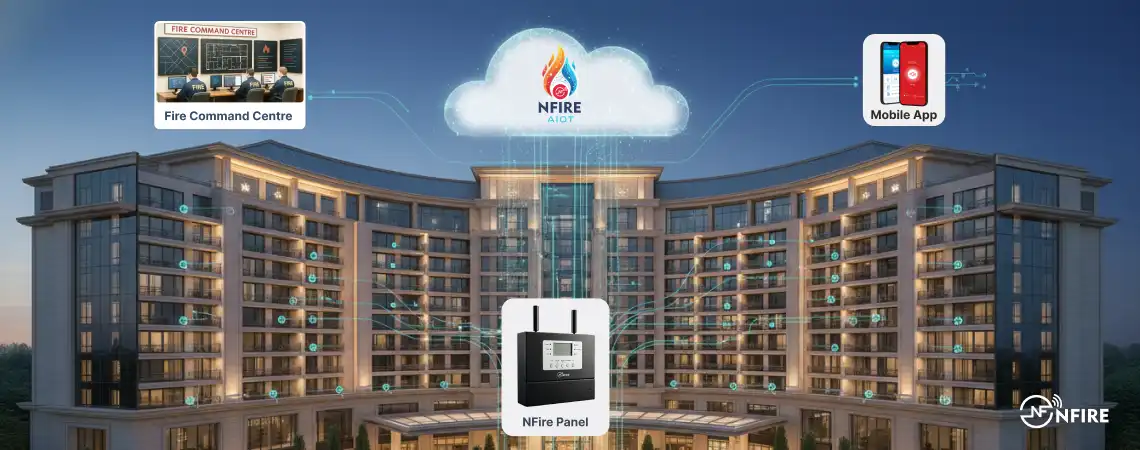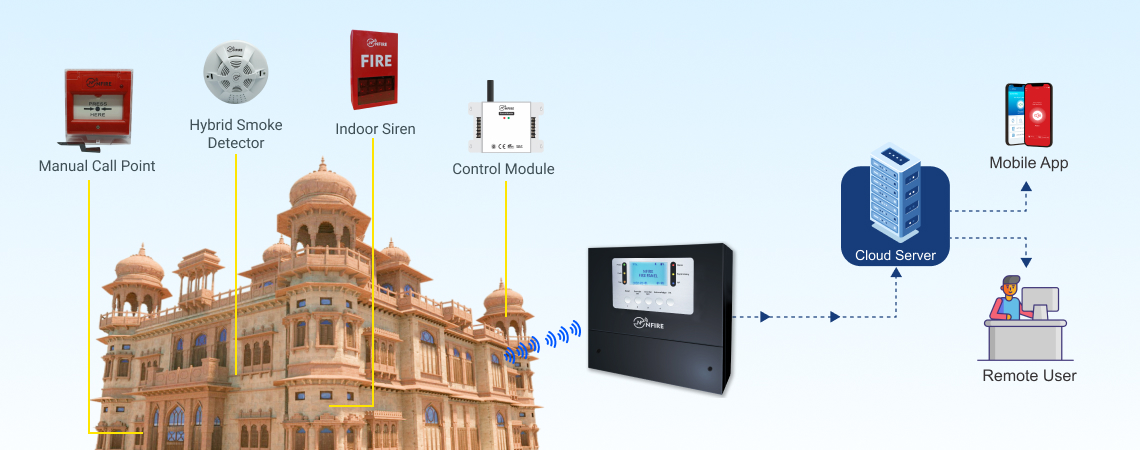

Every fire alarm system specified today will protect or fail to protect people and assets for the next 20 years. For fire consultants and MEP engineers, the specification decision is a professional responsibility, not just a product selection. This guide makes the technical case for specifying NFire AIoT: the compliance credentials, integration architecture, detection intelligence, and sector-specific capabilities that make it the defensible, future-proof choice for India’s next generation of critical buildings.

India’s fire safety regulatory environment is undergoing its most significant transformation in decades. The National Building Code 2025 (NBC 2025) introduces mandatory requirements for addressable fire detection, remote monitoring capability, and measurable system performance — requirements that conventional zone-based systems cannot satisfy.
Simultaneously, major insurers and AHJs (Authorities Having Jurisdiction) are tightening scrutiny of fire safety specifications, and institutional clients are demanding demonstrable, auditable compliance. Specifying a system that only meets yesterday’s compliance threshold exposes your client — and your practice — to regulatory, financial, and reputational risk.
NBC 2025 mandates addressable fire alarm systems for buildings above prescribed occupancy thresholds, remote monitoring capability, and integration with building management infrastructure. These requirements directly disqualify conventional zone-based systems from compliance. Wireless addressable AIoT systems are now the minimum standard, not the premium option.
Annual Fire Deaths India — NCRB data
Rising Incidents Delhi fire calls, 2023–24
Market by 2030 India fire protection market
Govt. Investment Fire services modernisation scheme
Before examining NFire’s capabilities, it helps to define the criteria every fire alarm system must satisfy during specification. Fire and MEP consultants bridge the gap between code requirements and real-world execution — the professional checklist includes:
Standards compliance: verifiable IS/ISO 7240, EN54, and NBC 2025 alignment, documentable for AHJ submission and insurer audit.
MEP system integration: native compatibility with HVAC, access control, SCADA, and building automation via standard protocols (BACnet/IP, Modbus, TCP/IP).
Detection performance: multi-criteria, low false-alarm detection with addressable device identification and AI-powered predictive alerting.
Installation practicality: wireless deployment that avoids cable disruption in occupied, heritage, and complex buildings, reducing project risk.
Remote monitoring and audit: cloud-based real-time dashboards and event logs that satisfy AHJ inspection and insurer audit requirements.
Long-term maintainability: predictive device health monitoring, remote diagnostics, and a proven support infrastructure protecting the client’s 20-year investment.
NFire AIoT satisfies every criterion on this checklist — and redefines what is possible within several of them.
For a specification to be defensible, the system’s compliance standing must be unimpeachable. NFire’s compliance profile is exceptional — and uniquely relevant to the Indian market:
NFire is compliant with IS/ISO 7240 and EN54. This dual Indian and European compliance standing is uncommon among Indian fire alarm manufacturers and provides specifying consultants with the strongest possible documentation for AHJ submission and client assurance.
| Basic Alarm + App Notification | Professional Protection Platform |
|---|---|
| Alert sent to mobile phone | Event received and validated by monitoring centre |
| Owner responsible for response | Trained Protection Officer responds within 60 seconds |
| No guaranteed action | SLA-backed escalation protocol |
| No documentation | Audit-ready incident logs and reports |
| Reactive — you act if you see it | Actively supervised — professionals act regardless |
| Response depends on one person | Structured escalation across multiple contacts |
| No system health tracking | Monthly remote health verification |
Understanding NFire’s system architecture is essential for writing accurate specification documents and advising clients on system capabilities. NFire operates across four integrated layers:
The foundation of the platform is the NFire AI Core, a proprietary AI engine that continuously analyses multi-sensor data streams. Unlike rule-based detection — which simply checks whether a sensor reading exceeds a fixed threshold — the AI Core applies pattern recognition, historical memory, zone-specific threshold intelligence, and CFD (Computational Fluid Dynamics) fire behaviour modelling to classify environmental conditions as: pre-fire risk, developing alarm, or confirmed alarm.
This is the critical distinction for specification. A conventional system reports what has happened. NFire reports what is about to happen — giving building operators time to investigate and prevent a fire event before it becomes an emergency.
The Agentic Model translates AI Core analysis into autonomous actions without manual intervention: triggering suppression systems, activating evacuation signals, sending alerts to the mobile app and Fire Command Centre (FCC), and coordinating with integrated MEP systems. This closed-loop autonomy directly addresses NBC 2025’s enhanced response capability requirements.
Field devices communicate using the proprietary RTNAP protocol through two hardware pathways:
Sensors communicate entirely wirelessly. No cabling required for power or signalling. Maximum installation speed with minimum disruption. Ideal for new builds, occupied retrofits, heritage buildings, and modular or temporary facilities.
Sensors are connected by a wired loop that delivers power and monitors for all loop faults — including open circuit, short circuit, and earth fault conditions. All signalling from sensors to the control module remains wireless. NFire’s distributed loop power architecture means power is delivered locally across modular segments rather than from a single central source, preserving the flexibility and scalability of a wireless system while adding the deterministic loop fault supervision and power reliability of a traditional wired installation.
Both modes feed the Fire Alarm Control Server (FACS) via RTNAP, maintaining identical monitoring, analytics, and response capability. The result: consultants can specify the mode that best suits each zone of a building — even mixing both modes within a single installation.
The sensor layer supports a comprehensive range of detectors suitable for commercial, institutional, and industrial environments:
| Sensor Type | Variants | Typical Application |
|---|---|---|
| Temperature | Variable / Fixed / LHS Linear Heat Sensing cable | Plant rooms, conveyor belts, cable trays, industrial tunnels, atria |
| Flame | IR / UV / Optical | High-ceiling warehouses, refineries, generator rooms, server halls |
| Gas | Variable / Fixed concentration | Kitchens, parking structures, chemical storage, LPG rooms |
| Pressure | — | HVAC duct monitoring, pressurised stairwells, suppression system readiness |
| Humidity | — | Server rooms, pharmaceutical stores, archival vaults |
| Liquid Flow | — | Sprinkler system monitoring, suppression pipeline integrity |
Fire alarm systems must coordinate with HVAC, access control, and building utilities to enable rapid smoke control, water supply management, and electrical circuit coordination during an emergency. NFire natively supports three industry-standard integration protocols:
| Protocol | Primary MEP Application | Typical Use Case |
|---|---|---|
| BACnet/IP | HVAC, BMS, AHU control, chiller plants | Smoke damper closure, AHU shutdown, pressurisation activation on alarm |
| Modbus | Industrial SCADA, PLCs, electrical panels | Coordinate with industrial control systems; generator and UPS monitoring |
| TCP/IP | Access control, CCTV, PA systems, IT networks | Door lock/unlock, CCTV recording trigger, PA announcements, security desk notification |
NFire’s tri-protocol native support means no third-party gateway hardware is needed between fire safety and building services. BACnet/IP integration allows the fire platform to trigger HVAC smoke control sequences directly — a life safety function that many fire alarm systems require custom gateways to achieve. Specifying NFire reduces interface risk, simplifies commissioning documentation, and removes a common source of system integration failure.
The following comparison evaluates NFire against a standard wired addressable system across the criteria that matter most to specifying consultants:
| Specification Criterion | Conventional Wired Addressable | NFire AIoT Wireless Addressable |
|---|---|---|
| IS/ISO 7240 compliance | ◐ Varies by product | ✔ Compliant |
| EN54 compliance | ◐ Rare for Indian manufacturers | ✔ Compliant |
| NBC 2025 Ready | ◐ Addressable only | ✔ Full platform compliance |
| Predictive / pre-fire detection | ✗ Threshold-only reaction | ✔ AI Core + CFD Zone Analysis |
| False alarm reduction (multi-criteria) | ◐ Limited | ✔ AI multi-criteria engine |
| Wireless installation | ✗ Cable infrastructure required | ✔ 100% wireless (WSCM mode) |
| Hybrid loop-powered / wireless signalling mode | ✗ Not available | ✔ HSCM — loop power + wireless signal + loop fault monitoring |
| Digital Twin / 2D + 3D dashboard | ✗ | ✔ Live 2D + 3D Digital Twin |
| Cloud remote monitoring | ◐ Third-party add-on | ✔ Native cloud + mobile app |
| BACnet/IP integration | ◐ Gateway required | ✔ Native |
| Modbus integration | ◐ Gateway required | ✔ Native |
| LHS cable for industrial zones | ◐ Separate system typically | ✔ Integrated sensor ecosystem |
| Predictive maintenance / device health | ✗ | ✔ Continuous IoT diagnostics |
The mechanism behind NFire’s predictive detection is worth examining in detail, because it answers the question every client will eventually ask: “How does it know a fire is coming?”
NFire’s Zone Analysis engine builds a dynamic risk profile for each monitored zone by integrating five data dimensions:
The practical outcome is illustrated by NFire’s conveyor belt use case: the system detected a temperature anomaly of 56°C at Conveyor Zone 2 and issued a timestamped alert with operator options — before ignition. This is the difference between a maintenance intervention and a catastrophic industrial fire. It is the difference that consultants can point to when justifying the specification to their clients.
Hospital specifications must account for patients who cannot self-evacuate. NFire’s addressable detection pinpoints the exact ward or room of origin, while the Digital Twin dashboard allows fire coordinators to direct staff to the precise location — enabling targeted, patient-safe responses rather than building-wide disruption. BACnet/IP integration coordinates HVAC smoke control sequences in affected zones automatically.
Industrial environments require detection that can monitor miles of cable trays, conveyor belts, and process pipework. NFire’s LHS (Linear Heat Sensing) cable integration, combined with CFD zone analysis and multi-sensor correlation (temperature + gas + flame), delivers spatially distributed, multi-criteria industrial fire detection that standalone point detectors cannot match. All system components — alarms, sprinklers, detectors, dampers — function as a single coordinated platform.
A hotel fire during night hours, with hundreds of sleeping guests across multiple floors, is one of the most challenging emergency scenarios. NFire’s addressable wireless network maps each room and corridor precisely, while the Digital Twin dashboard guides security and fire response teams with the situational clarity needed to execute safe, floor-by-floor evacuations.
For consultants specifying upgrades in occupied hospitals, operating factories, or heritage structures, NFire’s two deployment modes offer a solution for every constraint. The fully wireless WSCM mode requires no cable routing — no false ceilings to demolish, no operational shutdown, no civil works — enabling rapid, non-invasive deployment from day one. Where loop fault supervision and wired power reliability are required without the disruption of full conventional cabling, the Hybrid HSCM mode delivers loop-powered sensors with full loop fault monitoring, while keeping all signalling wireless. NFire’s distributed loop power design means even the Hybrid mode retains the modularity and installation flexibility that makes wireless deployment so practical in complex or occupied buildings.
Server rooms and record archives represent irreplaceable assets. NFire’s multi-criteria detection is sensitive enough to detect early combustion products from electrical equipment before visible smoke appears. Combined with automatic suppression integration, this provides the level of protection that financial institutions and their regulatory auditors demand.
NFire’s wireless scalability allows campus-wide deployment and zoned management — a fire in one building triggers targeted evacuation, not campus-wide panic, while operators retain complete situational awareness. For high-rack warehouses, wireless deployment flexibility and LHS cable integration enable comprehensive coverage of architecturally challenging storage environments.
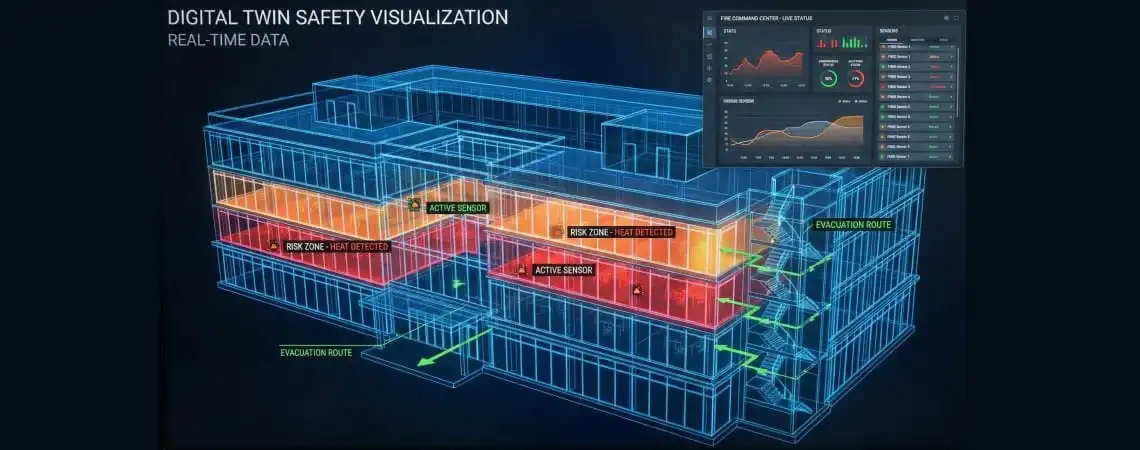
The monitoring and management experience your client lives with for the next two decades deserves as much attention as the detection specification. NFire’s Dynamic Dashboard presents a live building model in both 2D floor plan overlay and 3D Digital Twin views, showing in real time:
During an emergency, the 3D Digital Twin becomes an operational command interface. Fire command centre operators see exactly where an incident is occurring, which zones are affected, which evacuation routes are clear, and which suppression systems have activated — all in real time, without waiting for radio reports from the field.
This is the specification detail that resonates with facility directors and safety officers. The ability to say “our system shows us exactly where every sensor is and exactly where any incident is occurring” is a transformative upgrade from a traditional fire alarm panel.
NFire AIoT Safety Intelligence Platform is India’s first wireless addressable fire alarm system with integrated Artificial Intelligence and IoT capabilities, developed by Atigo Enterprises Limited in collaboration with IIT Gandhinagar. A standard addressable system identifies which device has triggered and reports it to a panel. NFire goes further: the NFire AI Core performs continuous multi-sensor pattern analysis, zone-specific risk profiling using CFD modelling, and historical baseline comparison to generate predictive fire risk alerts — before ignition occurs. It also provides a live 2D/3D Digital Twin dashboard, native BACnet/Modbus/TCP-IP integration, cloud remote monitoring, and an agentic autonomous response layer. NFire is compliant with IS/ISO 7240 and EN54, is CE marked, and is fully NBC 2025 Ready.
Yes. NFire is compliant with IS/ISO 7240 (Bureau of Indian Standards — mandatory for NBC 2025 compliance and fire NOC issuance in India) and EN54 (the European standard for fire detection and alarm systems, widely regarded as one of the world’s most rigorous quality benchmarks for fire safety equipment). NFire is also CE marked and fully NBC 2025 Ready. This dual Indian and European compliance standing is uncommon among Indian fire alarm manufacturers, providing specifying consultants with robust documentation for AHJ submission, insurer audit, and client assurance.
NFire natively supports BACnet/IP, Modbus, and TCP/IP integration — no third-party gateway hardware required. BACnet/IP enables direct communication with HVAC, BMS, and AHU systems for smoke damper actuation and AHU shutdown. Modbus connects with industrial SCADA, PLCs, and electrical panel monitoring. TCP/IP integration covers access control, CCTV triggering, public address systems, and network-connected building services. Native tri-protocol support simplifies interface documentation and eliminates common commissioning failure points.
NFire field devices communicate using the proprietary RTNAP protocol via multiple physical-layer radio technologies including WiFi, LoRa, and RF — enabling selection of the appropriate medium based on building geometry and radio environment. LoRa’s low-frequency, high-penetration characteristics are especially effective in concrete-heavy industrial and commercial buildings. NFire’s EN54 compliance confirms the wireless architecture meets the reliability standards required for life safety applications.
NFire’s AI Core evaluates multiple sensor data streams simultaneously — temperature, gas concentration, flame signature, and humidity — before classifying an event as an alarm condition. It compares readings against zone-specific dynamic thresholds (not static fixed values) and historical baseline patterns. A temperature rise in a kitchen zone at midday is evaluated against that zone’s known lunch-hour thermal profile; a simple threshold system would alarm, but NFire’s AI Core recognises it as within the expected range. Only when multiple criteria align in a pattern consistent with genuine fire conditions does the system escalate. This multi-criteria intelligence dramatically reduces nuisance activations while improving genuine alarm confidence and response speed.
NBC 2025 mandates addressable fire alarm systems for buildings above prescribed occupancy thresholds, remote monitoring capability, integration with building management systems, and IS/ISO 7240 compliance. NFire satisfies all four requirements natively: it is a fully addressable system (every device has a unique address), provides cloud-based remote monitoring via the NFire Cloud Server and mobile app, integrates with BMS via BACnet/IP and Modbus, and is IS/ISO 7240 compliant. NFire goes beyond NBC 2025 minimum requirements through predictive AI detection and Digital Twin monitoring.
NFire AIoT is suitable for manufacturing plants (LHS cable for conveyor belts, AI zone analysis), hospitals and healthcare facilities (precise location detection for patient safety), hotels and hospitality (wireless deployment across occupied multi-floor buildings), banking and financial institutions (server room early electrical fire detection), education campuses (scalable wireless multi-building deployment), and warehousing and logistics (high-rack storage with flame and LHS detection). NFire’s two deployment modes — fully wireless (WSCM) for maximum installation flexibility, and Hybrid (HSCM) with loop-powered sensors and wireless signalling for environments requiring full loop fault supervision — make it equally suited to new build projects, occupied retrofits, and high-reliability industrial specifications.
For fully wireless deployments (WSCM mode): wireless detectors and sensors are placed and registered to their WSCM units; WSCMs communicate via RTNAP to the central Fire Alarm Control Server (FACS); the FACS connects to the Fire Command Centre, cloud server, and integrated MEP systems. The Fire Alarm Display Panel (FADP) provides local status. Zone analysis parameters — ambient thresholds, fire load profiles, CFD model inputs — are configured during commissioning. The 2D/3D Digital Twin dashboard is populated with floor plans and device locations. No cable routing, conduit, or trunking is required, significantly reducing commissioning time and building disruption.
For Hybrid deployments (HSCM mode): sensors are connected to the HSCM via a wired loop that delivers power and provides continuous loop fault monitoring — including open circuit, short circuit, and earth fault supervision. All signalling from sensors to the HSCM remains wireless. NFire’s distributed loop power architecture delivers power locally across modular loop segments rather than from a single central source, preserving the flexibility and scalability of a wireless system. Both modes produce identical output to the FACS, meaning the same cloud monitoring, Digital Twin dashboard, and MEP integration capabilities are available regardless of which deployment mode is used — or whether both are mixed within a single building.
NFire Solutions provides fire consultants and MEP firms with complete technical specification documentation, compliance data sheets, integration guides, and site assessment support — everything needed to specify with confidence.
Published by: NFire Solutions Technical Team — Atigo Enterprises Limited, IIT Gandhinagar Research Park, Gujarat, India — www.nfire.in