

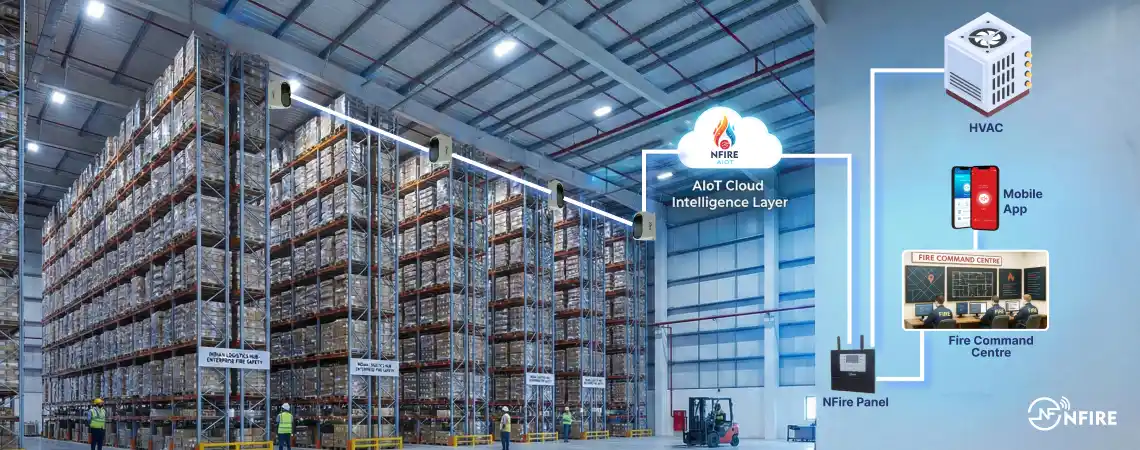
AIoT fire alarm systems are becoming essential for large warehouses in India because traditional fire alarms cannot scale to modern warehouse sizes, fail to detect fires early, generate costly false alarms, and do not integrate with HVAC, suppression, and evacuation systems as required under the National Building Code 2016.
AIoT systems use AI-driven analytics and IoT sensors to predict fires before ignition, pinpoint exact locations, and autonomously coordinate building systems—reducing loss of life, inventory damage, and operational downtime.
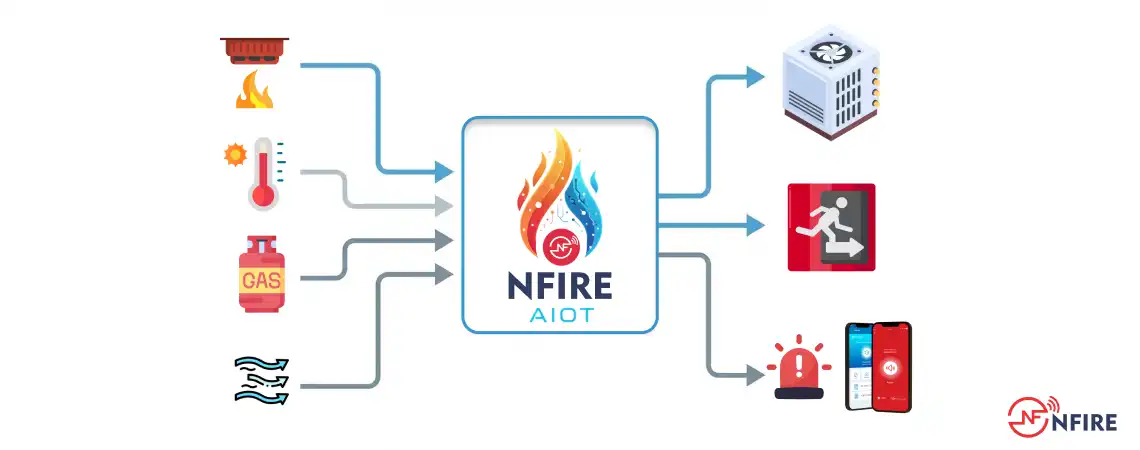
An AIoT (Artificial Intelligence of Things) fire alarm system combines:
Unlike conventional fire alarms that react after smoke or flames appear, AIoT systems continuously analyze environmental and operational data to predict and prevent fires before ignition.
India’s logistics and warehousing sector is rapidly expanding, driven by large distribution hubs, cold storage facilities, and Multi-Modal Logistics Parks (MMLPs). Warehouses today range from 15,000 sqm distribution centers to 400,000+ sqm mega facilities—yet fire safety systems often remain outdated.
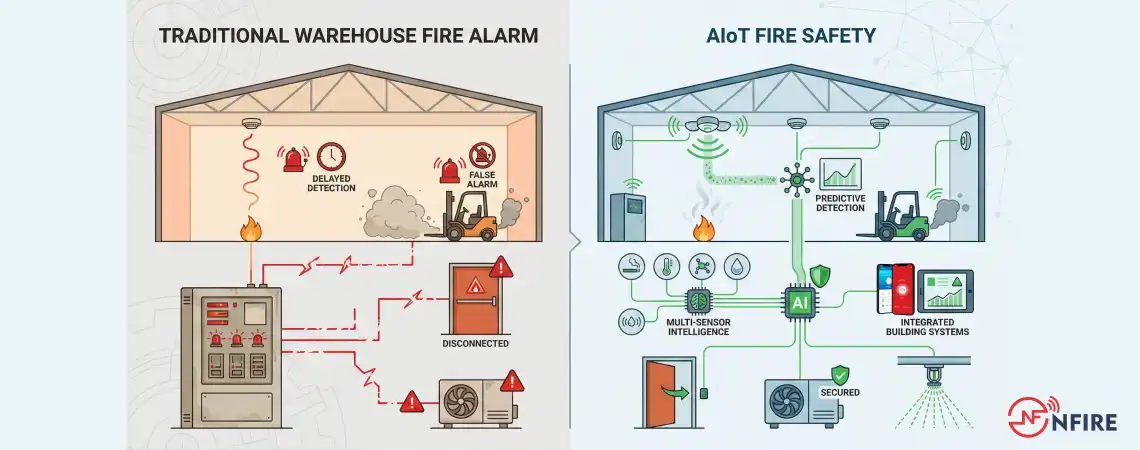
In high-bay warehouses with racking heights of 12–15 meters, ceiling-mounted smoke detectors trigger alarms too late. Fires frequently spread through concealed paths such as cable trays, service shafts, and false ceilings—an effect explicitly warned against in NBC 2016.
By the time smoke reaches a distant detector, thousands of square meters of inventory may already be compromised.
Warehouses operate in constantly changing environments:
Traditional fire alarms cannot distinguish these conditions from real fire events, leading to frequent false alarms.
Each false alarm can cost ₹50,000–₹2,00,000 in lost productivity, emergency response charges, and restart delays.
AIoT systems reduce false alarms by up to 40% by correlating multiple sensor inputs instead of reacting to a single trigger.
Modern warehouses depend on interconnected systems—HVAC, automated storage and retrieval systems (AS/RS), conveyors, cold chain infrastructure, and access control.
Traditional fire alarms:
NBC 2016 explicitly requires coordinated control of these systems during fire events—something legacy alarms are not designed to deliver.
In a large warehouse, knowing “Zone 12” is on fire is operationally useless.
AIoT systems identify the exact sensor location—aisle, rack, and height—allowing response teams to act immediately instead of searching blindly.
AI models establish a baseline of normal behavior for each warehouse zone.
They detect subtle deviations—long before smoke or flames appear.
Example:
In a battery charging or electrical panel area, AI may detect:
Individually acceptable. Together, they signal thermal runaway risk, enabling intervention hours before ignition.
AIoT systems combine inputs from:
This prevents unnecessary evacuations while ensuring instant confirmation of real fire threats.
For warehouses ranging from 20,000 sqm to mega logistics parks, wireless AIoT systems provide critical advantages:
This makes wireless AIoT systems ideal for both expanding warehouses and greenfield logistics parks.
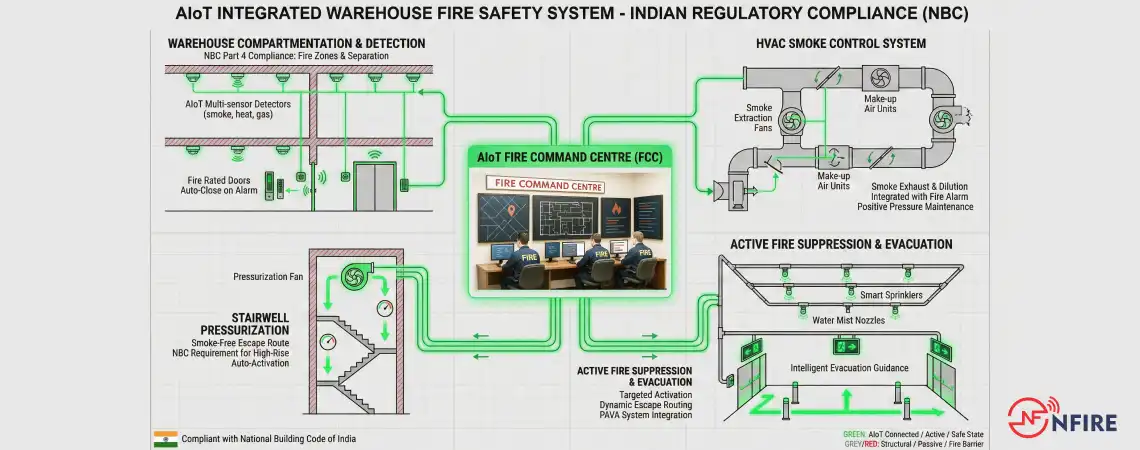
NBC mandates breaking large floor plates into manageable fire compartments.
A large logistics facility may require dozens to hundreds of compartments, depending on size and usage.
AIoT systems:
During fire events, AIoT systems:
AIoT transforms the Fire Command Centre from a passive monitoring room into a real-time decision engine, coordinating detection, containment, suppression, and evacuation automatically.
Fire safety is a state subject in India, creating varying Fire NOC requirements.
AIoT systems simplify compliance by maintaining:
This ensures alignment with national NBC standards while satisfying state-level authorities.
According to the National Crime Records Bureau, India records thousands of fire-related deaths annually.
Industrial incidents repeatedly show the same failure points:
AIoT systems are designed specifically to eliminate these gaps.
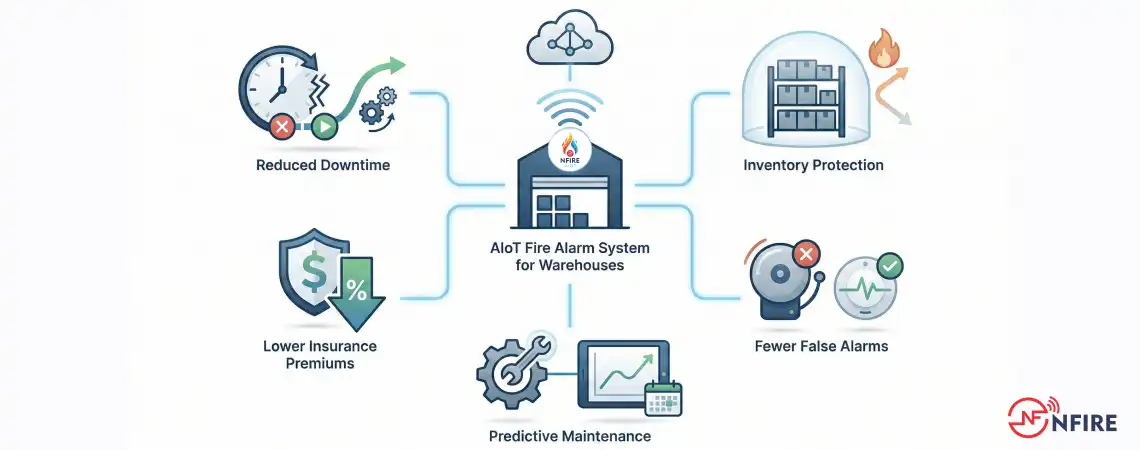
Advanced predictive fire systems can reduce insurance premiums by 15–25%.
Fewer false alarms mean uninterrupted 24/7 operations.
Early detection can prevent ₹10–₹50 crore losses from a single warehouse fire.
AIoT sensors also identify overheating motors, electrical faults, and mechanical stress—preventing fires and breakdowns.
This dual alignment supports Indian approvals, global insurers, and multinational logistics operators.
Typical implementation timeline:
As India moves toward becoming a $360 billion logistics economy by 2032, fire safety must evolve from reactive alarms to predictive, autonomous systems.
Whether you operate a regional distribution center or a mega logistics park, AIoT fire safety systems scale intelligently with your operations.
If your warehouse operates at logistics speed but relies on legacy fire alarms, your safety strategy is already outdated.
In 2026, AIoT fire alarm systems are not a premium upgrade—they are the baseline requirement for protecting lives, inventory, and business continuity in India’s modern warehousing ecosystem.
We design and deploy wireless addressable AIoT fire alarm systems for warehouses ranging from mid-sized distribution centers to large logistics parks. Our solutions comply with IS/ISO 7240, EN54, and NBC 2016 Part 4, delivering predictive fire safety aligned with India’s evolving logistics infrastructure.
Ready to future-proof your facility? Stop relying on outdated detection. Contact NFire today
An AIoT fire alarm system combines IoT-based multi-sensor fire detectors with artificial intelligence to predict and detect fire risks earlier than traditional alarms. It continuously analyzes temperature, smoke, gas, air quality, and electrical patterns to prevent fires before ignition and to coordinate automatic responses during emergencies.
AIoT fire alarm systems are needed because modern Indian warehouses are large, high-density, and operate 24/7. Traditional fire alarms cannot detect fires early enough, generate frequent false alarms, and do not integrate with HVAC, fire doors, and evacuation systems as required under the National Building Code 2016.
NBC 2016 does not mandate AIoT specifically, but it requires automatic fire detection, compartmentation, smoke control, and Fire Command Centre integration for large and high-risk buildings. AIoT systems are currently the most effective way to meet and exceed these requirements in large warehouses and logistics facilities.
Warehouses larger than 15,000–20,000 sqm, high-bay storage facilities, cold storage warehouses, and logistics parks benefit significantly from AIoT fire alarm systems. As warehouse size and operational complexity increase, traditional zone-based fire alarms become inadequate.
AIoT systems reduce false alarms by correlating data from multiple sensors—such as smoke, heat, gas, and air quality—instead of reacting to a single trigger. AI algorithms recognize normal operational patterns like dust, forklifts, or temperature changes and only raise alarms when coordinated fire signatures are detected.
Yes. AIoT systems use predictive analytics to identify early warning signs such as abnormal temperature rise, gas emissions, or electrical anomalies. This allows facility teams to intervene hours before ignition, especially in high-risk areas like battery charging zones and electrical rooms.
Yes. Wireless addressable fire alarm systems are highly reliable for large warehouses when designed with redundancy and industrial-grade communication protocols. They reduce installation time, eliminate extensive cabling, and provide precise sensor-level location data—making them ideal for large and expanding facilities.
When a fire risk is detected, AIoT systems automatically:
In an AIoT-enabled setup, the Fire Command Centre becomes a real-time decision hub rather than a passive monitoring room. It receives live sensor data, visualizes exact fire locations, triggers automated responses, and supports emergency teams with actionable intelligence.
Yes. AIoT systems simplify Fire NOC compliance by maintaining automated logs, sensor health reports, test records, and actuation histories. These records help demonstrate compliance with NBC standards across different Indian states, where Fire NOC requirements may vary.
The cost depends on warehouse size, risk profile, sensor density, and integration scope. While AIoT systems have a higher upfront cost than conventional alarms, they often reduce installation costs by 30–40% (due to wireless architecture) and deliver long-term ROI through fewer false alarms, lower insurance premiums, and reduced losses.
Yes. Modern AIoT fire alarm systems are designed to comply with IS/ISO 7240 (Indian standard for fire detection and alarm systems) and may also carry EN54 certification, which is widely accepted by global insurers and multinational operators.
No. AIoT fire alarm systems scale efficiently from mid-sized distribution centers to large logistics parks. The same platform can be deployed modularly, making it suitable for growing warehouses and phased expansions.
A typical implementation takes 8–12 weeks, including risk assessment, system design, installation, commissioning, and AI model optimization. Wireless deployment minimizes disruption to ongoing warehouse operations.