
Your next refurbishment will likely trigger NBCS 2026 fire safety requirements. The system you choose to comply with decides whether that means lost revenue and bad reviews or no disruption at all.
On the morning of 3 June 2026, fire tore through the Flourish Stay hotel in the congested Malviya Nagar neighbourhood of New Delhi. Twenty-one people died — most of them foreign nationals, many of whom had travelled to India for medical treatment and were staying near the hospital. Television footage showed guests jumping from upper-floor windows. A preliminary investigation found the hotel had no valid fire safety certificate.
It was one of the deadliest blazes in the capital in years — and it followed the 2025 Kolkata Mechua Market hotel fire that claimed 14 lives, and the Ajmer hotel fire the same year. The grim signature is consistent across all of them: inadequate fire safety infrastructure and exit configurations that trapped people who trusted the building to keep them safe.
For every hotel owner and general manager in India, these are not just tragedies in the news. They are the reason your fire inspector’s posture has changed — and the reason your next NOC renewal or refurbishment may not go the way the last one did.
NBCS 2026 Section 3.3 stipulates that any alteration covering 1,000 sq m or more requires fire authority approval, and altered areas must meet the fire safety standards of new construction. A guest-floor refurbishment, a banquet hall upgrade, or a restaurant expansion routinely crosses this line — and the moment it does, your fire alarm system is assessed against today’s standard, not the one in place when you built.
killed in the June 2026 Flourish Stay hotel fire, New Delhi
Fire NOC for every hotel to legally operate in India
renovation threshold activating NBCS 2026 fire standards
raised maximum NOC non-compliance fine, with daily penalties
For decades, hotel fire safety was treated as a box to tick: get the NOC, file it, move on. That era is over, for three converging reasons.
The regulatory floor has risen. India replaced the National Building Code (NBC 2016) with the National Building Construction Standards (NBCS 2026) this year. While fire provisions are now technically advisory at the national level, implementation sits with state and municipal fire authorities — and the leading states for adoption are Maharashtra, Karnataka, Tamil Nadu, Gujarat, Telangana, and Delhi NCR, exactly where India’s hospitality density is highest.
Enforcement has sharpened. The Flourish Stay fire was found, in preliminary investigation, to have occurred in a hotel with no valid fire safety certificate — the same pattern of missing or lapsed clearance that has recurred across India’s recent hotel tragedies. In response, fire NOC non-compliance penalties have increased, with daily fines for unrectified issues, and authorities are conducting more rigorous inspections. An establishment found operating without valid clearance now faces not just fines but closure — and the reputational damage of a public safety failure that, in the Flourish Stay case, drew comment from the Prime Minister and international media.
Guests and OTAs are watching. In an era where a single viral safety incident can erase years of brand-building, and where corporate travel buyers increasingly audit supplier safety, demonstrable fire safety has quietly become a competitive differentiator. The Flourish Stay victims were largely international medical tourists — a reminder that India’s hospitality increasingly serves guests whose home governments, insurers, and families scrutinise safety closely. The cost of a fire safety failure is no longer measured only in fines. It is measured in cancelled bookings, delisting risk, and a reputation that does not recover.
There is also a structural lesson in how that fire spread. The Flourish Stay was a hotel sitting above a ground-floor restaurant — a mixed-occupancy configuration extremely common across Indian hospitality, and one where a fire originating in a commercial kitchen can reach guest floors before anyone upstairs is aware. In exactly this kind of layout, the speed and precision of detection is not a technical nicety. It is the entire margin between a contained incident and a mass-casualty event.
“The most expensive fire alarm system is the one that forces you to close three floors for three weeks to install it. The second most expensive is the one that fails an inspection you weren’t expecting. There is now a third option that avoids both.”
Here is why so many hotel owners know their fire system needs upgrading and still do nothing.
A conventional wired addressable system requires physical cabling from every detector, every call point, and every sounder back to the control panel. In an operational hotel, that means running cables through finished corridors, above guest-room ceilings, and along walls that were decorated, not designed for retrofitting. The work is invasive: drilling, chasing cables into plaster, lifting ceilings, patching, repainting.
The result is weeks of civil works per floor, guest-room closures, noise that bleeds into occupied areas, dust, and a parade of contractors moving through spaces where guests expect calm and cleanliness. For a hotel, every closed room is lost revenue that never comes back, and every disturbed guest is a potential one-star review. The math rarely works — so the upgrade is deferred, and the risk continues.
For heritage hotels — the crown jewels of Indian hospitality — wired retrofits are often simply impossible. Drilling into original masonry, routing cables through historic structures, and altering protected interiors can violate preservation guidelines and require special permissions. The very features that make these properties valuable are the features that wired systems cannot accommodate.
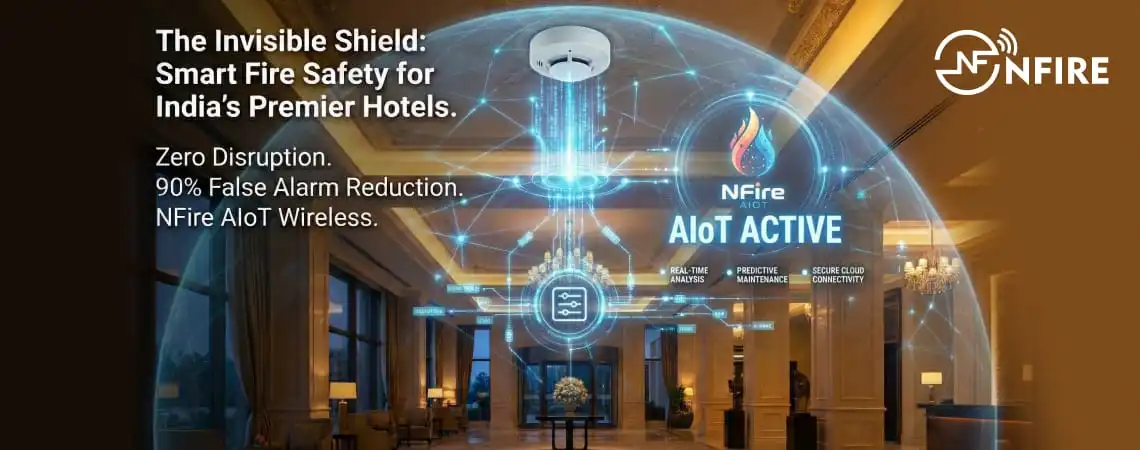
NFire is India’s first wireless addressable AIoT fire alarm system, developed at IIT Gandhinagar Research Park and compliant with both IS/ISO 7240 and EN54. It was engineered specifically to solve the retrofit problem that makes wired systems impractical for operational hotels.
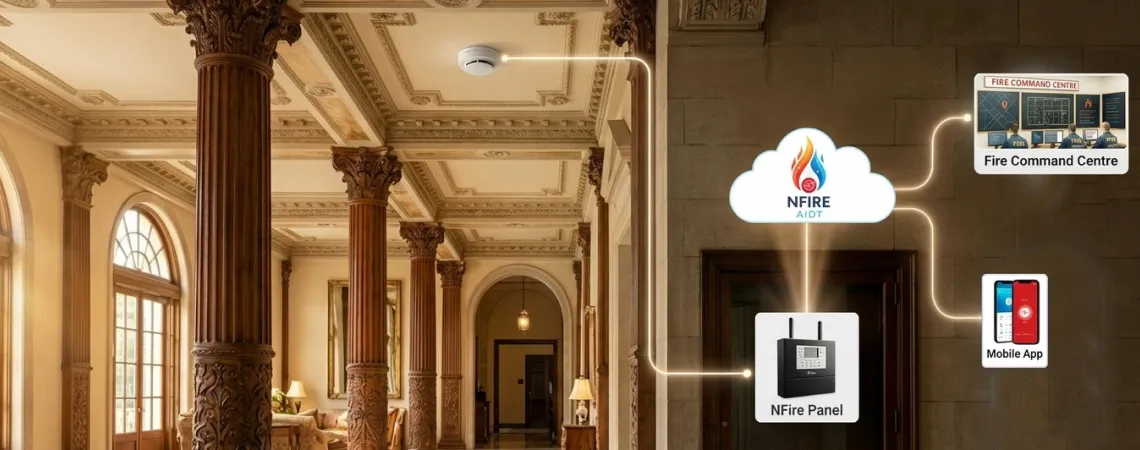
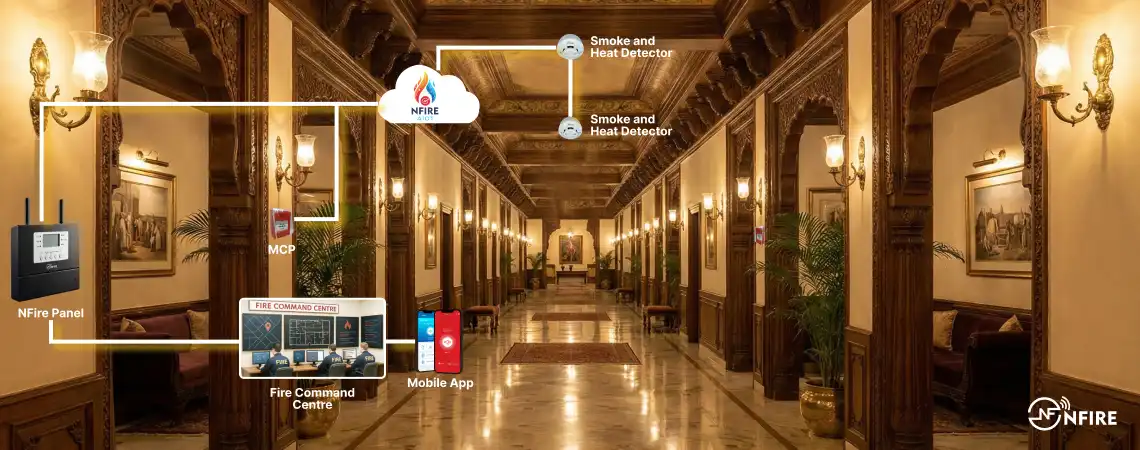
Each NFire detector communicates wirelessly with its Sensor Control Module (SCM) — an intelligent edge controller managing its zone independently. There are no cable runs, no conduit, no chasing into walls. A detector is surface-mounted, paired with its SCM, and commissioned in hours.
For a hotel, this changes everything about the deployment:
For heritage hotels — the crown jewels of Indian hospitality — wired retrofits are often simply impossible. Drilling into original masonry, routing cables through historic structures, and altering protected interiors can violate preservation guidelines and require special permissions. The very features that make these properties valuable are the features that wired systems cannot accommodate.
NFire is fully addressable: when a detector triggers, the NFire Command Centre and the NFire Connect mobile app identify it by exact location instantly “Room 412” or “4th Floor East Corridor,” not just “Zone 3.” For a night manager handling an alarm at 3 a.m., that precision is the difference between a calm, targeted response and a full-hotel evacuation that wakes 200 guests and dominates tomorrow’s reviews.
That precision also addresses hospitality’s chronic false-alarm problem. Shower steam, kitchen vapours, and guest smoking routinely trigger conventional detectors, producing nuisance evacuations that frustrate guests and desensitise staff. NFire’s AIoT multi-criteria detection and environmental pattern recognition distinguish real fire signatures from harmless triggers, cutting false alarms substantially while keeping genuine response times fast.
And through the NFire Connect app, a general manager — or a group operations head overseeing multiple properties — has real-time visibility of every device, its battery health, signal strength, and any alarm event, from anywhere. Fire safety stops being a folder in a drawer and becomes a live, monitored operational asset.
| Factor | Wired Addressable Retrofit | NFire Wireless Addressable |
|---|---|---|
| Guest Room Closures | ✖Required — weeks of civil works per floor | ✔None forced by install; follow your schedule |
| Revenue Impact During Install | ✖Significant lost room nights | ✔Minimal — clean, fast, contained |
| Guest Disruption | ✖Dust, noise, contractor presence | ✔Virtually invisible to guests |
| Heritage Property Suitability | ✖Often impossible; preservation permissions | ✔Ideal — no drilling, finishes preserved |
| Phased / Wing-by-Wing Rollout | ✖Difficult — riser infrastructure first | ✔Native — independent SCM zones |
| False Alarm Management | ✖No environmental learning | ✔AIoT multi-criteria detection |
| Remote / Multi-Property Monitoring | ✖On-site panel only | ✔NFire Connect App + Command Centre |
| IS/ISO 7240 & EN54 Compliance | ◐Varies by system | ✔Compliant with both |
If yes, fire authority approval of the altered areas assessed against current standards is coming.
In leading NBCS 2026 adoption states, renewal is now the moment conventional systems get challenged.
If not, you cannot offer guests or inspectors the response precision the new standard expects.
If any answer gives you pause, the retrofit conversation is already on your doorstep. The only real choice is whether you have it on your terms phased, clean, revenue protecting or reactively, under pressure, with rooms closed and revenue lost.
NFire’s team will assess your property, map it against NBCS 2026 requirements, and show you exactly how a wing-by-wing wireless retrofit protects your revenue, your guests, and your reputation without closing a single floor.
NBCS 2026 Part F is a voluntary national standard, but it creates binding compliance pressure two ways. First, any renovation covering 1,000 sq m or more must conform to current fire safety standards — and hotel refurbishment programmes routinely exceed this. Second, Fire NOC renewals, mandatory for all hotels to legally operate, increasingly reference NBCS 2026 as the benchmark, particularly in Maharashtra, Karnataka, Tamil Nadu, Gujarat, Telangana, and Delhi NCR.
Yes. NFire’s fully wireless addressable system requires no cable runs, no drilling, and no wall cutting. Detectors are surface mounted and paired wirelessly with their Sensor Control Module (SCM). Installation follows your refurbishment or low-occupancy schedule floor by floor and wing by wing, with no need to close operational guest floors the decisive advantage over wired retrofits, which require weeks of invasive civil works per floor.
NFire is particularly well suited to heritage properties. Because it is fully wireless, it requires no drilling into original masonry, no cable chases through historic walls, and no structural modification challenges that often make wired retrofits impossible or prohibitively expensive in heritage buildings, and that can trigger preservation-authority permission requirements. NFire preserves original finishes entirely.
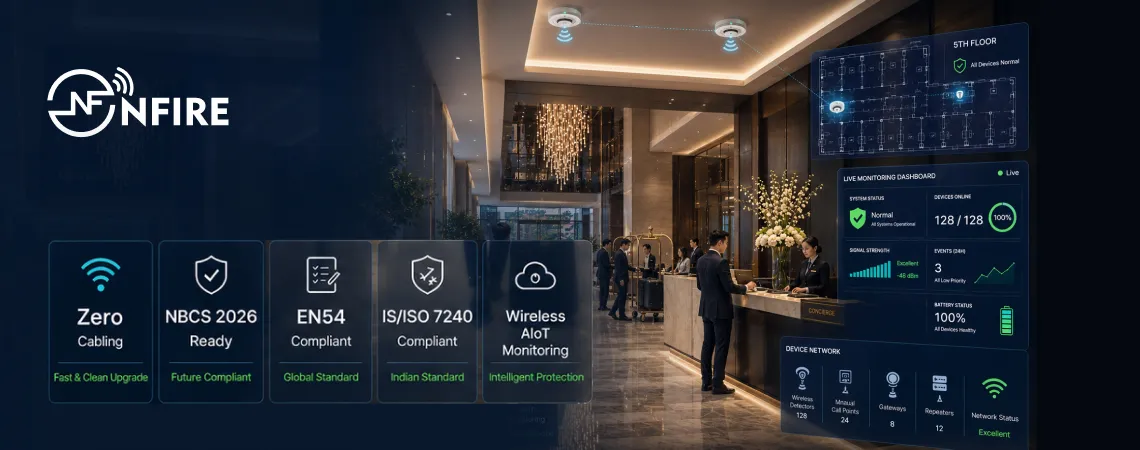
NFire systems are compliant with IS/ISO 7240 (the Indian and international fire detection standard) and EN54 (the European standard). Both are referenced in NBCS 2026 Part F and accepted by fire authorities across India for Fire NOC purposes.
False alarms from shower steam, kitchen vapours, or guest smoking are a serious operational and reputational problem, causing unnecessary evacuations and guest dissatisfaction. NFire’s AIoT layer uses multi-criteria detection and environmental pattern recognition to distinguish genuine fire signatures from harmless triggers, substantially reducing nuisance alarms while preserving rapid response to real events.