

A parametric way to compare wired and wireless addressable fire alarm systems in Indian buildings, using your own drawings, your own quotes and the questions every vendor should answer.
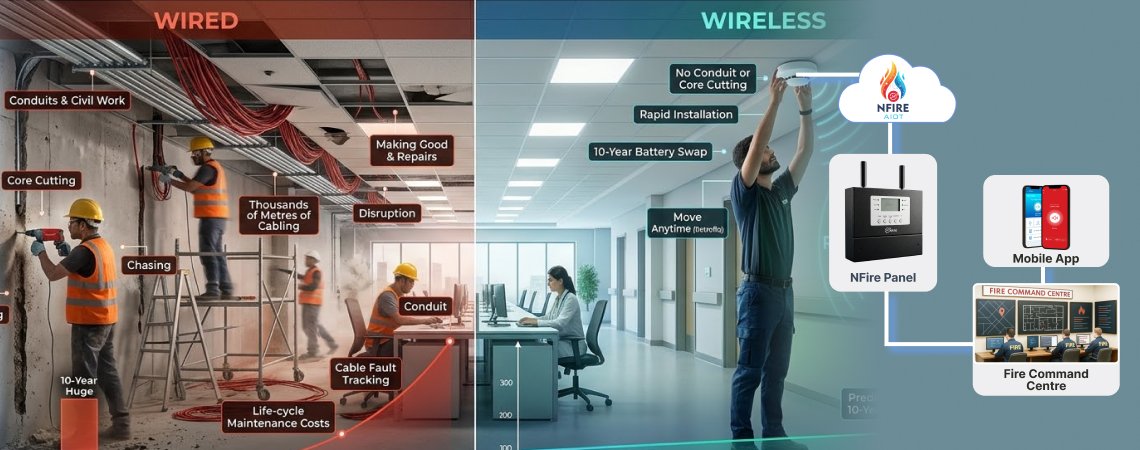
Put two fire alarm tenders side by side and the comparison usually stops at the equipment schedule: detectors, call points, sounders, a panel. On many Indian projects, the cable, conduit, core cutting and finishing work sit in a separate electrical or civil package, priced by someone else and approved on a different day. Ten years later, the building owner has paid for all of it, along with service visits, cable faults and every partition that moved.
This guide sets out how to compare wired and wireless addressable systems on the number that matters to an owner: what it costs to protect each point for ten years. It doesn’t publish anyone’s price list. It gives you a model to fill in from your own drawings and quotes, and shows how NFire’s AIoT wireless addressable fire alarm system changes each input.
Because ten years is roughly the service life the industry plans for point detectors. BS 5839-1 sets no fixed lifetime for components and defers to manufacturer guidance, which is commonly benchmarked at around a decade. By year ten most detectors are due for replacement, so the useful question is what the owner paid along the way.
So what: a state government has now written continuous digital monitoring — with cybersecurity conditions attached — into law. Fire services are a state subject, so this spreads jurisdiction by jurisdiction rather than nationally. Delhi is usually where it starts.
The ten-year benchmark also separates two kinds of spend. Capital cost is what the tender compares. Operating cost is what the facility manager lives with: routine testing and servicing under IS 2189:2026, the code of practice for fire detection and alarm systems, plus everything the building asks of the system as it changes.
Mostly around the cable rather than in it. SP 7:2026 says fire alarm and PA cables should run in metal conduit or be armoured, wiring in shafts and false ceilings should run in metal conduit, and penetrations through shafts and slabs need fire-stopping. Containment, core cutting and making good are part of every compliant wired installation.
| Cable metres per point | Per point | 300-point system |
|---|---|---|
| 6 m | ₹510 | ₹1.53 lakh |
| 12 m | ₹1,020 | ₹3.06 lakh |
| 18 m | ₹1,530 | ₹4.59 lakh |
| 30 m | ₹2,550 | ₹7.65 lakh |
Cable metres per point is total loop and spur length divided by the number of devices, taken from your own layout. These figures exclude metal conduit, core cutting, fire-stopping, making good and loss of use while areas are handed over.
The excluded items are where the money goes, especially in occupied buildings. In a hotel, hospital, office or factory running shifts, every opened ceiling and chased wall has to be closed, finished and handed back before the space earns again. For buildings already in use, our guide to wireless fire alarm retrofits breaks these lines down further.
Add three things per protected point: the installed cost, the running cost for years one to ten, and the cost of the changes you expect. Price each line from your own layout and quotes, then compare wired and wireless on the total, not on the equipment schedule alone.
10-year cost per point = installed + running (years 1–10) + change
Installed, wired = devices + panel + (cable metres per point × wiring rate) + conduit + civil work and making good + commissioning
Installed, wireless = devices + panel + radio infrastructure + commissioning
Running = service visits + fault repairs + battery changes × (battery + access labour), for battery-powered devices
Change = expected relocations and additions × cost of each
Three inputs decide most comparisons. The first is device price: wireless detectors have traditionally cost more than wired ones, and one UK installer puts the premium at 30 to 50% per unit (DC Fire & Security). The second is cabling and civil work, which that premium has to be weighed against. The third is change: a building re-planned every few years pays for new cable, conduit and making good each time, while a radio device is re-sited and re-paired.
Radio infrastructure deserves its own line. Wireless is not cable-free end to end: signal collection modules need power and a link back to the panel. Ask for those items to be priced, not assumed away.
NFire removes the wireless device premium, removes the cable route, and narrows maintenance to three predictable tasks. Its detectors are priced in line with mainstream wired addressable detectors, installation needs no loop cable, conduit or making good, and devices can be moved without new cabling.
NFire wireless detectors are priced in line with mainstream wired addressable detectors sold in India. That removes most of the per-device premium that wireless comparisons usually start from, leaving radio infrastructure as the main hardware line to add to the wireless column.
Detectors, call points and sounders are fixed to the ceiling or wall and communicate by radio. Each signal collection module (SCM) serves up to 56 devices, is mains-powered with a 27-hour lithium battery backup, and links to the panel over Ethernet or dedicated, battery-backed 2.4 GHz point-to-point backbone nodes. That is a handful of fixed points per building, not a cable to every device.
Maintenance at each NFire device is limited to three tasks: replace the battery, clean the sensor, or replace a device that has failed. A wired system adds an open-ended fourth category, the cable itself. As installations age, insulation deteriorates, junction boxes take in moisture, earth faults appear and renovation works disturb routes nobody mapped. Each fault means tracing cable through ceilings and walls before it can be fixed, which is why wired running costs are harder to predict.
Every NFire device checks in with its SCM every 60 seconds, so a silent device is shown on the panel as a fault, with its address, within 180 seconds. NFire Command Centre runs on-premise or in the cloud, the NFire Connect app puts alerts and system status on a facility manager’s phone, and 24/7 monitoring is available for NFire sites across India. When a service team can see a fault before travelling, fewer visits are wasted. NFire also provides firmware and server software updates, so capability can be added over the system’s life without replacing installed hardware.
Moving or adding a device means re-siting and pairing it, with no new cable path, conduit or making good. For buildings that are refitted, re-tenanted or extended within ten years, this is often the line that decides the comparison.
It depends on the declared battery interval. EN 54-25 requires battery-powered radio devices to run for at least 36 months, which means three changes in ten years at that minimum. Longer-rated devices need fewer. Ask every vendor for the interval, how it was calculated, and the figure for sounders separately.
Battery changes per device over ten years, by declared interval (detectors replaced at year ten)
| Declared battery interval | Changes in years 1–10 | Count |
|---|---|---|
| 3 years (EN 54-25 minimum) | Years 3, 6 and 9 | 3 |
| 4 years | Years 4 and 8 | 2 |
| 5 years or more | Once, at mid-life | 1 |
EN 54-25 calculates the minimum under quiescent conditions with 15% of rated capacity held in reserve (EN 54-25 preview). Real life depends on temperature, test frequency and alarm activity. Sounders and sounder-beacons draw more current than detectors.
Every battery change is a planned visit, not an emergency call. That is the point of the maintenance line: a wireless system’s running cost is a schedule you can price on day one, whereas a wired system’s cable faults arrive when they arrive.
Certification applies component by component against the relevant part of IS/ISO 7240, including IS/ISO 7240-25 for components using radio transmission paths (BIS). That applies to every brand, including ours, which is why it belongs on a checklist rather than in a sales pitch. NFire is compliant with IS/ISO 7240 and EN 54, STQC-tested.
In new construction where cable goes in at first fix alongside other services, before ceilings close; in compact buildings with short, accessible routes and a layout that will not change; and in plants where an RF survey shows reliable radio links cannot be achieved economically. A credible comparison says so, and the model will show it.
Wireless is not automatically cheaper. Its advantage grows with cable length, finish quality, occupancy during works and the number of changes the building will see. Run the model with honest inputs and the answer for your building usually becomes clear.
It depends on the building. Wireless usually costs less to install and change where cable runs are long, conduit and civil works are needed, or the building stays occupied during work. Wired can cost less in open new-build with short cable routes. Compare both on cost per protected point over ten years.
Installed cost, including cable, conduit, civil work and commissioning; running cost, including service visits, fault repairs and battery changes; and change cost for relocating or adding devices. Over ten years, the lines outside the equipment schedule often decide which system is cheaper to own.
At a typical private-installation rate of ₹80–₹90 per running metre, cable costs about ₹510 per point at 6 metres and ₹2,550 at 30 metres, using ₹85. That excludes metal conduit, core cutting, fire-stopping, making good and downtime, which usually cost more than the cable itself.
EN 54-25 requires battery-powered radio devices to operate for at least 36 months, which means three changes in ten years at that minimum. Devices rated for five years or more need one change. Ask how the declared interval was calculated, and check sounders separately because they draw more current.
Maintenance at a wireless device is limited to battery replacement, sensor cleaning and replacing a failed device, all of which can be scheduled and priced in advance. Wired systems add cable faults from ageing insulation, moisture, earth faults and renovation damage, which are harder to predict and to trace.
Yes. Once the Fire Detection and Alarm Systems (Quality Control) Order 2025 is enforced, covered products cannot be made, imported or sold in India without a valid BIS licence. Certification is per component, so ask every vendor for the licence or certification status of each one.
Clause 3.5.5.2 of SP 7:2026 says fire alarm and PA cables should be laid in metal conduit or be armoured, to separate them physically from power cables. Wiring in shafts and false ceilings should run in metal conduit. SP 7:2026 applies through state bye-laws and the Fire NOC process.
BS 5839-1 sets no fixed lifetime for fire alarm components and defers to manufacturer guidance, which the industry commonly benchmarks at around ten years. Detectors that fail sensitivity tests, sit in harsh environments or can no longer be supported may need replacing sooner.