

For hospitals, nursing homes, schools, hotels and commercial buildings facing a Fire NOC renewal or audit: what a wired retrofit really costs, and the three ways a wireless addressable system removes that cost.
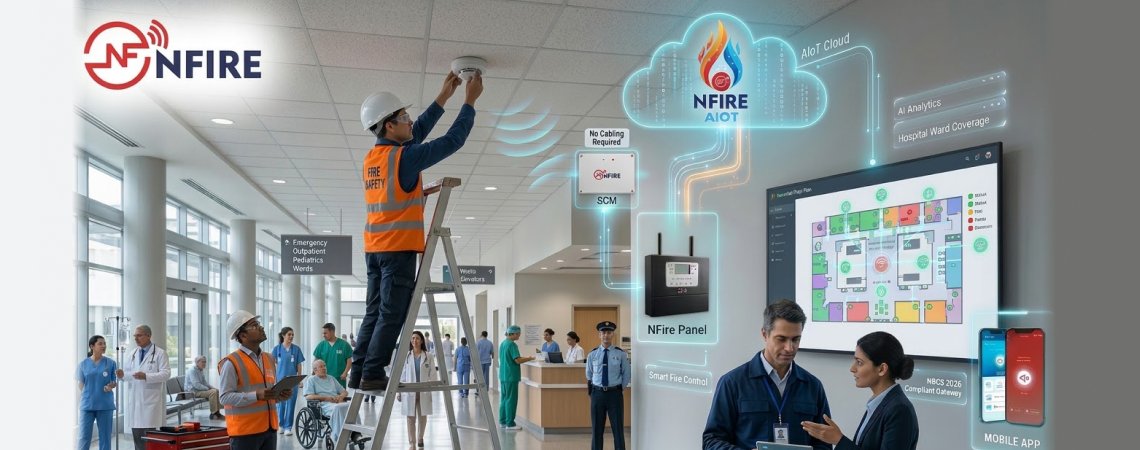
For an existing, occupied building, a wireless addressable fire alarm is usually the most cost-effective compliant option, because it removes cable runs, metal conduit, ceiling and wall works, and the downtime they cause. NFire adds two further savings: its wireless detectors cost half or less than the other wireless detectors we benchmarked in October 2026, and its maintenance is limited to battery changes, sensor cleaning and replacing failed devices.
The inspection report lands on your desk. The fire alarm is old, zones keep faulting, and the Fire NOC renewal depends on fixing it. The catch: your hospital, school or office cannot close for the weeks it takes to chase cable through every corridor and ceiling.
That is the retrofit problem, and 2026 has made it harder to postpone. NBCS 2026 (SP 7:2026) was gazette-notified on 30 April 2026, replacing NBC 2016 as the national reference standard; it reaches your building through state fire rules and the Fire NOC process. In healthcare, the Health Ministry released the National Guidelines on Fire and Life Safety in Healthcare Facilities during Fire Safety Week in May 2026 (DD India). In July it asked every state to audit all public and private healthcare facilities through a special drive, and to have hospitals, including private hospitals and nursing homes, run monthly fire safety audits on the IHIP portal (Medical Buyer). Renewal cycles vary by state, from yearly renewal before 31 March in Assam (Assam Fire & Emergency Services) to up to five years for some buildings in Kerala (Onmanorama). In every state, though, the inspector checks that the fire alarm works.
This guide is for the person who has to fix it: the owner, administrator or facility head of an existing building. It explains where wired retrofit money actually goes, whether wireless is accepted, and three specific reasons NFire’s AIoT wireless addressable fire alarm system costs less to install and to keep.
Because in a retrofit the cable is the cheap part. A wired addressable loop must reach every detector, call point and sounder, and in a finished building that means opening false ceilings, chasing walls, sealing penetrations and making good, while staff and occupants work around the crew.
The rules add to the bill. SP 7:2026 says cables for fire alarm and PA systems should be laid in metal conduit or be armoured, to keep them physically separate from power cables (clause 3.5.5.2). Low and medium voltage wiring in shafts and above false ceilings should run in metal conduit (clause 3.5.5.1), and cable penetrations through shaft walls and slabs need fire-stopping (clause 3.5.4.4). In our experience of private-sector installations, fire alarm wiring itself is typically quoted at ₹80–₹90 per running metre. The expensive lines sit around it:
None of these appears on a detector price list, and most are priced by the civil contractor rather than the fire alarm vendor. That is why they are easy to leave out when two quotes are compared.
The IS/ISO 7240-25 listing and the IS 2189:2026 code of practice are both on the BIS portal. What separates a fire-grade wireless system from a consumer smoke alarm is supervision: every device is addressed, checked continuously, and reported as a fault if it goes silent.
NFire is compliant with IS/ISO 7240 and EN 54, STQC-tested. Each detector talks directly to a signal collection module (SCM), not through a mesh of other detectors, and checks in every 60 seconds. A device that stops responding is shown as a fault within 180 seconds, inside the 300-second limit set by EN 54-25. SCMs are mains-powered with a 27-hour lithium battery backup, and report to the panel on a 15-second heartbeat.
The submission pack should reference IS 2189:2026, IS/ISO 7240-2 and IS/ISO 7240-25, EN 54-25 and SP 7:2026 Part F, and include an RF site survey and an addressed device schedule. Under the Fire Detection and Alarm Systems (Quality Control) Order 2025, BIS certification of components is being phased in, so ask every vendor, NFire included, for the licence or certification status of each component.
This matters because the usual case against wireless is device cost. Buyers expect to pay a premium for every wireless detector and to recover it through cheaper installation. NFire removes that premium. Its wireless detector is priced in line with mainstream wired addressable detectors, so a retrofit no longer has to trade a higher device bill for a lower civil bill: you keep the civil saving and pay no device premium for it.
On a 300-detector retrofit, that means the detector line of an NFire quote is roughly half, or less, of the same line from another wireless vendor. The gap widens with every detector you add.
Benchmark basis: like-for-like prices for wireless smoke detectors, collected by NFire in October 2026. Call points, sounders and panels are priced separately and are not included. Prices change, so ask every vendor for a dated, itemised quote and compare the same line items.
All of the cable route. NFire detectors, call points and sounders are fixed to the ceiling or wall and communicate by radio, so there is no loop cable, no metal conduit to the devices, no ceiling or wall opening and no making good. NFire is priced simply as device cost plus installation labour.
Wireless is not zero-infrastructure, and an honest quote should say so. The panel needs a location, each SCM serves up to 56 devices and needs a mains power point, and SCMs link back to the panel over Ethernet or dedicated, battery-backed 2.4 GHz point-to-point backbone nodes. These are a handful of fixed points per building, planned during the RF survey, rather than a cable to every device.
To size what you avoid, use your own drawings in this formula:
Benchmark basis: like-for-like prices for wireless smoke detectors, collected by NFire in October 2026. Call points, sounders and panels are priced separately and are not included. Prices change, so ask every vendor for a dated, itemised quote and compare the same line items.
Wired cost avoided = (N × L × Rc) + conduit + civil making good + downtime
N = number of field devices
L = average cable length per device (metres)
Rc = wiring rate per running metre (₹80–₹90 in private installations)
Take 300 detectors and an illustrative average of 15 metres of cable per device. Wiring alone is 4,500 metres × ₹85 = ₹3,82,500, or about ₹3.8 lakh. That is before metal conduit, false-ceiling and wall making good, fire-stopping, out-of-hours labour and beds out of use, each of which a wired retrofit adds and NFire does not need.
Now combine the first two reasons. Against another wireless system, NFire’s detector line is half or less, and the civil saving is similar. Against a wired addressable system, device costs are comparable, so the saving is the whole cable-and-civil bill. Replace the 15-metre assumption with figures from your own layout; the longer and more finished the routes, the larger the gap.
For the ten-year view, including batteries and support, see our guide to fire alarm cost of ownership.
Because maintenance at each device is limited to three tasks: replace the battery, clean the sensor, or replace a device that has failed. A wired system adds a fourth, open-ended category, the cable itself, and cable faults tend to grow as an installation ages and the building around it changes.
In a wired loop, insulation deteriorates, junction boxes take in moisture, earth faults appear, and later renovation works disturb routes nobody has mapped. Each fault means tracing a cable through ceilings and walls before it can be repaired. A UK council’s survey of an older installation, for instance, found that faults were mainly caused by disturbance to the existing cabling and judged that cabling beyond repair (London Borough of Camden).
With NFire there is no cable to trace. Every device is supervised, so a fault appears on the panel with its exact address, and battery status is reported before it becomes a problem. The AIoT platform adds remote monitoring and diagnostics, with 24/7 monitoring available for NFire sites across India, and NFire provides firmware and server software updates. Your annual maintenance budget becomes a list you can write in advance: scheduled battery changes, periodic sensor cleaning, and a small spares allowance.
The obligations themselves do not change. Testing, servicing and record-keeping under IS 2189:2026 apply to wired and wireless systems alike, and your Fire NOC renewal will still look for the maintenance log.
When cabling is cheap and disruption is irrelevant: an empty building, a new build under construction, or open structures with short, exposed cable routes where civil work is happening anyway. Wired can also make sense where an RF survey shows radio coverage cannot be achieved economically.
The case for NFire is strongest exactly where wired is weakest: finished interiors, occupied floors, heritage or marble surfaces, and buildings that cannot stop operating. That describes most Indian hospitals, nursing homes, schools, hotels and older commercial buildings facing a renewal or an audit.
Ask six things: will you do an RF survey, what is each component compliant or certified to, what does the per-device price include, how fast is a silent device reported, what does maintenance consist of, and is remote monitoring available. Get every answer in writing.
Send us your floor plans and device count. We will plan an RF survey and give you a per-device quote, so you can compare it line by line with a wired or wireless alternative before the inspector returns.
Yes, wireless fire detection is recognised in Indian standards through IS/ISO 7240-25 for radio-linked components, and systems are designed and maintained under IS 2189:2026. The state fire authority decides whether a particular installation is accepted, so submit the design, RF survey and device schedule early.
Yes. In NFire’s October 2026 like-for-like benchmark of wireless fire detectors sold in India, NFire’s detector cost half or less than every alternative, which puts it in line with wired addressable detectors. Call points, sounders and panels are priced separately, so compare dated, itemised quotes.
Usually, yes. In a finished, occupied building, most of a wired retrofit’s cost is conduit, ceiling and wall works, fire-stopping, out-of-hours labour and downtime. Wireless removes those lines. Where device prices are comparable, as with NFire, the saving is the whole cable-and-civil bill.
A little. Detectors, call points and sounders communicate by radio, but the panel and the signal collection modules need power and a link back to the panel. With NFire each module serves up to 56 devices, so that means a few fixed points per building rather than a cable to every device.
A fire-grade wireless system is supervised. Every NFire detector checks in with its signal collection module every 60 seconds, and a silent device is shown as a fault within 180 seconds, inside the 300-second limit set by EN 54-25. Modules are mains-powered with 27-hour battery backup.
Battery replacement on schedule, periodic sensor cleaning, and replacing any device that fails. There is no cable to age or trace. Testing, servicing and record-keeping under IS 2189:2026 still apply, and the maintenance log supports your Fire NOC renewal.
Occupied buildings with finished interiors that cannot close for works: hospitals and nursing homes, schools and coaching centres, hotels, offices, heritage buildings and older commercial complexes. The more finished the ceilings and the longer the cable routes, the larger the saving.
Choose wired when the building is empty or under construction, cable routes are short and open, and civil work is happening anyway. Wired may also suit sites where an RF survey shows radio coverage cannot be achieved economically.