

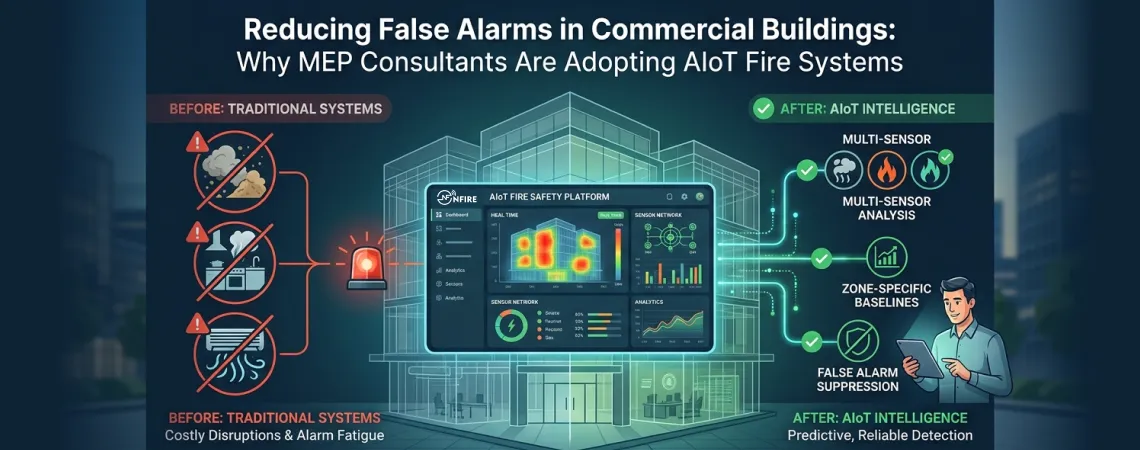
In modern commercial buildings and IT parks, fire safety systems must detect real threats instantly—while ignoring everyday environmental fluctuations. Yet, most traditional systems fail.
Industry estimates suggest up to 80% of fire alarms are false, costing organizations nearly ₹2.5 crore annually in lost productivity and disruptions.
To solve this, MEP consultants are shifting toward AIoT-based fire safety platforms, led by solutions like NFire, which combine intelligence, integration, and operational efficiency. For a full technical specification guide, see our NFire AIoT Safety Intelligence Platform pillar article.
Legacy fire systems rely on rigid thresholds and single-sensor inputs, making them prone to false triggers from:
⚠️ In large IT parks, a single false alarm can cost up to ₹56 lakhs, and multiple incidents per year can exceed ₹5.6 crore annually—not to mention the operational disruptions and alarm fatigue among facility staff.
Traditional systems are reactive: they only report an event after it happens. NFire’s AIoT fire alarm platform replaces this with multi-sensor intelligence and machine learning, allowing early detection of real threats while ignoring false triggers.
Key features include:
✅ The result: up to 90% reduction in false alarms and significantly faster, pre-emptive response times
For consultants looking for the full technical architecture, compliance credentials, and predictive detection methods, see our comprehensive NFire AIoT specification guide.
NFire is more than a fire alarm system—it’s a complete AIoT fire safety ecosystem for modern commercial buildings.
Unlike traditional panel-based systems, NFire’s AIoT Fire Command Centre (FCC) offers:
NFire’s open architecture supports integration via APIs, allowing MEP engineers to automate critical responses:
This eliminates the need for complex third-party gateways and reduces interface risk.
NFire is engineered to meet NBCS 2026 standards and is fully compliant with:
This makes it ideal for globally compliant commercial developments.
NFire’s secure wireless mesh architecture eliminates extensive cabling, enabling:
🏗️ Perfect for occupied buildings, heritage structures, and IT campuses where minimal disruption is critical.
| Feature | Traditional Systems (Before) | NFire AIoT Platform (After) |
|---|---|---|
| False Alarm Rate | Up to 80% false positives | <10% via AI multi-sensor filtering |
| BMS Integration | Manual and isolated | Seamless via APIs |
| Tenant Fit-Outs | Weeks of recabling & disruption | Instant wireless adaptation |
| Detection Speed | Reacts 2–5 minutes later | Predicts threats 50–70% faster |
This is not just an upgrade it’s an architectural shift that makes fire safety intelligent, predictive, and fully integrated.
Fire safety in commercial buildings must evolve beyond reactive systems. With NFire AIoT, MEP consultants can design infrastructure that is:
The outcome: safer buildings, fewer false alarms, and uninterrupted operations.
If your building faces frequent false alarms or you’re planning a new project, it’s time to upgrade.
Partner with NFire to design an AIoT-driven fire safety system tailored to your commercial campus.