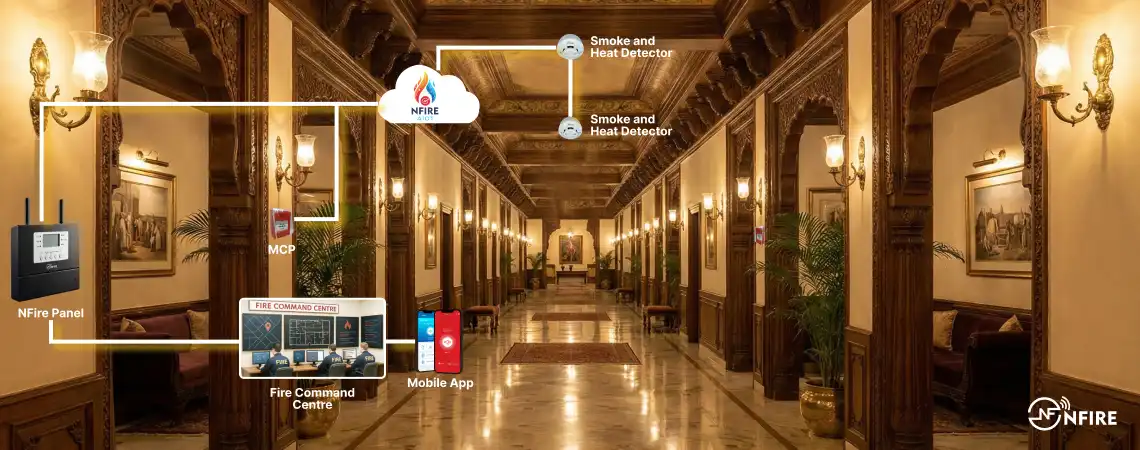

How Delhi’s Rule 37, Maharashtra’s Section 3(3A) and NBCS 2026 have made continuous digital monitoring the new baseline — and what an AIoT-native system brings to it.
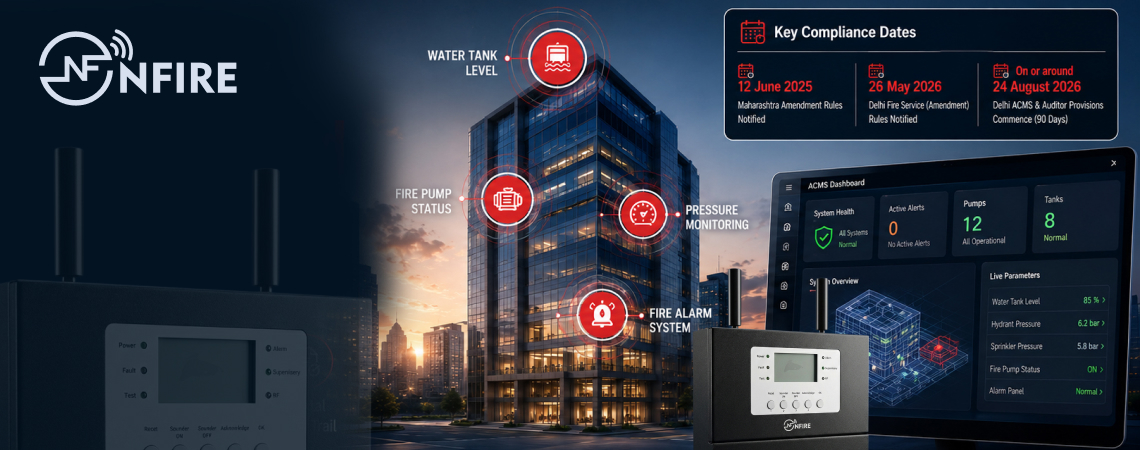
Automated Continuous Monitoring Systems (ACMS) are IoT-based systems that report the real-time health of a building’s firefighting installations pumps, tanks, pressures, detection panels to a cloud portal, with SMS/email alerts and, in a later phase, direct alerts to the fire department.
A fire pump with a tripped breaker looks exactly like a working fire pump. So does a hydrant riser that lost pressure three weeks ago, a fire alarm panel running on a dead battery, or a staircase pressurisation fan that hasn’t turned since the last drill.
For decades, Indian fire safety compliance rested on a periodic snapshot: an inspection, a certificate, a file. What happened in the 364 days between inspections was largely invisible. That gap is exactly where fires turn fatal — NCRB’s Accidental Deaths & Suicides in India data records 5,888 deaths from fire accidents in 2024, with a majority occurring in residential buildings.
Two of India’s most consequential regulators have now closed that gap by law, and the national standards framework has moved in the same direction. If you own, occupy or manage a building of any meaningful size in Delhi or Maharashtra, your fire system is no longer required merely to exist. It is required to report that it is alive, continuously, to a cloud server.
The Maharashtra Fire Prevention and Life Safety Measures (Amendment) Act, 2023 inserted Section 3(3A), obliging owners (or occupiers, where the owner is untraceable) of buildings specified under Section 45 to provide their firefighting systems with an automated continuous monitoring system, certified by a Licensed Agency in a prescribed form. The Amendment also widened Section 45 to bring in residential buildings above 70 m, large oil and gas installations such as refineries and LPG bottling plants, and industrial buildings — moderate-hazard above 30,000 m² and high-hazard above 10,000 m².
The technical substance arrived with the Maharashtra Fire Prevention and Life Safety Measures (Amendment) Rules, 2025, notified by the Urban Development Department on 12 June 2025. A new Rule 3A and a detailed Appendix define ACMS as an IoT-based system covering both active and passive measures. Compliance is evidenced through Form A-1 (installation) and Form B-1, a maintenance certificate issued by a Licensed Agency twice a year, in January and July.
The Delhi Fire Service (Amendment) Rules, 2025, notified by the Lieutenant Governor on 26 May 2026 under Section 63 of the Delhi Fire Service Act, 2007, introduce ACMS at Rule 37 again IoT-based, again in two phases. Crucially, the rules also transfer routine certification to empanelled third-party Fire Safety Auditors and widen the regulatory net dramatically: residential buildings above 15 m or five storeys, hotels above 12 m, educational and institutional buildings above 9 m, all assembly buildings, industrial and storage buildings above 250 m², and hazardous occupancies above 100 m². The certification, auditor and ACMS provisions commence ninety days after publication placing the switch-on in late August 2026.
SP 7 : 2026, the National Building Construction Standards, was gazette-notified on 30 April 2026 and withdrew NBC 2016 with immediate effect. Part F, clause 4.9(j) states that where an automatic fire alarm system is provided, water level in all tanks, hydrant and sprinkler pressures by zone, pump ON/OFF status and supervised isolation valves should all be monitored from the fire alarm panel. Elsewhere, Part F asks for interface with pressurisation and smoke management systems, integration with BMS for real-time monitoring in data centres, and smart detection for EV charging areas.
NBCS 2026 is advisory at the BIS level and becomes enforceable only when a state or local body writes it into its byelaws. Delhi’s and Maharashtra’s rules, by contrast, are already law. The direction of travel is identical; only the compulsion differs.
| Aspect | Maharashtra | Delhi | NBCS 2026 (National) |
|---|---|---|---|
| Legal Instrument | Section 3(3A), Fire Prevention & Life Safety Measures Act (2023); Amendment Rules 2025 | Rule 37, Delhi Fire Service (Amendment) Rules, 2025 | SP 7:2026, Part F, Clause 4.9(j) |
| Notification Date | 12 June 2025 | 26 May 2026 | 30 April 2026 |
| Status | Binding Law | Binding Law ACMS provisions commence approximately 90 days after notification. |
Advisory Becomes mandatory only after adoption into applicable state or local building byelaws. |
| Who Must Comply |
Buildings under Section 45 including:
|
|
Occupancies where an automatic fire alarm system is required under Table 7A–7J. |
| Certification |
Form A-1 (Installation) Form B-1 (Biannual Maintenance — January & July) Through Licensed Agency |
Form K (Annual) Through Empanelled Third-Party Fire Safety Auditor |
No separate certification prescribed. Integrated into fire alarm panel monitoring requirements. |
| Escalation Phases |
Phase I: Owner / Installer alerts Phase II: Critical alarms escalated to Local Fire & Emergency Services |
Phase I: Owner / Auditor alerts Phase II: Critical alarms escalated to Delhi Fire Service |
Panel-level monitoring only. No phased escalation model specified. |
Maharashtra’s Appendix is unusually specific, and it doubles as a procurement checklist. Any system you buy should demonstrably deliver:
Main, standby diesel/electrical, jockey and booster pump run status; diesel tank level; power status at the MCC; hydrant and sprinkler riser pressure; underground, aboveground and overhead tank levels; detection operation status; control and repeater panel status; panel battery status; manual call point status; PA system status; staircase and lift-lobby pressurisation fans; basement supply and exhaust fans.
Machine-to-machine communication over MQTTS to a cloud portal, with data received from the gateway at one-minute intervals over 4G/5G, Ethernet, Wi-Fi or equivalent.
An SMS alarm if no data reaches the cloud for more than fifteen minutes the system must prove it hasn’t gone silent.
Gateway on UPS with up to seven hours of backup, a minimum 10,000 event logs stored locally, a real-time clock for timestamping, and at least 99 percent uptime.
Phase I alerts to owner/occupier and the licensed installer; Phase II routing of critical alarms pump power failure, low hydrant and sprinkler pressure, fire and fault conditions to the local fire and emergency services, with API provision built in.
Delhi’s Rule 37 tracks the same architecture and adds an explicit expectation of compliance with prescribed technical standards and cybersecurity protocols.
Read that list closely and a pattern emerges. Roughly half the parameters are hydraulic and mechanical pumps, tanks, pressures, fans. The other half sit inside the fire alarm system itself: detection status, panel health, battery condition, manual call points, PA status. Which means the fire alarm system is no longer a standalone box. It is now the primary data source for a regulated telemetry stream.
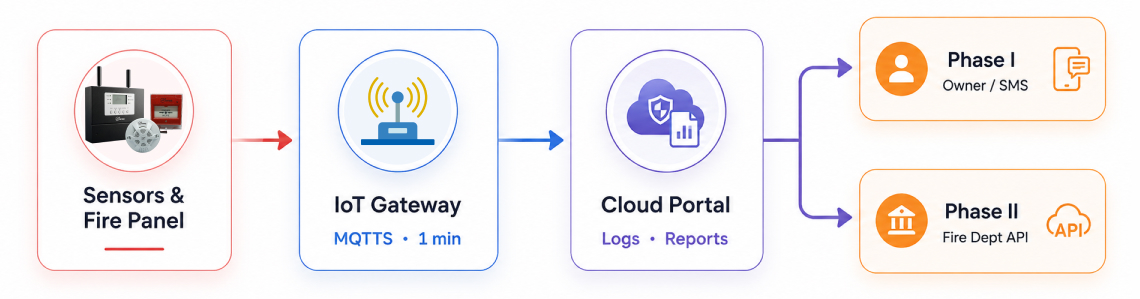
15-min silence → SMS fault alert (no data ≠ no fire, but no data = no compliance)
UPS backup: up to 7 hrs · Local storage: 10,000+ event logs · Uptime target: 99%
Fig. 1 ACMS two-phase escalation flow as specified in Maharashtra’s Appendix and mirrored in Delhi’s Rule 37
Most Indian buildings facing these deadlines are not greenfield. They are occupied, revenue-generating, and already carry a conventional or wired addressable panel installed years ago. Bolting a compliant monitoring layer onto that is where the cost sits — and where architecture matters.
NFire, developed by Atigo Enterprises Limited and launched in 2018 as India’s first wireless addressable fire alarm system, was built cloud-first rather than cloud-retrofitted. Three characteristics map directly onto the new obligations:
Detection operation status, control and repeater panel status, panel battery health and manual call point activation are states the panel already knows. In a legacy installation, these typically have to be harvested through potential-free contacts wired back to a third-party gateway the very approach Maharashtra’s Appendix describes as “POTS free contacts from fire panel.” An AIoT panel reports them as data. Fewer interface points, fewer failure modes, less commissioning.
NFire Command Centre provides multi-user, real-time graphical monitoring; NFire Connect delivers mobile alerts; and the platform is designed for SMS, email and app notification with AES-256 encryption and TLS 1.3 in transit relevant given Delhi’s explicit cybersecurity expectation. Atigo has also run a 24/7 emergency monitoring service since 2013, which is precisely the operational muscle Phase II escalation assumes.
Conduiting a loop through an occupied hospital ward, a heritage façade, a running hotel or a live warehouse is the reason retrofit projects stall. Wireless addressable devices install in hours rather than days or weeks, with no chasing, no shutdowns and no ceiling reinstatement while retaining the device-level addressing that tells a responder which room, not merely which zone.
To be precise about scope: a fire alarm system does not measure diesel tank level or riser pressure. Those still require dedicated sensors pressure switches, ultrasonic level devices, voltage sensors at the MCC — exactly as the Appendix prescribes. The advantage of an AIoT-native platform is that it supplies the detection-side data natively and provides the gateway, cloud portal, alerting and reporting spine that the mechanical sensors feed into, instead of forcing you to run two parallel systems and reconcile two dashboards at audit time.
ACMS is an IoT-based system that continuously tracks the operational status of a building’s active and passive fire safety installations — pumps, tanks, pressures, detection panels, pressurisation fans — and sends real-time alerts to owners, occupiers and, in a later phase, the local fire department if a fault is detected.
Yes. Section 3(3A) of the Maharashtra Fire Prevention and Life Safety Measures Act (inserted by the 2023 Amendment) makes ACMS mandatory for buildings specified under Section 45, with technical detail set out in the Amendment Rules notified 12 June 2025.
Yes. Rule 37 of the Delhi Fire Service (Amendment) Rules, 2025, notified 26 May 2026, makes ACMS mandatory for an expanded set of occupancies, with the provision commencing roughly ninety days after notification.
NBCS 2026 (SP 7:2026) recommends that tank levels, hydrant and sprinkler pressures, and pump status be monitored from the fire alarm panel, but the standard is advisory at the national level and becomes binding only when a state or local authority adopts it into its building byelaws.
Yes, provided it is compliant with IS/ISO 7240 and EN 54 and integrates with an IoT gateway and cloud portal meeting the data cadence, resilience and escalation requirements set out in the applicable rules. The fire alarm panel itself typically supplies detection-side parameters; hydraulic parameters such as tank level and riser pressure still require dedicated sensors regardless of panel type.
1. Maharashtra Fire Prevention and Life Safety Measures (Amendment) Act, 2023 (Mah. Act No. XXIV of 2023), inserting Section 3(3A) and amending Section 45 of Mah. Act III of 2007.
2. Maharashtra Fire Prevention and Life Safety Measures (Amendment) Rules, 2025 — Urban Development Department notification No. MFS-2023/C.R.370/UD-14, dated 12 June 2025, inserting Rule 3A and the ACMS Appendix.
3. Delhi Fire Service (Amendment) Rules, 2025, notified by the Lieutenant Governor of the National Capital Territory of Delhi on 26 May 2026 under Section 63 of the Delhi Fire Service Act, 2007, introducing Rule 37 (Automated Continuous Monitoring System).
4. National Building Construction Standards 2026 (SP 7:2026), Bureau of Indian Standards, Gazette of India notification CG-DL-E-30042026-272177, dated 30 April 2026, Part F (Fire and Life Safety), clause 4.9(j).
5. National Crime Records Bureau, Accidental Deaths & Suicides in India (ADSI) 2024, Chapter 1 (Fire Accidents), Ministry of Home Affairs.
This summary reflects secondary reporting and official notifications available as of 5 August 2026. Readers should verify current, exact provisions against the primary gazette text before making compliance decisions.