
The grand staircases of Rajasthan’s palace hotels, the intricate woodwork of colonial-era properties, the hand-carved stonework of centuries-old havelis—India’s heritage hotels are living museums that transport guests to another era. But with this historic charm comes a modern dilemma: how do you protect guests and staff with state-of-the-art fire safety systems without drilling through 200-year-old walls or running cables across hand-painted ceilings?
Recent hotel fire tragedies in India underscore the urgency of this challenge. In 2019, a fire at Delhi’s Hotel Arpit Palace claimed 17 lives, while a 2025 incident at Kolkata’s Rituraj Hotel resulted in 15 fatalities, with most victims succumbing to smoke inhalation in stairwells. For heritage hotel owners, these incidents raise a critical question: Can we meet modern fire safety standards without compromising the architectural integrity that makes these properties irreplaceable?
The answer lies in wireless AIoT-based addressable fire alarm systems—a technology specifically designed to retrofit fire protection into existing buildings without the invasive installation requirements of traditional wired systems.
Heritage hotels in India face unique fire safety challenges that conventional properties simply don’t encounter. The very features that make these properties architecturally significant—thick stone walls, ornate wooden ceilings, historical artifacts, protected facades—create substantial obstacles for traditional fire alarm installation.
Consider the regulatory landscape. Properties designated as heritage sites often fall under the Archaeological Survey of India’s jurisdiction, which strictly regulates any structural modifications. Even minor drilling or cable routing can violate preservation guidelines, potentially resulting in penalties or loss of heritage status. This creates a situation where property owners are caught between fire safety compliance requirements under the National Building Code of India 2016 Part IV and heritage preservation mandates.
The fire risk in heritage properties is often elevated compared to modern buildings. According to data from the National Crime Records Bureau, between 2014 and 2022, states with significant heritage tourism like Rajasthan, Gujarat, and Maharashtra accounted for a substantial portion of India’s fire incidents. Heritage buildings typically feature combustible materials—wooden beams, antique furnishings, historical tapestries—that can accelerate fire spread. Many lack modern fire-resistant construction standards, and their complex layouts with narrow corridors and multiple levels can impede evacuation.
Insurance companies recognize these risks. Heritage properties face higher premiums and more stringent safety requirements, with some insurers requiring documented, compliant fire detection systems before providing coverage. For hotel owners, inadequate fire safety isn’t just a regulatory issue—it’s a significant business liability that affects insurance costs, guest confidence, and ultimately, the property’s financial viability.

The conventional approach to fire safety—installing wired addressable or conventional fire alarm systems presents insurmountable challenges for heritage hotels.
Installing a wired fire alarm system requires extensive cable routing throughout the property. This means drilling through walls, creating cable channels in ceilings, and routing conduits across historic surfaces. For a typical heritage hotel with 30-50 rooms across multiple buildings, this could involve kilometers of cabling and hundreds of penetration points.
Each drill hole in a 150-year-old wall isn’t just a minor modification—it’s potential structural damage to an irreplaceable historical artifact. Hand-painted frescoes, decorative molding, original plasterwork—all become collateral damage in a traditional fire alarm installation. For properties under ASI oversight, such modifications may be entirely prohibited, making wired systems a non-starter regardless of their technical merits.
Heritage hotels operate in a unique market segment where guest experience is paramount. The installation of a wired fire alarm system can take weeks or even months, during which significant portions of the property become construction zones. Guests paying premium rates for an authentic heritage experience don’t expect to navigate around ladders, cables, and contractors.
The revenue impact is substantial. A 40-room heritage hotel might need to take 10-15 rooms out of service at any given time during installation, representing potential revenue losses of ₹15-25 lakhs over an extended installation period. For properties operating on seasonal tourism patterns, finding an acceptable installation window becomes logistically complex.
Heritage buildings weren’t designed with modern system maintenance in mind. Wired fire alarm systems require periodic testing and maintenance of every connected device. When sensors are hardwired into locations accessible only through antique attics, behind architectural features, or in historically significant spaces, routine maintenance becomes a preservation concern every time a technician needs access.
Cable failures in wired systems often require invasive troubleshooting to locate and repair breaks in the wiring. In a heritage property, this could mean opening walls or ceilings that were painstakingly restored, creating an ongoing cycle of damage and repair that gradually degrades the property’s historical integrity.
Heritage properties rarely have simple, rectangular floor plans. Multiple wings, various elevation levels, courtyards, and separate buildings are common features. Each architectural complexity multiplies the cable runs required for a wired system.
Installation costs for wired systems in heritage properties can be 40-60% higher than in modern buildings of comparable size. A project quoted at ₹25 lakhs for a modern hotel might cost ₹35-40 lakhs for a heritage property with equivalent coverage, with much of the additional expense going toward specialized installation techniques attempting to minimize visible impact.
| Criteria | Traditional Wired Fire Alarm System | Wireless AIoT-Based Addressable Fire Alarm System |
|---|---|---|
| Installation Method | Extensive cabling, conduits, drilling through walls and ceilings | No inter-device cabling; devices communicate wirelessly |
| Impact on Historic Architecture | High – drilling, surface damage, visible conduits | Minimal – discreet mounting with no visible wiring |
| ASI / Heritage Authority Approval | Difficult due to structural intervention | Easier due to non-invasive installation |
| Installation Time | 4–6 weeks (or longer for complex layouts) | 5–7 days for most heritage hotels |
| Guest Disruption During Installation | Significant – rooms often taken out of service | Minimal – room-level installation in 30–45 minutes |
| Suitability for Thick Stone Walls & Courtyards | Poor – complex cable routing required | Excellent – RF mesh networking adapts to layouts |
| Maintenance & Fault Repair | Invasive – cable faults may require opening walls | Simple – device-level diagnostics and quick replacement |
| Compliance with IS/ISO 7240 & EN54 | Yes | Yes (EN54-25 for wireless components) |
| Scalability & Future Expansion | Difficult and costly | Easy – add devices without structural work |
| Total Project Cost (40-room heritage hotel) | ₹48–67 lakhs (including disruption & restoration) | ₹29–40 lakhs |
| Overall Suitability for Heritage Hotels | ❌ Poor | ✅ Ideal |
Bottom line:
For heritage hotels, wireless fire alarm systems are not just an alternative—they are the only practical and preservation-compliant solution.
Wireless addressable fire alarm systems represent a transformative approach to fire safety in heritage properties. By eliminating the need for cables between devices, these systems overcome virtually all the installation challenges that make wired systems problematic for historic buildings.
India has emerged as a leader in developing indigenous wireless fire alarm technology specifically suited to local conditions and heritage architecture. Advanced systems like NFire combine wireless addressable technology with AIoT intelligence, creating solutions that are both globally compliant and optimized for Indian heritage properties.
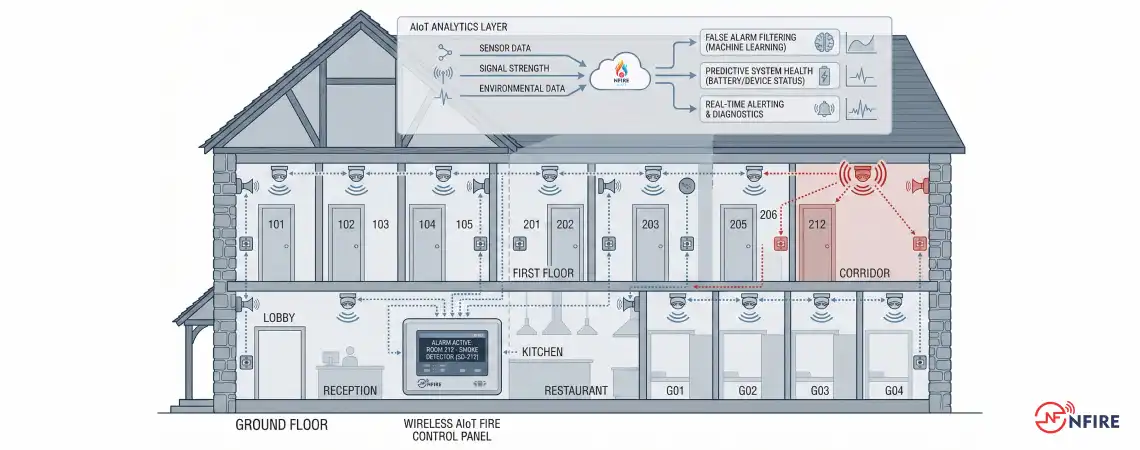
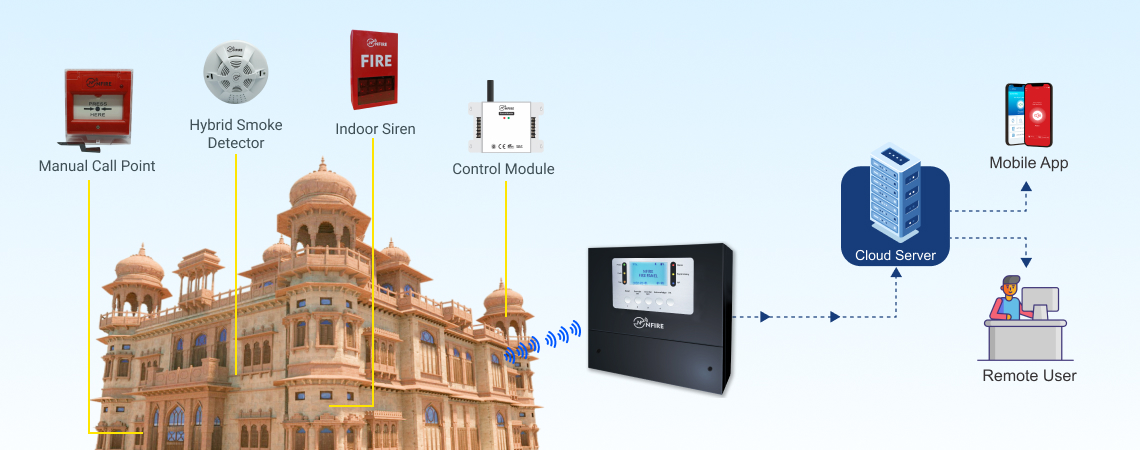
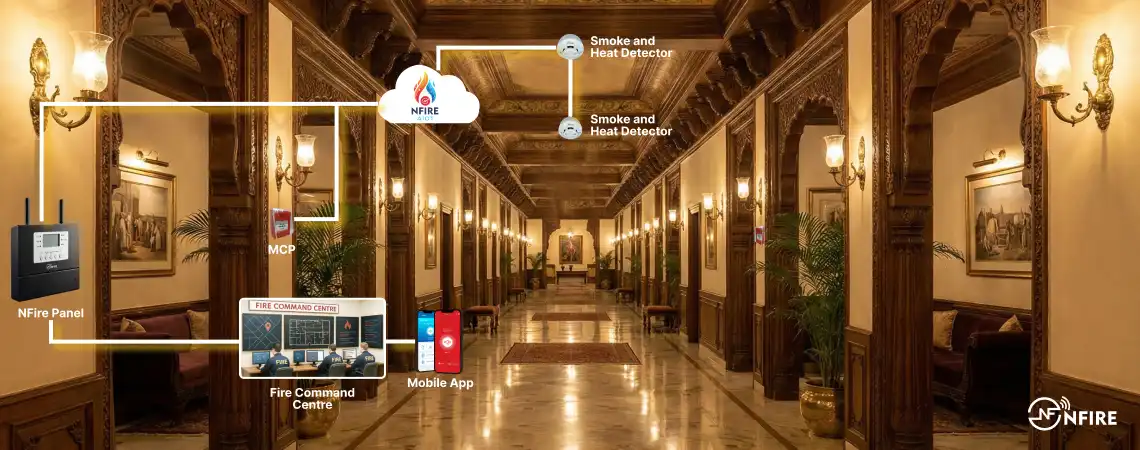
Modern wireless fire alarm systems use radio frequency technology to create a mesh network of intelligent devices that communicate with a central control panel. Each smoke detector, heat sensor, manual call point, and alarm device has its own unique digital address and can transmit and receive signals wirelessly—similar to how modern smartphones and smart home devices communicate.
What makes these systems particularly suitable for heritage applications is their addressable architecture. Unlike conventional fire alarm systems that only indicate which zone has a problem, addressable systems pinpoint the exact device that detected smoke or heat. In a 50-room heritage hotel, this means responders know immediately whether the alarm originated in Room 212 or the ground-floor restaurant—critical information that accelerates response and can save lives.
The AIoT component—Artificial Intelligence combined with Internet of Things connectivity—adds another layer of sophistication. Modern systems like NFire use intelligent algorithms to distinguish between actual fire conditions and environmental factors that might trigger false alarms. They learn the normal patterns of each space, adapting detection algorithms to reduce nuisance alarms from cooking, incense, or other routine activities common in heritage hotels. Real-time data from sensors is continuously analyzed, providing predictive insights about system health and potential fire risks before they escalate.
The installation process for a wireless system in a heritage hotel is remarkably non-invasive. Devices mount to walls or ceilings using discrete brackets that require minimal fixing points—typically 2-4 small screws per device. No cables run between devices, eliminating the need for cable trays, conduits, or extensive drilling.
The control panel, which requires AC power and data connectivity, can be located in a utility area, office, or other non-heritage space. From there, wireless devices communicate via radio signals that pass through walls and across buildings without requiring any physical modifications to the structure.
For a typical 40-room heritage hotel spread across two buildings, a wireless system can be fully installed in 5-7 days compared to 4-6 weeks for an equivalent wired system. Guest disruption is minimal—installation in individual rooms typically takes 30-45 minutes, allowing the property to maintain near-normal operations during the rollout.
Modern wireless fire alarm devices are designed with aesthetics in mind. Detectors and sounders come in discrete designs and colors that blend with heritage interiors. White, cream, or even custom-colored devices can be specified to minimize visual impact on historical ceilings.
Device placement follows fire safety standards—typically ceiling-mounted for optimal smoke detection—but the absence of visible wiring means the installation looks remarkably clean. Unlike wired systems where conduits often create unsightly runs across walls and ceilings, wireless devices appear as simple, discrete units with no visible connection to other parts of the system.
For properties where even minimal visual impact is a concern, manufacturers offer specialized discrete mounting options and lower-profile designs specifically for heritage applications. In consultation with heritage preservation specialists, installation plans can be designed to place devices in locations that meet fire safety requirements while respecting architectural sight lines and significant decorative elements.
A common misconception about wireless fire alarm systems is that they represent a compromise on safety standards. In reality, modern wireless addressable systems meet the same rigorous compliance requirements as wired alternatives.
The IS/ISO 7240 series, published by the Bureau of Indian Standards, establishes requirements for fire detection and alarm systems in India and is typically required under the National Building Code of India 2016 for commercial properties including hotels. Wireless systems that comply with IS/ISO 7240 undergo identical testing protocols as wired systems, proving reliable operation and appropriate sensitivity to fire conditions.
Many advanced wireless systems also carry EN54 certification—the European standard recognized globally as a benchmark for fire safety equipment quality. EN54-25 specifically addresses wireless fire alarm components, establishing requirements for communication reliability, battery life, fault indication, and security against interference.
Systems carrying both IS/ISO 7240 and EN54 certifications, tested by organizations like STQC (Standardization Testing and Quality Certification), provide assurance they’ll perform reliably under Indian environmental conditions—particularly critical for heritage properties in regions experiencing extreme temperatures or humidity.
Modern wireless systems address reliability concerns through stringent requirements. Devices continuously monitor their connection to the control panel, alerting maintenance if communication is lost—ensuring system integrity is always verifiable. Mesh networking allows signals to route through multiple paths, making systems robust even in complex heritage building layouts. Battery life requirements typically mandate minimum three-year operation under normal conditions, with low-battery warnings well before exhaustion.
For heritage hotel owners, fire safety investments deliver tangible financial returns beyond regulatory compliance—particularly through insurance savings and asset protection.
Insurance companies assess fire risk based on multiple factors, with fire detection and suppression systems being among the most significant. Properties with modern, compliant fire alarm systems typically qualify for premium reductions ranging from 10-20% compared to properties without adequate systems.
For a heritage hotel with annual fire insurance premiums of ₹8-12 lakhs, this translates to annual savings of ₹80,000-₹2.4 lakhs. Over the typical 10-15 year lifespan of a fire alarm system, cumulative insurance savings can substantially offset installation costs.
More significantly, inadequate fire safety can make properties uninsurable or require prohibitively expensive coverage. Heritage properties carry replacement values far exceeding standard commercial real estate due to irreplaceable historical significance. Insurers may refuse coverage or apply exclusions for fire damage if properties don’t meet minimum safety standards—a situation that effectively makes business operations untenable.
The 2019 Notre-Dame Cathedral fire in Paris, while not a hotel, illustrated the global impact of heritage fire losses. The structure may be rebuilt, but 850 years of history, original craftsmanship, and cultural continuity were partially lost despite massive restoration efforts.
For Indian heritage hotels, many of which represent architectural styles, craftsmanship traditions, or historical periods that no longer exist elsewhere, fire prevention isn’t just about business continuity—it’s about cultural stewardship. An early-detection fire alarm system provides the critical minutes needed for effective response before a manageable fire becomes a devastating loss.
The financial calculation for heritage properties extends beyond insurance premiums to the irreplaceable value of the property itself. A fire at a heritage hotel doesn’t just destroy a building—it erases history, eliminates a unique tourist destination, and causes cultural losses that can’t be quantified in rupees.
Beyond property damage, fire incidents in hotels create substantial liability exposure. Hotel operators have a duty of care toward guests, and failure to provide adequate fire safety can result in legal liability for injuries or fatalities.
Recent fire incidents in Indian hotels have resulted in both criminal charges against management for safety violations and substantial civil liabilities to victims’ families. The 2019 Hotel Arpit Palace fire led to FIRs noting multiple safety lapses including locked emergency exits and missing fire alarms. For heritage hotels operating in competitive markets, such incidents can destroy reputation and business viability even beyond direct legal consequences.
A properly installed and maintained wireless addressable fire alarm system provides documented evidence of due diligence in guest safety. Compliance certificates, regular inspection records, and system monitoring logs demonstrate that property management took reasonable steps to protect occupants—critical factors in liability assessment should an incident occur.
Understanding how wireless fire alarm systems perform in actual heritage properties helps demonstrate their practical viability.
Across India and globally, heritage properties have successfully implemented wireless addressable fire alarm systems. Historical buildings in the United Kingdom, where heritage preservation regulations are similarly strict, have widely adopted wireless systems as the preferred retrofit solution.
Properties ranging from converted castles to Victorian-era hotels have demonstrated that wireless systems can meet both fire safety standards and heritage preservation requirements. Installation case studies show completion times 60-70% shorter than wired alternatives, with minimal architectural impact and full compliance with fire safety codes.
In India, heritage properties including palace hotels, converted forts, and colonial-era buildings have begun adopting wireless solutions. Indigenous systems like NFire, developed specifically for Indian conditions and heritage architecture, have proven particularly effective in properties with stone construction and multi-building complexes. These installations demonstrate that wireless signals penetrate effectively through traditional materials, and wireless communication eliminates the need for underground cable runs between structures.
Heritage property owners often raise specific concerns about wireless technology, which can be addressed through understanding modern system capabilities:
“Will wireless signals penetrate our thick stone walls?” Modern wireless fire alarm systems use robust radio frequencies designed for building penetration. In testing across various construction types, wireless signals reliably penetrate stone, brick, and concrete walls up to 1-2 meters thick. For exceptionally thick walls or complex layouts, wireless repeaters can extend coverage without requiring cables between devices.
“What about electromagnetic interference from WiFi and phones?” Wireless fire alarm systems use dedicated frequency bands and encryption protocols that avoid interference from consumer devices. Systems are specifically designed to coexist with WiFi networks, cellular signals, and other RF devices without communication issues. This is validated through EN54-25 testing that includes interference immunity requirements.
“How do we maintain the system without disrupting guests?” Wireless systems provide significant maintenance advantages. Remote diagnostics allow many troubleshooting tasks to be performed without physically accessing devices. When maintenance is needed, device replacement is quick—typically 5-10 minutes per device—and doesn’t require specialized electrical work. Battery replacements occur on 3-5 year cycles and can be scheduled during low occupancy periods.
“What happens during power failures?” Wireless systems include battery backup both at the control panel level and in individual devices. The system continues functioning during power outages, with backup power typically providing 24-72 hours of operation depending on system specifications and requirements under relevant standards.
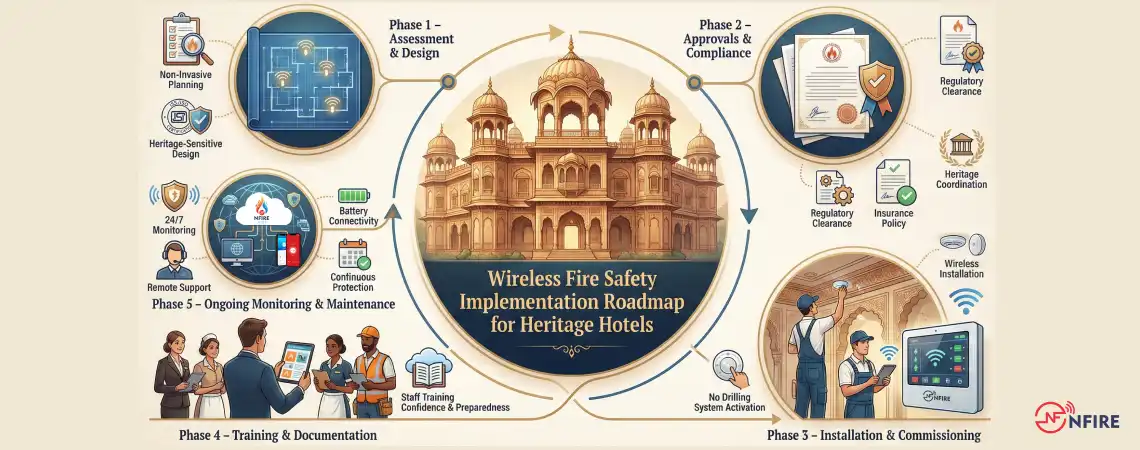
For heritage hotel owners ready to implement wireless fire safety, understanding the implementation process helps set realistic expectations and ensure successful deployment.
The first step involves engaging qualified fire safety consultants to conduct a comprehensive fire risk assessment of the property. This assessment identifies areas requiring coverage, evaluates specific risk factors, and establishes system requirements based on occupancy type, building layout, and applicable regulations.
System designers develop a wireless fire alarm system design that:
For heritage properties, this design phase should involve consultation with heritage preservation specialists or ASI representatives if applicable. The goal is to develop an installation plan that meets fire safety requirements while respecting architectural significance and minimizing visual impact.
With system design complete, the next step involves securing necessary approvals. This typically includes:
This administrative phase occurs in parallel with equipment procurement, ensuring devices are delivered as regulatory approvals are secured.
The actual installation of a wireless system in a heritage property is remarkably straightforward compared to wired alternatives. A typical installation sequence involves:
Throughout installation, technicians coordinate with hotel operations to minimize guest impact. Installation in occupied rooms occurs during turnover periods between guests, while public areas can typically be addressed during off-peak hours.
Effective fire safety requires trained personnel. Following installation, comprehensive training should cover:
Training should include property management, front desk staff, housekeeping supervisors, and maintenance personnel. Multiple staff members should be fully trained to ensure coverage across all shifts and throughout the year.
Following commissioning, wireless systems require periodic maintenance:
Many properties opt for 24/7 emergency monitoring services where alarm signals are transmitted to a central monitoring station staffed by trained operators. This service, modeled on emergency response systems used globally, provides immediate verification of alarms and ensures appropriate response even when property staff may not be immediately available.
Heritage hotel owners must evaluate fire safety investments within their broader business context. Understanding the return on investment helps justify the necessary expenditure.
For a typical 40-room heritage hotel property:
The wireless approach typically delivers 30-40% lower total project costs once all factors are considered—not just equipment but installation labor, business disruption, and preservation costs.
The wireless approach typically delivers 30-40% lower total project costs once all factors are considered—not just equipment but installation labor, business disruption, and preservation costs.
With annual insurance premium reductions of ₹80,000-₹2.4 lakhs, the system investment pays for itself over time:
Over the typical 15-year lifespan of a fire alarm system, cumulative insurance savings alone can total ₹12-36 lakhs—potentially offsetting 30-90% of installation costs through insurance benefits alone.
Beyond direct financial calculations, wireless fire safety systems deliver benefits difficult to quantify:
For heritage hotels, where room rates command premiums based on authentic experience and historical significance, the catastrophic risk of fire extends beyond financial loss to the permanent destruction of the very assets that define the business. Wireless fire safety represents essential insurance against an existential business risk.
For heritage hotel owners and operators, implementing modern fire safety without compromising historical integrity is no longer an unsolvable dilemma. Wireless AIoT-based addressable fire alarm systems provide a proven solution that:
The technology exists today to protect both people and priceless architectural heritage. The question isn’t whether wireless fire safety works for heritage properties—it’s how quickly property owners will recognize it as the only practical path forward.
Your next step begins with understanding your property’s specific fire safety requirements and how wireless technology can meet them without compromise.
Ready to explore wireless fire safety for your heritage property? Our comprehensive Heritage Hotel Fire Safety Retrofit Checklist guides you through:
✓ Assessment Requirements – Understanding your property’s fire risk profile and regulatory obligations
✓ System Specification – Determining the appropriate wireless technology for your specific building layout
✓ Vendor Evaluation – Questions to ask fire alarm system providers to ensure IS/ISO and EN54 compliance
✓ Preservation Coordination – Working with ASI and heritage authorities on installation plans
✓ ROI Calculation – Estimating costs, insurance savings, and payback periods for your property
✓ Implementation Timeline – Planning installation around your operational schedule
Protect your guests. Preserve your heritage. Secure your future with wireless fire safety technology designed specifically for India’s most precious properties.
We specialize in NFire—an indigenous wireless AIoT-based addressable fire alarm system designed specifically for India’s unique requirements. Our systems meet both IS/ISO 7240 and EN54 standards, providing heritage hotels with reliable, non-invasive fire protection that preserves architectural integrity while ensuring guest safety. From historic palaces to colonial properties, NFire has helped heritage hotel owners achieve modern fire safety without compromising the irreplaceable character of their properties.
Contact us to schedule a no-obligation assessment of your heritage property’s fire safety needs.
Yes. Wireless addressable fire alarm systems that comply with IS/ISO 7240 and EN54-25 are permitted and increasingly preferred for heritage hotels because they require minimal structural intervention and align with preservation guidelines.
Modern wireless fire alarm systems are designed for robust signal penetration. They reliably operate through stone, brick, and concrete walls commonly found in heritage buildings. Where required, wireless repeaters extend coverage without additional cabling.
Absolutely. Wireless fire alarm systems include battery backup at both the control panel and individual device level. They continue operating during power outages for 24–72 hours, depending on system configuration and regulatory requirements.
Battery life typically ranges from 3 to 5 years under normal operating conditions. NFire Systems provide early low-battery alerts, allowing replacements to be scheduled during low-occupancy periods without guest disruption.
In most cases, yes. Insurers often offer 10–20% premium reductions for properties equipped with compliant, modern fire detection systems. For heritage hotels, this can translate into substantial long-term savings.
Yes. Because wireless systems avoid invasive drilling and cabling, they are generally more acceptable to the Archaeological Survey of India (ASI) and other heritage authorities compared to traditional wired systems.