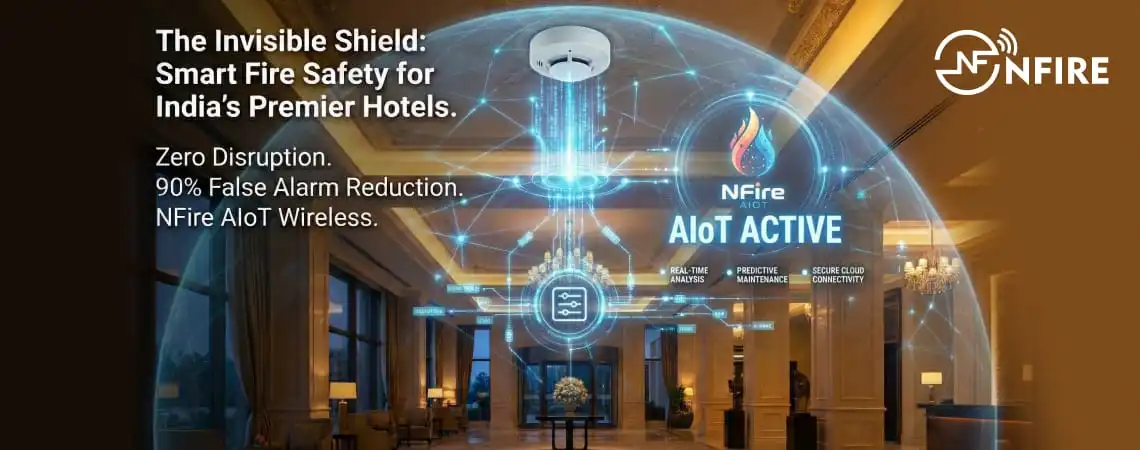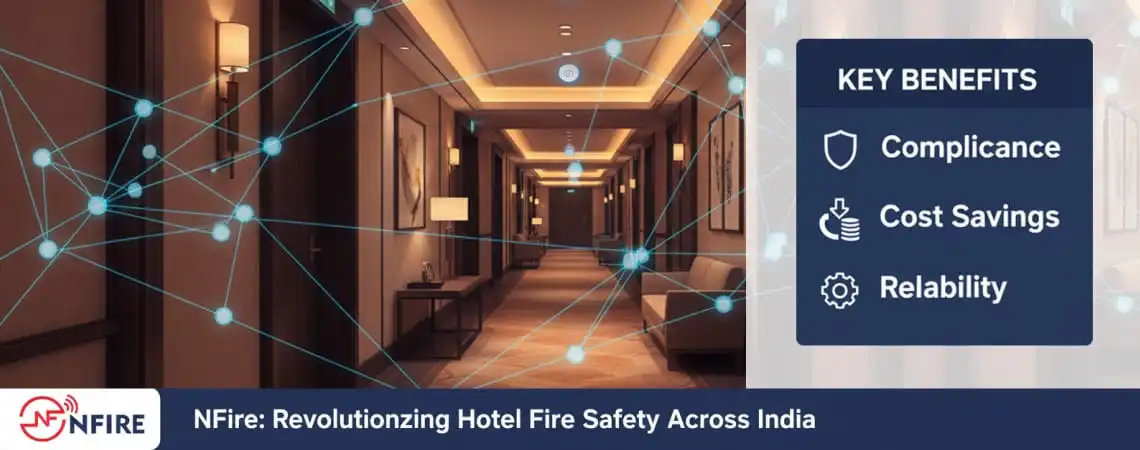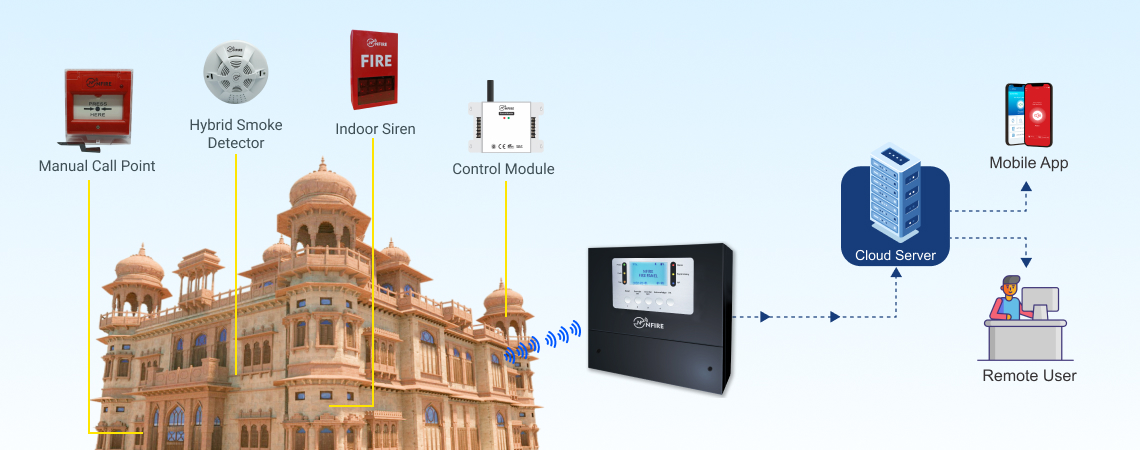

Stop reacting to fires. Start predicting them. Discover how NFire’s AIoT-powered wireless addressable fire alarm system transforms hotel fire safety from reactive detection to predictive intelligence — with measurable ROI, automated compliance, and 40-60% fewer false alarms.
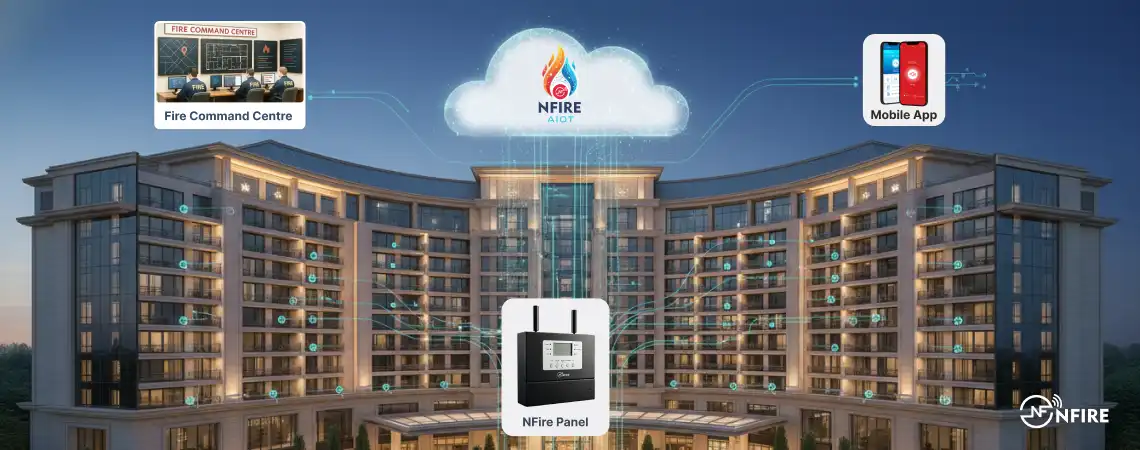
| Topic | Key Insight |
|---|---|
| The Problem | Conventional fire systems fail hotels due to imprecise detection, high false alarms, and zero predictive capability. |
| The Solution | AIoT combines AI-powered prediction with wireless IoT sensors for precise, intelligent fire safety. |
| The Technology | NFire delivers five critical capabilities: wireless addressable detection, AI prediction, 24/7 monitoring, automated compliance, and predictive maintenance. |
| The ROI | ₹3–5 lakh savings in Year 1 through insurance reduction, false alarm elimination, and predictable maintenance. |
| Compliance | EN54 and IS/ISO 7240 compliant, meets NBC 2016 requirements, and automates audit documentation. |
⏱️ Reading Time: 12 minutes | For: Hotel owners, facility managers, safety directors, resort operators
Quick Answer: Approximately 25,000 people die annually in India due to fire-related causes, with hotels featuring prominently in statistics. Fire-related losses cost the Indian economy over ₹1,000 crore yearly, and recent tragedies like the 2023 Kolkata hotel fire (15 deaths) and 2019 Delhi hotel fire (17 deaths) demonstrate that conventional fire safety systems are failing to protect guests adequately.
A hotel is a place where guests surrender their vigilance. They sleep in unfamiliar rooms, unaware of the building’s layout, trusting that the establishment has done everything possible to keep them safe. That trust is not just a moral obligation — it is a legal and financial one.
According to data compiled by the National Crime Records Bureau, approximately 25,000 people die annually in India due to fire and related causes. FICCI estimates indicate that fire-related losses cost the Indian economy over ₹1,000 crore every year, with fire accounting for roughly 45% of major insurance claims reported by Indian insurers.
Recent Hotel Fire Tragedies in India:
These are not isolated tragedies — they are symptoms of a systemic gap between what fire safety regulations demand and what most hospitality properties actually deliver.
Quick Answer: Conventional fire alarm systems fail in hotels because they only identify broad zones (not specific rooms), have high false alarm rates (15-30%) that disrupt guests and erode staff confidence, provide no predictive warning before fires start, and cannot accommodate the 24/7 complexity of hospitality environments with constantly changing occupancy and diverse fire risk areas.
Hotels present a uniquely challenging environment for fire protection:
Operational Complexity:
Diverse Risk Zones:
Human Factors:
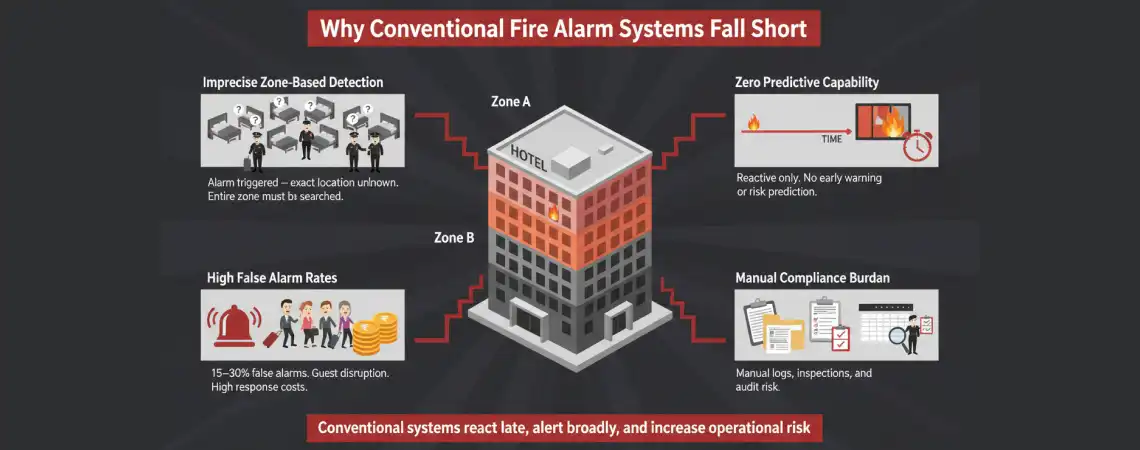
Problem 1: Imprecise Zone-Based Detection Conventional systems divide buildings into broad zones. When an alarm triggers, responders must physically search the entire zone to locate the source. In a 200-room hotel with dozens of rooms per floor, this delay is not an inconvenience — it’s a life-safety risk.
Problem 2: High False Alarm Rates Research shows false alarm rates of 15-30% are common in conventional installations. Each false alarm:
Problem 3: Zero Predictive Capability Conventional systems react only after smoke or heat reaches dangerous levels. They cannot identify emerging risk patterns or provide early warning before visible flames or smoke.
Problem 4: Manual Compliance Burden Conventional systems require manual documentation of inspections, testing, maintenance, and incidents creating administrative burden and audit risk.
| Feature | Conventional (Zone) | Addressable (Wired) | NFire (Wireless AIoT) |
|---|---|---|---|
| Location Precision | Zone-level (entire floor) | Device-level (specific room) | Device-level + AI context |
| False Alarm Rate | High (15–30%) | Medium (8–15%) | Low (3–7% with AI) |
| Installation Cost | Low | High (extensive cabling) | Medium (no cabling) |
| Installation Time | 2–3 weeks | 4–6 weeks | 1–2 weeks |
| Predictive Capability | None | None | Yes (AI-powered) |
| Remote Monitoring | No | Optional | Standard (24/7) |
| Compliance Automation | Manual documentation | Semi-automated | Fully automated |
| Retrofit Capability | Limited | Difficult (cabling) | Excellent (wireless) |
| Aesthetic Impact | Visible wiring | Extensive conduit | Minimal (wireless) |
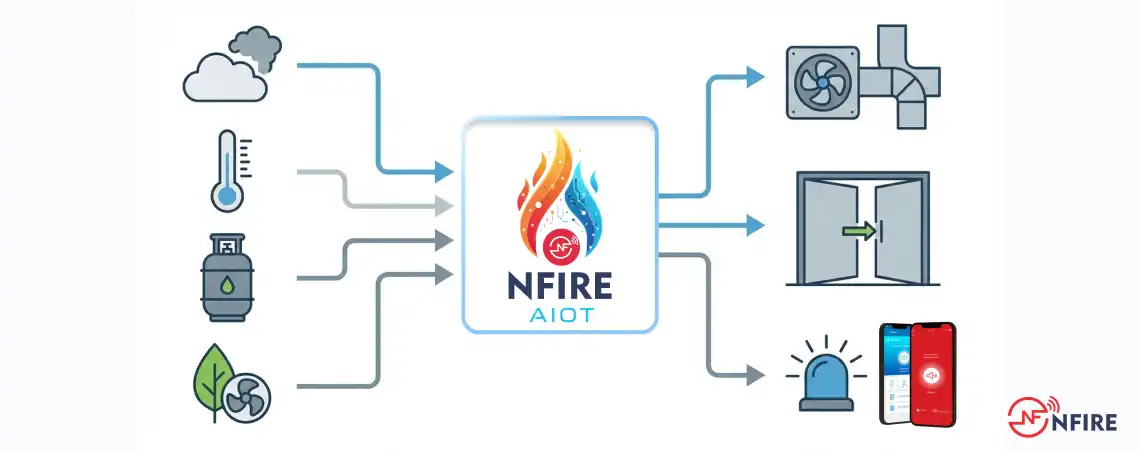
Quick Answer: AIoT (Artificial Intelligence + Internet of Things) transforms fire safety from reactive detection to predictive intelligence. IoT provides dense wireless sensor networks gathering real-time environmental data, while AI analyzes patterns to distinguish genuine threats from benign triggers and predict fire conditions 5-10 minutes before visible smoke — achieving 40-60% reduction in false alarms while dramatically improving detection speed.
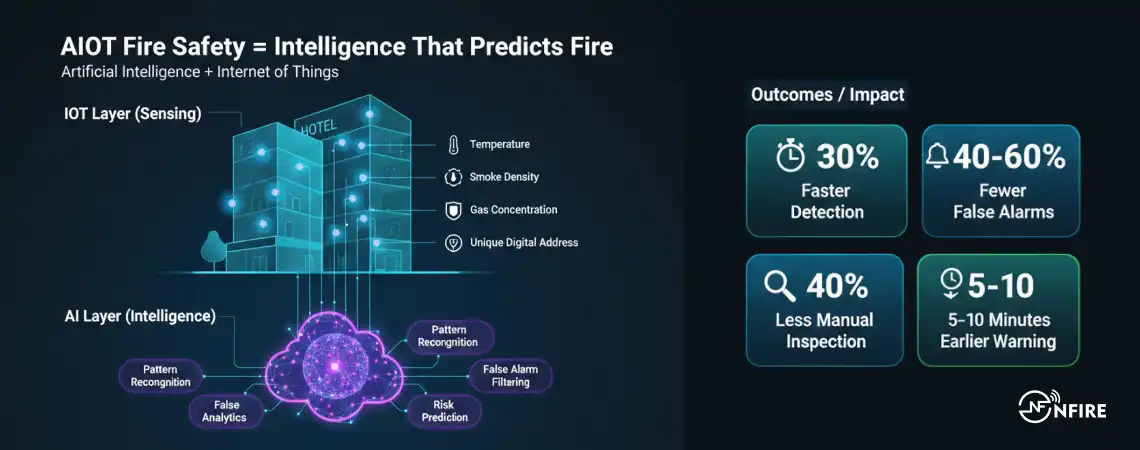
The IoT Layer (Sensing):
The AI Layer (Intelligence):
The Research Backing AIoT Fire Safety
Research published in 2025 by the MDPI journal Safety confirmed that IoT-based fire safety systems — integrating cutting-edge sensors with real-time data analytics — represent the most significant advancement in fire management capability in over a decade.
Key Research Findings:
Want to see how predictive intelligence looks in a real hotel environment?
Q: How does AI reduce false alarms by 40-60%?
A: AI analyzes multiple data streams simultaneously — smoke, temperature, humidity, and historical patterns — to distinguish genuine fire conditions from benign triggers like cooking steam or shower vapor. The system learns normal conditions for each area and applies contextual evaluation, so cooking-related smoke at 6 PM is treated differently than smoke at 3 AM.
| Method | How It Works | Benefit |
|---|---|---|
| Multi-criteria analysis | Evaluates 3–5 environmental factors simultaneously (not just smoke) | Eliminates single-factor false positives |
| Pattern recognition | Learns normal conditions for each area (kitchen vs. guest room) | Context-appropriate sensitivity |
| Contextual evaluation | Smoke during meal prep hours treated differently than overnight | Time-aware intelligence |
| Adaptive thresholds | Adjusts sensitivity based on seasonal conditions and usage | Prevents weather-related false alarms |
| Historical baseline | Compares current data against 30–90 day patterns | Detects anomalies accurately |
| Hotel Size | Conventional System False Alarms / Year | NFire AIoT False Alarms / Year | Annual Savings |
|---|---|---|---|
| 100-room | 8–12 (@ ₹20,000 each) | 2–4 | ₹80,000 – ₹1.6 lakh |
| 200-room | 10–15 (@ ₹20,000 each) | 3–5 | ₹1 – ₹2 lakh |
| 300+ room | 15–20 (@ ₹20,000 each) | 4–6 | ₹1.8 – ₹2.8 lakh |
Quick Answer: NFire is India’s first wireless addressable fire alarm system, developed by Atigo Corporation in collaboration with IIT Gandhinagar, launched in 2018. It delivers EN54 and IS/ISO 7240 compliant fire safety through five integrated capabilities: wireless addressable detection (exact room-level alerts), AI-powered prediction (identifies fires before visible smoke), 24/7 emergency monitoring, automated compliance documentation, and predictive maintenance — all purpose-built for Indian environmental conditions (40°C+ heat, 90% humidity).
Development Background:
Certifications & Compliance:



✅ EN54 Compliant: European fire detection standard
✅ IS/ISO 7240 Compliant: Indian fire alarm system standard
✅ STQC Tested: Government testing confirms BIS requirements
✅ NBC 2016 Part 4 Compliant: National Building Code fire safety provisions
Client Validation (Trusted By): Indian Railways | India Post | Coca-Cola | Decathlon | Aditya Birla Grasim | Tata Tanishq | Adani Power | State Bank of India | Amazon Warehouses | Mumbai AIDS Hospital | Fern Hotels | Heritage Properties
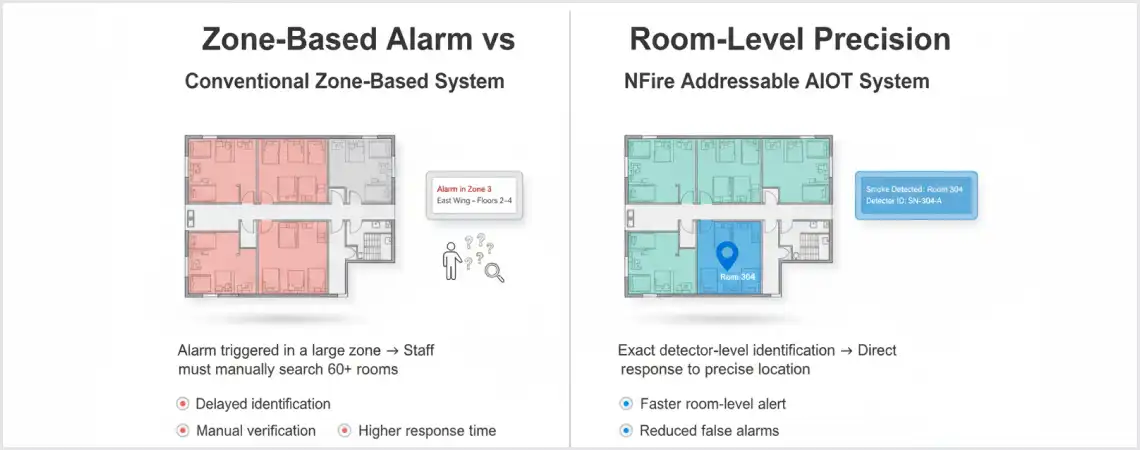
Quick Answer: Every NFire detector carries a unique digital address, providing exact room-level or corridor-level identification when an alert triggers. Wireless deployment eliminates invasive cabling, reducing installation costs by 30-50%, enabling rapid deployment (1-2 weeks vs. 4-6 weeks for wired systems), and preserving building aesthetics — critical for heritage properties and guest-facing areas.
How Addressable Technology Works:
| Benefit | Impact |
|---|---|
| No invasive cabling | Preserves aesthetics, protects heritage architecture |
| 30–50% lower installation cost | No conduit, no cable pulling, less labor |
| 1–2 week deployment | vs. 4–6 weeks for wired systems |
| Easy expansion | Add devices without rewiring |
| Retrofit-friendly | Ideal for existing buildings |
| Minimal guest disruption | No drilling through occupied areas |
Real-World Scenario: Conventional Zone System: “Alarm in Zone 3 (East Wing, Floors 2-4)” → Staff must search 60+ rooms
NFire Addressable System: “Smoke detected: Room 304, Detector ID SN-304-A” → Direct response to exact location
Quick Answer: NFire’s AI engine continuously analyzes data from every sensor, monitoring for subtle environmental shifts (gradual temperature increases, unusual humidity changes, early-stage gas emissions) that historically precede fire events. This pattern recognition enables intervention 5-10 minutes before visible flames or smoke, identifying fire conditions that conventional detectors would miss entirely.
What the AI Monitors:
| Traditional Detection | NFire AI Prediction |
|---|---|
| Reacts to visible smoke | Detects pre-fire conditions |
| Threshold-based (smoke > X = alarm) | Pattern-based (trends indicate risk) |
| Single-factor evaluation | Multi-criteria analysis |
| No learning capability | Learns normal patterns per area |
| Same sensitivity everywhere | Context-appropriate sensitivity |
Example: Kitchen Fire Prevention
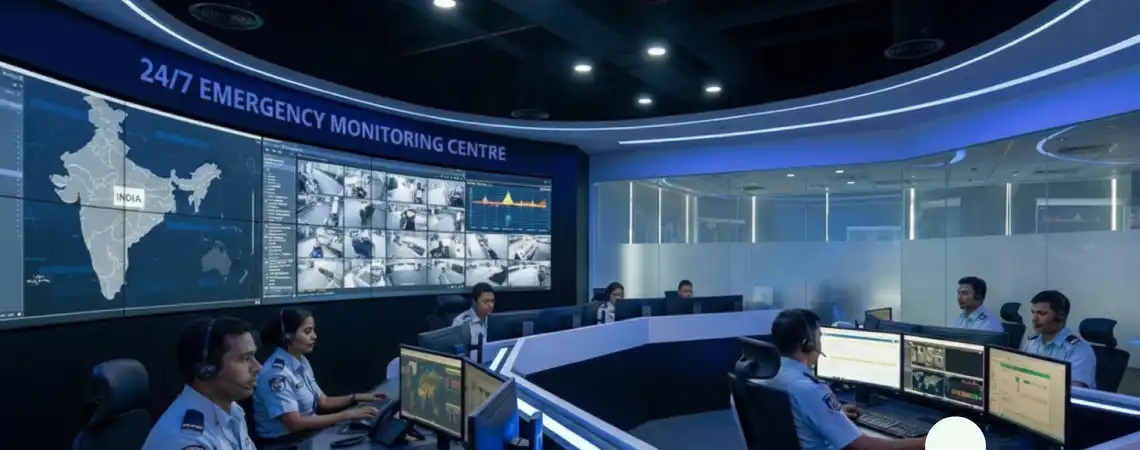
Quick Answer: NFire operates with Atigo’s 24/7 Emergency Monitoring Service India’s first professional fire monitoring center modeled on US 911 systems, operational since 2013. When genuine threats are detected, trained monitoring personnel receive immediate notification, assess the situation, coordinate with local fire services, and guide hotel emergency response providing critical backup during overnight hours when occupancy is highest and staff presence is lowest.
How 24/7 Monitoring Works:
Step 1: Detection → NFire system identifies genuine threat (AI-verified)
Step 2: Immediate Alert → Monitoring center notified within seconds
Step 3: Assessment → Trained personnel evaluate severity, location, context
Step 4: Coordination → Simultaneous notification to hotel staff + local fire department
Step 5: Guidance → Monitoring team guides hotel emergency response
Why Professional Monitoring is Critical for Hotels:
Statistics:
Quick Answer: NFire automatically logs system health, detector status, alarm events, maintenance activities, and testing records — generating comprehensive compliance reports on demand that satisfy NBC 2016, state fire department audits, and insurance requirements. This eliminates manual documentation burden, prevents compliance gaps that lead to penalties (up to ₹10 lakh+ in some states), and provides auditors with verifiable real-time data rather than paper records.
| Requirement | Source | NFire Solution |
|---|---|---|
| Automatic fire detection | NBC 2016 Part 4 | Wireless addressable system |
| Annual fire safety audit | State fire departments | Automated report generation |
| Quarterly self-assessments | States like Tamil Nadu | Continuous system health logs |
| Fire NOC (No Objection Certificate) | Mandatory for operation | Compliance documentation |
| System testing logs | Insurance requirements | Automated test records |
| Incident documentation | Legal requirement | Real-time event logging |
| Maintenance records | Audit requirement | Predictive maintenance logs |
Compliance Automation Features:
✅ Real-time system health dashboard
✅ Automatic test and inspection logging
✅ One-click compliance report generation
✅ Pre-configured report templates for different audit types
✅ Historical data retention (5+ years)
✅ Integration with Building Management Systems (BMS)
Penalty Avoidance: Recent state-level penalty increases for non-compliance:
Real Cost of Manual Compliance:
Quick Answer: NFire monitors component health in real-time — tracking sensor performance degradation, battery status, communication path stability, and panel diagnostics. When the system identifies components approaching failure or performing outside optimal parameters, it generates proactive maintenance alerts before failures occur — reducing maintenance costs by 30-40%, eliminating unplanned downtime, and ensuring 99.9%+ system reliability.
Traditional Maintenance: Fixed schedule (annual/quarterly) regardless of actual condition
❌ Maintenance performed even when unnecessary
❌ Component failures occur between scheduled visits
❌ Unpredictable emergency repair costs
❌ Audit findings for failed components
NFire Predictive Maintenance: Condition-based alerts trigger targeted intervention
✅ Maintenance only when needed
✅ Failures prevented before they occur
✅ Predictable maintenance budgets
✅ Continuous system reliability
| Component | What’s Monitored | Early Warning Signs |
|---|---|---|
| Smoke Detectors | Sensitivity drift, optical chamber contamination | Performance degradation alerts |
| Batteries | Voltage, charge capacity, cycle count | Replace before failure |
| Communication Paths | Signal strength, packet loss, latency | Network stability issues |
| Control Panels | Power supply, processor health, storage | System health degradation |
| Wireless Modules | RF signal quality, interference levels | Communication risks |
| Maintenance Approach | Annual Cost | Characteristics |
|---|---|---|
| Reactive (conventional) | ₹3–4 lakh | Emergency repairs, unpredictable, includes audit failures |
| Scheduled (basic addressable) | ₹2–3 lakh | Fixed visits regardless of need, some emergency repairs |
| Predictive (NFire AIoT) | ₹1.5–2 lakh | Targeted interventions, minimal emergencies, optimal reliability |
Annual Savings: ₹1-2 lakh through predictive maintenance vs. conventional approaches
Our experts can help you map out a transition plan that balances safety and budget.
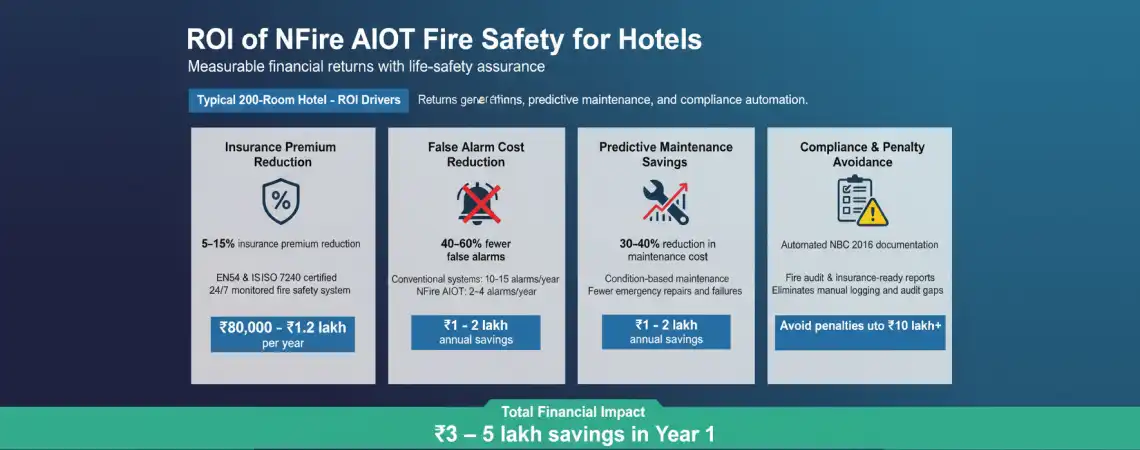
Quick Answer: NFire delivers measurable ROI through four channels: (1) Insurance premium reductions of 5-15% annually for EN54-certified monitored systems, (2) False alarm cost elimination saving ₹1-2 lakh/year for mid-size hotels, (3) Predictive maintenance reducing costs 30-40% vs. reactive approaches, and (4) Compliance penalty avoidance preventing fines up to ₹10 lakh+. Typical payback period: 2-3 years with cumulative 5-year savings of ₹25-35 lakh for 200-room properties.
How It Works: Insurance companies assess fire risk based on detection system sophistication, monitoring presence, and compliance certifications. Properties with advanced, monitored systems qualify for lower premiums.
| Factor | Conventional System | NFire AIoT System |
|---|---|---|
| Detection precision | Zone-level (high risk) | Device-level (low risk) |
| False alarm rate | 15–30% (unreliable) | 3–7% (highly reliable) |
| Monitoring | Often none | 24/7 professional |
| Certification | Varies | EN54 + IS/ISO 7240 |
| Maintenance predictability | Reactive / unpredictable | Predictive / documented |
Typical Premium Reduction: 5-15% for certified, monitored systems
Financial Impact (200-room hotel):
Cost per False Alarm:
| System Type | False Alarms / Year | Cost / Alarm | Annual Cost |
|---|---|---|---|
| Conventional | 10–15 | ₹20,000 | ₹2–3 lakh |
| Basic Addressable | 6–10 | ₹20,000 | ₹1.2–2 lakh |
| NFire AIoT | 2–4 | ₹20,000 | ₹40,000–₹80,000 |
Annual Savings: ₹1-2 lakh through 40-60% false alarm reduction
| Approach | Annual Cost | Breakdown |
|---|---|---|
| Reactive (conventional) | ₹3–4 lakh | 2–3 scheduled visits + 3–4 emergency repairs + audit failures |
| Scheduled (basic) | ₹2–3 lakh | 4 quarterly visits regardless of need + some emergency repairs |
| Predictive (NFire) | ₹1.5–2 lakh | Targeted interventions based on actual condition + minimal emergencies |
Annual Savings: ₹1-2 lakh through condition-based maintenance
Compliance Risk Without Automated Documentation:
Hidden Compliance Costs:
NFire Automated Compliance Value:
| Requirement | Source | NFire Solution |
|---|---|---|
| Automatic fire detection | NBC 2016 Part 4 | Wireless addressable system |
| Annual fire safety audit | State fire departments | Automated report generation |
| Quarterly self-assessments | States like Tamil Nadu | Continuous system health logs |
| Fire NOC (No Objection Certificate) | Mandatory for operation | Compliance documentation |
| System testing logs | Insurance requirements | Automated test records |
| Incident documentation | Legal requirement | Real-time event logging |
| Maintenance records | Audit requirement | Predictive maintenance logs |
Payback Period: 2-3 years for typical 200-room hotel installation
5-Year Net Savings: ₹22 lakh+ (not including avoided fire damage, business continuity, life safety)
The Intangible Value: Life Safety & Brand Protection
Beyond measurable financial ROI, NFire delivers critical intangible benefits:
Life Safety:
Brand Protection:
Operational Continuity:
An AIoT (Artificial Intelligence + Internet of Things) fire alarm system uses AI-powered sensors that continuously analyze environmental data (smoke, temperature, humidity, gas levels) to predict fires before they start, while IoT connectivity enables real-time monitoring and remote management. Unlike conventional systems that only react to smoke or heat, AIoT systems identify risk patterns early and distinguish genuine threats from false triggers.
NFire provides exact room-level detection (vs. broad zone alerts), uses AI to reduce false alarms by 40-60%, predicts fires before visible smoke, includes 24/7 professional monitoring, and automates compliance documentation. Conventional systems only detect existing fires, cannot pinpoint locations precisely, have high false alarm rates, provide no professional monitoring, and require manual compliance tracking.
| Capability | Conventional | NFire AIoT |
|---|---|---|
| Location precision | Zone-level | Exact room / device |
| False alarms | 15–30% | 3–7% |
| Prediction | None | 5–10 min early warning |
| Monitoring | None or basic | 24/7 professional |
| Compliance | Manual | Automated |
| Installation | 2–3 weeks | 1–2 weeks |
| Maintenance | Reactive | Predictive |
Yes, NFire is fully compliant with Indian and international fire safety standards. It complies with EN54 certification (European standard), IS/ISO 7240 certification (Indian standard), STQC testing validation, and meets NBC 2016 Part 4 (National Building Code) requirements for commercial buildings and hotels. The system also automates documentation to satisfy state fire department audits and insurance requirements.
✅ EN54 (European fire detection standard) Compliant
✅ IS/ISO 7240 (Indian fire alarm standard) Compliant
✅ STQC Tested (Government certification)
✅ NBC 2016 Part 4 Compliant
Wireless addressable systems certified to EN54 standards are highly reliable for life-safety applications. They undergo rigorous testing for signal reliability, interference resistance, and failover performance under adverse conditions. NFire’s wireless architecture includes redundancy mechanisms, continuous communication health monitoring, and automatic alerts if any detector loses connectivity — ensuring the same reliability as wired systems with added flexibility.
AI analyzes multiple data streams simultaneously — smoke, temperature, humidity, historical patterns — to distinguish genuine fire conditions from benign triggers like cooking steam or shower vapor. The system learns normal conditions for each area (kitchen vs. guest room), applies contextual evaluation (cooking smoke at 6 PM vs. 3 AM), and adapts sensitivity based on seasonal conditions — achieving 40-60% false alarm reduction compared to conventional systems.
Yes, NFire supports hybrid deployment. Wireless devices can be integrated alongside existing hardwired infrastructure, allowing hotels to migrate incrementally. You can add wireless addressable coverage in priority areas first (guest floors, high-risk zones) while maintaining existing systems in other areas, then expand over time without requiring complete system replacement.
Installation timeline for NFire wireless systems is 1-2 weeks for typical 100-200 room hotels, compared to 4-6 weeks for wired addressable systems. The wireless architecture eliminates cable pulling, conduit installation, and extensive wall penetration — allowing faster deployment with minimal guest disruption. Larger resorts (300+ rooms) typically require 2-3 weeks.
Wireless technology is ideal for heritage properties because it eliminates the need to drill through historic walls, run conduit through ornate ceilings, or disturb architectural features. Devices are surface-mounted with minimal aesthetic impact, powered by long-life batteries (5-7 years), and can be installed without scaffolding or extensive access equipment — preserving the property’s historical integrity while meeting modern fire safety requirements.
Yes, NFire supports hybrid deployment. Wireless devices can be integrated alongside existing hardwired infrastructure, allowing hotels to migrate incrementally. You can add wireless addressable coverage in priority areas first (guest floors, high-risk zones) while maintaining existing systems in other areas, then expand over time without requiring complete system replacement.
Typical ROI timeline is 2-3 years for 200-room hotels through four savings channels: insurance premium reduction (5-15%), false alarm cost elimination (₹1-2 lakh/year), predictive maintenance savings (30-40% reduction), and compliance penalty avoidance (up to ₹10 lakh+ in some states). Five-year cumulative savings typically reach ₹22-35 lakh, not including intangible benefits like life safety and brand protection.
Yes, NFire was specifically engineered for Indian environmental conditions. Atigo’s R&D began in 2009 after imported sensors proved unreliable in temperatures exceeding 40°C and humidity levels approaching 90%. NFire’s sensors and electronics are designed, tested, and validated for extreme heat, high humidity, dust, and the electrical infrastructure challenges common in India — a fundamental advantage over imported systems designed for temperate climates.
Quick Answer: NFire meets all mandatory fire safety standards for Indian hotels including IS/ISO 7240 (Indian fire alarm standard), EN54 (European certification for international quality assurance), STQC testing (government validation), and NBC 2016 Part 4 (National Building Code fire safety provisions). The system automates compliance documentation for state fire department audits, insurance requirements, and quarterly self-assessments mandated in states like Tamil Nadu.
| Standard | Description | Relevance to Hotels | NFire Status |
|---|---|---|---|
| IS/ISO 7240 | Indian standard for fire detection and alarm systems | Mandatory for commercial buildings in India | ✅ Compliant |
| EN54 | European fire detection and alarm equipment standard (Parts 2, 3, 5, 7, 25) | International quality benchmark, insurance requirement | ✅ Compliant |
| STQC | Standardisation Testing and Quality Certification (Govt of India) | Confirms compliance with BIS requirements | ✅ Tested |
| NBC 2016 Part 4 | National Building Code fire and life safety provisions | Mandatory for hotels (starred hotels = dedicated occupancy category) | ✅ Compliant |
| ISO 9001 | Quality Management System | Manufacturing and service quality assurance | ✅ Certified |
| CE Marking | European Conformity | Product safety and export capability | ✅ Marked |
| RoHS | Restriction of Hazardous Substances | Environmental compliance | ✅ Compliant |
NBC 2016 Part 4 Requirements:
State-Level Requirements:
Penalty Framework (Recent Increases):
Automated Documentation:
✅ Real-time system health logs
✅ Detector status tracking (online/offline/degraded)
✅ Alarm event logging with timestamps
✅ Maintenance activity records
✅ Testing and inspection logs
✅ User access audit trails
One-Click Report Generation:
Audit-Ready Features:
Quick Answer: NFire’s 10,000+ installations across India have prevented 500+ fire and safety emergencies through early detection and 24/7 professional monitoring, achieving 100% zero fire fatalities at monitored sites. The system protects critical infrastructure for major organizations including Indian Railways, India Post, Coca-Cola, Tata Tanishq, Adani Power, State Bank of India, and Amazon Warehouses — demonstrating proven reliability in diverse, high-stakes environments.
| Metric | Achievement |
|---|---|
| Active Installations | 10,000+ nationwide |
| Emergencies Prevented | 500+ through early intervention |
| Fire Fatalities at Monitored Sites | Zero (100% prevention) |
| System Uptime | 99.9%+ across installations |
| Monitoring Service Operational | Since 2013 (12+ years) |
| Average Response Coordination Time | 90 seconds from detection to fire department notification |
Critical Infrastructure:
Commercial & Retail:
Industrial:
Hospitality & Healthcare:
Geographic Reach:
✅ Installations across India (all major metros + tier 2/3 cities)
✅ International: UK, Africa
✅ Diverse environments: Hotels, factories, warehouses, hospitals, heritage sites, commercial buildings
For Critical Infrastructure (Railways, India Post, Power):
For Commercial & Retail (Coca-Cola, Decathlon, Amazon):
For Hospitality (Hotels, Resorts, Heritage Properties):
For Healthcare:
Quick Answer: The future of hotel fire safety is predictive, integrated, and AI-driven. NFire is advancing next-generation industrial automation and building management platforms that integrate fire safety with HVAC, access control, and energy management — creating unified intelligence layers that predict maintenance needs, optimize resource usage, and provide real-time situational awareness across entire properties while maintaining human life safety as the paramount priority.
1. Predictive Analytics Evolution
2. Integration with Smart Building Ecosystems
3. Enhanced Guest Safety Features
4. Regulatory Evolution
5. Insurance Industry Transformation
Near-Term (2026-2027):
Medium-Term (2027-2028):
Long-Term Vision:
Regulatory Positioning:
Insurance Benefits:
Brand Differentiation:
Operational Excellence:
Future-Proofing:
The Choice is Clear: Continue with conventional systems that react only after fires start, provide imprecise zone-level detection, generate costly false alarms, require manual compliance documentation, and offer no predictive maintenance — or upgrade to NFire’s AIoT platform that predicts fires before they start, pinpoints exact locations, reduces false alarms by 40-60%, automates compliance, and delivers measurable ROI within 2-3 years.
Option 1: Schedule a Free Fire Safety Assessment
Option 2: Download the Compliance Checklist
Option 3: Request a Live System Demonstration
Regulatory Pressure Increasing:
Insurance Requirements Tightening:
Guest Expectations Rising:
Technology Window Closing:
Atigo Corporation was founded in 2013 with a strategic MoU signed at Vibrant Gujarat Summit, committing ₹250 crore to establish advanced R&D and manufacturing capabilities in India. Our mission: Make India self-reliant in critical safety and security technology.
✅ EN54 Certified (Fire Detection & Alarm Systems)
✅ IS/ISO 7240 Certified (Indian Fire Alarm Standard)
✅ STQC Tested (Government of India)
✅ ISO 9001 Quality Management
✅ CE Marking & RoHS Compliant
🏆 Youth Icon Pathbreaker 2025 Award (MD Pushpendrasinh Jhala, presented by Government of India)