
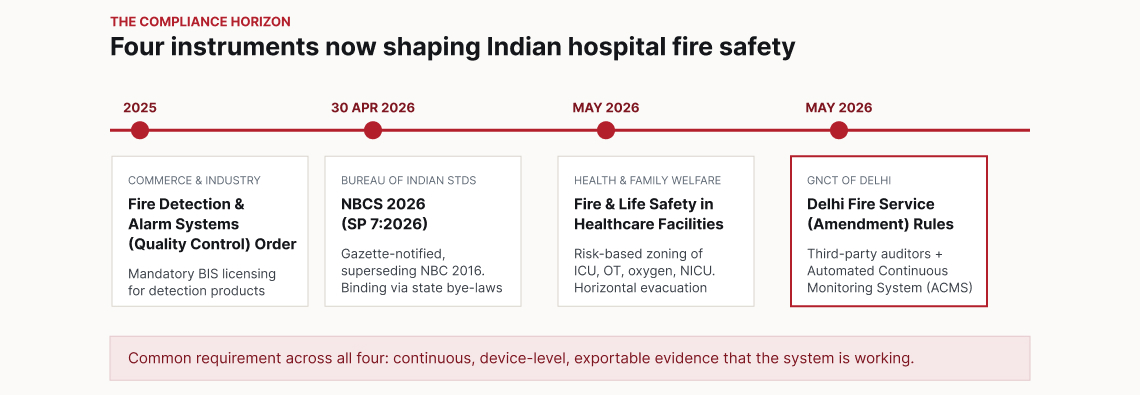
Four regulatory instruments have landed on Indian hospitals in under eighteen months. Strip away the detail and every one of them asks the same question can you show me, device by device and continuously, that this system is working?
A future-proof hospital fire alarm system is one whose architecture can still satisfy a regulator a decade from now. India is shifting from one-time Fire NOC approval towards continuous, digitally-evidenced compliance: risk-zoned detection, third-party audits and automated monitoring. Systems that can identify every device individually, supervise themselves continuously and produce their own audit trail will keep pace. Systems that cannot will need replacing.
The fire alarm panel a hospital commissions this year will still be running in 2040. Very few things a hospital buys have that kind of lifespan not the CT scanner, not the HVAC plant, not the building management software. A fire alarm system is closer to the electrical distribution board: installed once, expanded occasionally, and otherwise left alone until something forces the question.
The rules it has to satisfy will not sit still for fifteen years. And when a fire system becomes obsolete in India, it is very rarely because it stopped detecting fire. It is because it stopped being able to prove anything.
If your immediate concern is a live retrofit rather than a new build, our guide to retrofitting a hospital fire alarm system without clinical disruption covers the sequencing side of this problem. This article deals with the longer question: what to buy so that you are not repeating the exercise in eight years.
It now faces a very different set of expectations. In the space of a single year, four separate instruments have redefined what “compliant” means for an Indian healthcare facility and none of them can be satisfied by a panel that reports “Zone 3, alarm.”
This is the real future-proofing question for hospital administrators and estate heads. Not will this system detect a fire, but will this system still be able to answer the questions a fire officer, a third-party auditor and an NABH assessor will be asking in 2033?
These four instruments arrived from different ministries and different levels of government. They were not co-ordinated. That is precisely what makes the pattern across them worth paying attention to.
Four instruments, four issuing authorities, one shared requirement: continuous, device-level, exportable evidence.
The revised guidelines replace the 2020 framework and introduce a structured, risk-based approach. Hospitals must identify high-risk zones ICUs, operation theatres, oxygen storage areas, electrical installations and neonatal units so that safety measures and monitoring can be targeted at them specifically. Detailed provisions cover fire detection, alarm mechanisms, smoke management, suppression, electrical safety, medical gas pipelines and HVAC integration.
They also recognise something particular to healthcare: hospitals cannot evacuate the way an office tower does. The guidelines call for phased and horizontal evacuation, moving ICU, NICU, PICU and operation theatre patients from one fire-safe compartment to another before any external evacuation is attempted. Governance is formalised through fire safety committees and named fire safety officers, supported by mock drills, audits and continuous monitoring. The document was prepared in consultation with the Directorate General Fire Services, the Bureau of Indian Standards, the School of Planning and Architecture and AIIMS institutions.
So what: horizontal evacuation only works if you know which compartment the fire is in. That is a detection-resolution requirement, not a procedural one.
This is the clearest signal of direction anywhere in Indian fire regulation right now. The rules introduce empanelled third-party fire safety auditors who inspect premises, certify compliance and upload their reports online a function previously performed directly by the Delhi Fire Service with at least five per cent of issued certificates randomly re-inspected every quarter.
More significant for equipment decisions: the rules create an Automated Continuous Monitoring System (ACMS) for identified categories of buildings, under which fire prevention and safety installations remain under continuous digital monitoring and must comply with prescribed technical and cyber security standards. The expanded list of vulnerable occupancies includes institutional buildings above nine metres, which captures most hospitals. Annual online declarations on the operational status of fire safety infrastructure become mandatory, and false declarations attract action under the Act.
So what: a state government has now written continuous digital monitoring — with cybersecurity conditions attached — into law. Fire services are a state subject, so this spreads jurisdiction by jurisdiction rather than nationally. Delhi is usually where it starts.
NBCS 2026 was gazette-notified on 30 April 2026 and superseded NBC 2016 as India’s national reference standard on the same date. Its legal force, though, is indirect: the standard is voluntary at BIS level and becomes binding on a specific building only when a state or municipal authority adopts it into local building bye-laws, or when the state fire service references it through the Fire NOC process. State adoption was still working its way through the system during 2026, and historically takes twelve to twenty-four months.
One change deserves care. NBCS 2026 raises the high-rise trigger for fire and life safety provisions from 15 m to 24 m. For hospitals this is a trap rather than a relief: Delhi’s amended rules treat institutional buildings above nine metres as vulnerable occupancies. A hospital designed to the national threshold can still sit well inside a stricter state one — a point we examine in detail in our compliance guide for buildings above 15 metres.
So what: design to the standard, verify against the bye-law. The national reference has moved; your local authority may not have moved with it yet.
Issued under the Bureau of Indian Standards Act, 2016, the Order makes BIS certification and the Standard Mark mandatory across a broad range of fire detection and alarm products covered by IS/ISO 7240 part standards — control panels, smoke and heat detectors, carbon monoxide detectors, manual call points, audible alarm devices and power supply equipment among them. Implementation is phased by enterprise size, and products made solely for export are exempt.
Historically, India’s fire alarm market operated under IS 2189 a code of practice last revised in 2008 without comprehensive mandatory product certification. The Order closes that gap and, in doing so, turns a design question into a procurement question.
So what: from here on, ask every vendor for their BIS licence status and the exact product categories it covers. Including us. See the checklist below.
Line these four up and a single requirement runs through all of them: continuous, device-level, exportable evidence. Risk-based zoning needs to know which zone. Horizontal evacuation needs to know which compartment. Third-party audit needs a record. ACMS needs a live feed. Annual declarations need something to declare against.
Whether a system can deliver that is decided by its architecture on day one. It is not a feature you add in year eight.
Evidence resolution by architecture conventional reports a circuit, addressable reports a device, wireless addressable AIoT reports a device and its history.
| Architecture | What It Can Tell You | Against the 2026 Direction |
|---|---|---|
| Conventional | A fire exists somewhere on this zone circuit. | Cannot support meaningful risk-based zoning or compartment-level evacuation decisions. |
| Wired Addressable | Which specific device is reporting and its current status. | Resolves location. Continuous external monitoring generally requires an additional gateway or BMS layer. |
| Wireless Addressable + AIoT | Which device is reporting, its status, its health trend, and a continuous record of all of it. | ✔ Device identity, continuous supervision, and the reporting path are native to the architecture. |
This is worth stating plainly, because it is still the first objection raised in Indian hospital tenders. IS/ISO 7240 Part 25 covers components using radio transmission paths, specifying requirements, test methods and performance criteria for radio-frequency components in fire detection and alarm systems, including system-level requirements where components must work together. It was reviewed and confirmed in 2025 and remains current. Part 14 governs design, installation, commissioning and service. We have set out the full picture of how the series relates to India’s legacy code in IS 2189 versus IS/ISO 7240.
A wireless addressable system specified and commissioned against IS/ISO 7240 sits on the same conformity footing as a wired one. The question to ask a vendor is never “is wireless allowed?” — it is “which parts of the series does each component conform to, and what evidence supports that?”
NFire is a wireless addressable AIoT fire alarm system developed by Atigo Enterprises Limited at IIT Gandhinagar Research Park, compliant with IS/ISO 7240 and EN 54 and STQC-tested. Rather than list features, here is how the architecture answers each instrument above.
Device-level addressing combined with multi-criteria sensing — smoke, heat, gas, carbon monoxide and multi-sensor detectors — lets each clinical zone be profiled on its own terms. An oxygen manifold room, an MRI suite, a records store and a hospital kitchen present four different fire signatures and four different false-alarm risks. Zoning that exists only on a drawing is not zoning; it has to exist in the detector selection.
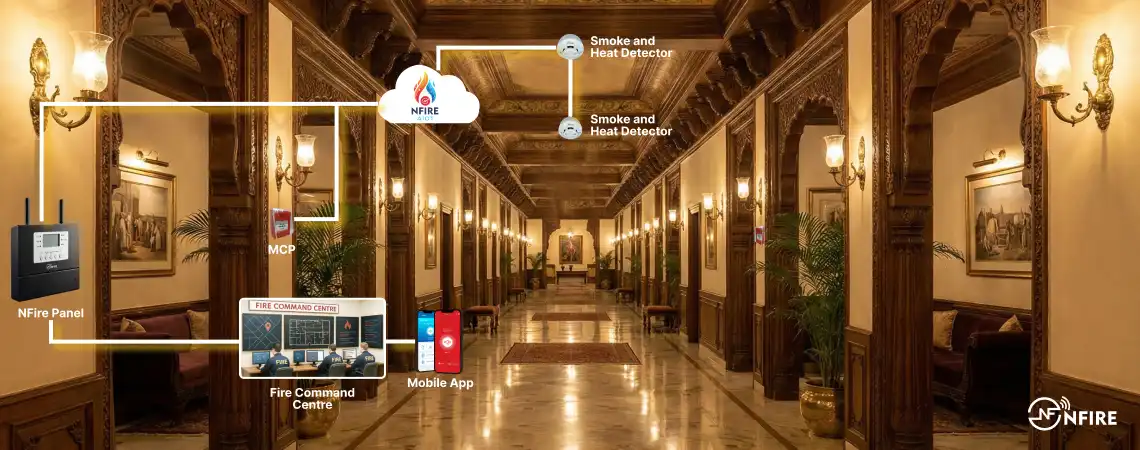
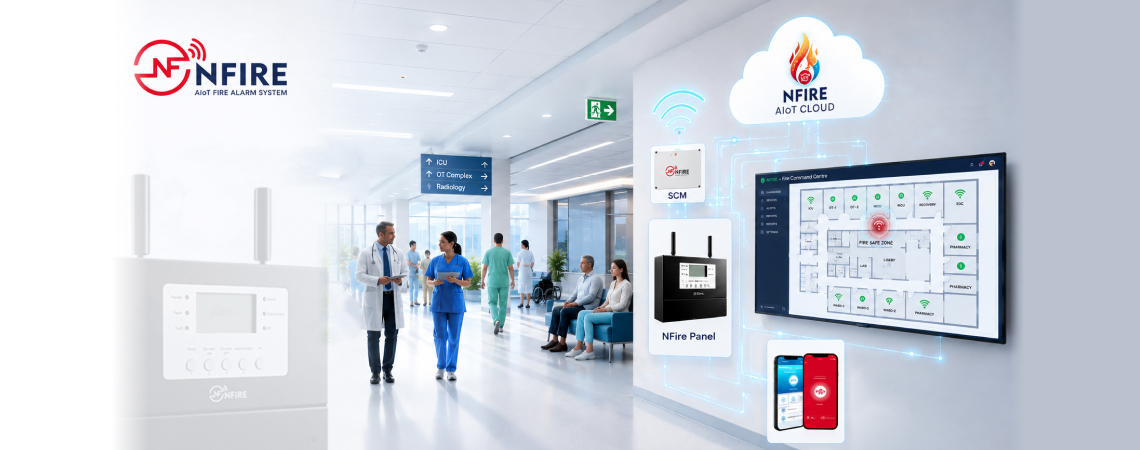
Because every sensor is individually identified, the NFire Command Centre’s real-time graphical monitoring shows staff which compartment is affected — the information horizontal evacuation actually depends on.
Each sensor holds its own supervised link directly to its sensor communication module, rather than relaying through neighbouring devices. Device status is reported continuously, so the monitoring feed and the audit record are by-products of normal operation rather than a bolt-on.
Monitoring traffic is protected with AES-256 encryption and TLS 1.3 in transit.
This one matters most in a hospital: the cloud layer is a monitoring overlay, not a system dependency. Detection, alarm and evacuation signalling sit in the field devices and the panel. If the hospital’s internet connection drops, the fire system does not degrade you lose remote visibility, not protection.
The hybrid HSCM mode delivers wired loop power while signalling remains wireless, for areas where an estate team prefers continuously powered devices.
NFire is compliant with IS/ISO 7240 and EN 54, and STQC-tested. That is a different claim from holding a Notified Body EN 54 certificate, and we do not make the stronger claim. Apply the same scrutiny to every vendor you evaluate — ask for certificate numbers and issuing bodies, and verify them.
Two shifts, both structural rather than promotional. First, testing moves from scheduled and blanket towards exception-based: when every device continuously reports contamination, link quality and battery state, technicians go to the devices that are asking for attention. Second, records move from assembled to generated. Under an audit regime that wants digital logs and annual declarations, a system that produces its own time-stamped device history costs materially less to comply with than one where someone compiles a file each year from paper test sheets.
Wireless devices introduce battery replacement as a recurring planned task that wired loops do not have. That is a genuine trade, not a hidden cost we will pretend away. Two things make it a favourable one in occupied clinical buildings: battery replacement is predictable, low-skill work requiring no hot work, no ceiling opening and no breach of a fire-rated compartment — unlike cable fault-finding; and a supervised system tells you which devices need attention instead of requiring a full sweep. Where an estate team still prefers continuous power in a specific area, HSCM covers it.
Put these to every shortlisted vendor, NFire included. A supplier confident in their position will answer all eight in writing.
What is your BIS licence status under the Fire Detection and Alarm Systems (Quality Control) Order, 2025, and which product categories does it cover?
Which parts of IS/ISO 7240 does each component conform to, and can you supply the corresponding test report or certificate references?
If you claim EN 54, which Notified Body issued the certificate and what is its number? We will verify it.
Demonstrate detection and alarm operating normally with the internet link physically disconnected.
How is monitoring data encrypted in transit and at rest, and in which jurisdiction is it stored?
What is the firmware and security update path across a fifteen-year service life, and who bears the cost?
What does it cost to add fifty devices in year seven including any panel, licence or infrastructure implications?
Can the system export a device-level, time-stamped log in a format a third-party auditor will accept?
India’s fire safety governance has a well-documented weakness: the focus has historically been on obtaining an NOC rather than sustaining compliance, with inspections that are reactive rather than preventive. Every instrument of the last eighteen months pushes in the opposite direction — third-party auditors, automated monitoring, annual declarations, risk-based zoning, periodic audits. The direction of travel is not ambiguous.
A hospital specifying a fire alarm system in 2026 is not choosing between brands. It is choosing between an architecture built for point-in-time inspection and one built for continuous evidence. The first still passes today. The second is still passing in 2040.
Fire systems in India rarely become obsolete because they stop detecting. They become obsolete because they cannot produce evidence.
Not directly. NBCS 2026 (SP 7:2026) was gazette-notified by the Bureau of Indian Standards on 30 April 2026 and superseded NBC 2016 as India’s national reference standard on the same date. It becomes legally enforceable on a specific hospital only when the relevant state government or municipal authority adopts its provisions into local building bye-laws, or when the state fire service references it through the Fire NOC process. State adoption was still in progress through 2026 and historically takes twelve to twenty-four months. Hospitals should design to NBCS 2026 while confirming which framework their local authority currently applies.
They require risk-based zoning. The revised Guidelines on Fire and Life Safety in Healthcare Facilities (2026) replace the 2020 framework, and hospitals must identify high-risk zones such as ICUs, operation theatres, oxygen storage areas, electrical installations and neonatal units for targeted measures and closer monitoring. Detailed provisions cover fire detection, alarm mechanisms, smoke management, suppression, electrical safety, medical gas pipelines and HVAC integration. The guidelines also require phased and horizontal evacuation for ICU, NICU, PICU and operation theatre patients, plus defined governance roles and continuous monitoring.
Yes. Wireless fire detection is a standardised approach, not a workaround. IS/ISO 7240 Part 25 covers components using radio transmission paths and specifies requirements, test methods and performance criteria for radio-frequency components in fire detection and alarm systems, including system-level requirements where components must work together. The standard was reviewed and confirmed in 2025 and remains current. A wireless addressable system specified and commissioned against IS/ISO 7240 sits on the same conformity footing as a wired addressable system. Hospitals should confirm which parts of the series each component conforms to and ask for the supporting test evidence.
An ACMS keeps fire prevention and safety installations under continuous digital monitoring rather than checking them only at inspection time. The concept was formally introduced in India through the Delhi Fire Service (Amendment) Rules, 2025, notified in May 2026, which requires identified categories of buildings to place fire safety installations under continuous digital monitoring meeting prescribed technical and cyber security standards. Because most hospitals fall within the expanded vulnerable-occupancy categories, which include institutional buildings above nine metres, ACMS is directly relevant to healthcare facilities in Delhi and is expected to influence rules drafted in other states.1111
It should not. In a correctly architected system the cloud layer is a monitoring overlay, not an operational dependency. Detection, alarm signalling and evacuation logic sit in the field devices and the fire alarm panel, so the system continues to detect and alarm normally if internet connectivity is lost. The cloud and mobile layers add remote visibility, alerting and audit records on top. Hospitals evaluating any connected fire system should ask the vendor to demonstrate full detection and alarm operation with the network link physically disconnected.
It turns a design question into a procurement gate. Issued by the Ministry of Commerce and Industry under the Bureau of Indian Standards Act, 2016, the Order makes BIS certification and the Standard Mark mandatory across fire detection and alarm products covered by IS/ISO 7240 part standards. Covered items include control panels, smoke and heat detectors, carbon monoxide detectors, manual call points, audible alarm devices and power supply equipment. Implementation is phased by enterprise size, and export-only products are exempt. Hospital tender documents should ask every vendor for their BIS licence status and the exact product categories covered.
In most occupied clinical buildings, yes, but it is a trade rather than a straight saving. Wireless addressable systems remove cable fault-finding, conduit access and ceiling opening from routine maintenance, and continuous device-level self-supervision allows scheduled blanket testing to shift towards exception-based attention on the specific devices reporting a problem. Against that, wireless devices introduce battery replacement as a recurring planned task that wired loops do not have. Battery replacement is predictable, low-skill work that does not require hot work or opening fire-rated compartments, and a supervised system identifies which devices need attention rather than requiring a full sweep.