
For MEP consultants, fire consultants and architects: the new standard is notified and in force, but the compliance burden has quietly moved onto the design table. Here is how to keep your detection specification defensible.
On 30 April 2026, the Bureau of Indian Standards notified the National Building Construction Standards 2026 (SP 7:2026) through the Gazette of India. On the same day, the National Building Code 2016 was withdrawn. For everyone who designs, services or signs off on a building’s fire protection, the document you have referenced for the last decade is gone — and the one that replaced it asks a different question of you.
That question is not “did you copy the table correctly?” It is “can you show that this design achieves the outcome?” NBCS 2026 leans further into performance-oriented language, and for the consultant that subtle wording change lands squarely on the detection layer you specify. This brief walks through what actually changed, where the real compliance trigger sits for the alteration and retrofit work most consultants handle, and how to write a detection specification that survives both an authority’s scrutiny and your own professional indemnity.
2026 — NBCS notified,
NBC 2016 withdrawn
4th revision since 1970
Section 3.3 alteration trigger
Enforced via bye-laws & Fire NOC
01 / What actually changed
It is worth being precise here, because the loose language already circulating online cuts both ways. NBCS 2026 is real, gazetted and current: it is the fourth revision of SP 7, issued under Rule 15(1) of the BIS Rules, 2018, and it replaces NBC 2016 as India’s central building reference. Treating it as “still just a draft” is now wrong.
But the opposite overstatement is equally wrong. NBCS 2026 does not independently carry the force of law. Building bye-laws and fire services are constitutional State and municipal subjects, and that has been true of every NBC edition since 1970 — the code’s authority has always been borrowed from state adoption, never inherent. The BIS Fire Safety Committee itself has publicly framed NBCS as a guiding framework, with occupant and structural safety remaining the responsibility of states and municipalities. The standard’s own text notes that implementation depends on adoption by the concerned parties.
Two practical consequences follow for anyone preparing a submission today. First, several states and corporations still reference NBC 2016 in their bye-laws and will continue to until they revise — so the first question on any project is which framework your authority having jurisdiction currently applies. Second, NBCS 2026 shifts a number of provisions from prescriptive “shall” toward advisory “should,” including in fire and life safety. That is not a loosening of the safety bar; the required outcomes are broadly equal to or stricter than before. It is a transfer of responsibility — from a code that told you exactly what to draw, to a designer who must now demonstrate the result.
Before you cite either code on a drawing, confirm in writing with the local fire authority whether NBCS 2026 or NBC 2016 governs the project. The transition is live and uneven across states — a mismatch here is the easiest way to lose a Fire NOC submission.
For most consultants, the day-to-day compliance event is not a greenfield tower — it is an existing building being altered, extended, repartitioned or repurposed. NBCS 2026 Part F addresses this directly in Section 3.3, and it is the clause worth knowing by heart.
In plain terms: an existing building generally need not be brought up to current requirements unless it is altered, or the local authority judges it a hazard to its occupants or to adjacent property. But once work begins, the standard sets a clear line. Any addition, alteration, partitioning that affects travel distance, change in the typology of occupancy, or densification of an existing occupancy — over a floor area exceeding 1,000 m² — requires the approval of the local fire authority. Crucially, that work must conform to the safety requirements applied to new buildings, and it must not bring fire and life safety below the level that existed before.
Read that last requirement carefully, because it is where detection design becomes unavoidable. A renovation that re-zones floors, moves partitions or increases occupant density changes the building’s detection logic. If the existing system cannot pinpoint where an event is occurring across the altered layout, demonstrating “no reduction in life safety” becomes an argument you cannot easily win on paper.
Section 3.3 effectively asks the designer to prove an outcome across a changed floor plate. Device-level addressable detection — where every detector reports its own identity and location — produces exactly the evidence that argument needs. A zone-based conventional system, which can only say “something, somewhere in this zone,” leaves the gap the clause is designed to close.
The move toward performance-oriented compliance is good news for anyone specifying modern detection — provided the system can generate the evidence. Under a prescriptive regime, a detector was a checkbox. Under a performance regime, the detector is part of a safety case you are asked to justify: it must detect early, distinguish a real event from a nuisance, and produce a record that an authority can review.
This is where AIoT detection earns its place in a specification, and it is worth separating the marketing term from what it actually does for you on a submission:
Sensors that combine smoke, heat, gas and CO inputs and apply on-device intelligence can discriminate between a genuine incipient fire and the steam, dust or cooking aerosols that plague single-criterion detectors. Fewer nuisance alarms is not just an operational convenience — it is a defensible argument that the system will be trusted and acted upon, which is itself a life-safety outcome.
An IoT-connected system logs device health, environmental trends and every event with a timestamp and a location. For the consultant, that record is the raw material of a performance justification and of an annual Fire NOC renewal — the difference between asserting that a system works and showing it.
Analytics that track the rate of change in a sensed environment can surface a developing condition before a fixed threshold trips. In a performance framing, demonstrably earlier detection directly supports the egress-time and tenability arguments that sit at the heart of a fire engineering case.
NBCS 2026 specifies the detection outcome, not the cabling method. That leaves the routing decision genuinely open to the designer and on alteration and retrofit work, it is often the decision that determines whether a project is buildable on programme at all.
| Design Consideration | Conventional (Zone) | Wired Addressable | Wireless Addressable AIoT |
|---|---|---|---|
| Location Precision | ◐ Zone only | ✔ Device level | ✔ Device level + Live Map |
| Section 3.3 Retrofit Fit | ✖ Poor | ◐ Disruptive (new cabling) | ✔ Minimal disruption |
| Structural / Heritage Impact | ✖ Chasing required | ✖ Chasing required | ✔ No detection chasing |
| Installation on Occupied Site | ✖ Difficult | ◐ Hard / Phased | ✔ Feasible in stages |
| Nuisance Alarm Handling | ◐ Limited | ✔ Better | ✔ Multi-criteria + Analytics |
| Monitoring & Audit Record | ✖ Manual | ◐ Panel-based | ✔ Continuous, Cloud & Exportable |
| Documentation for Fire NOC | ◐ Sparse | ◐ Moderate | ✔ Rich, Timestamped Documentation |
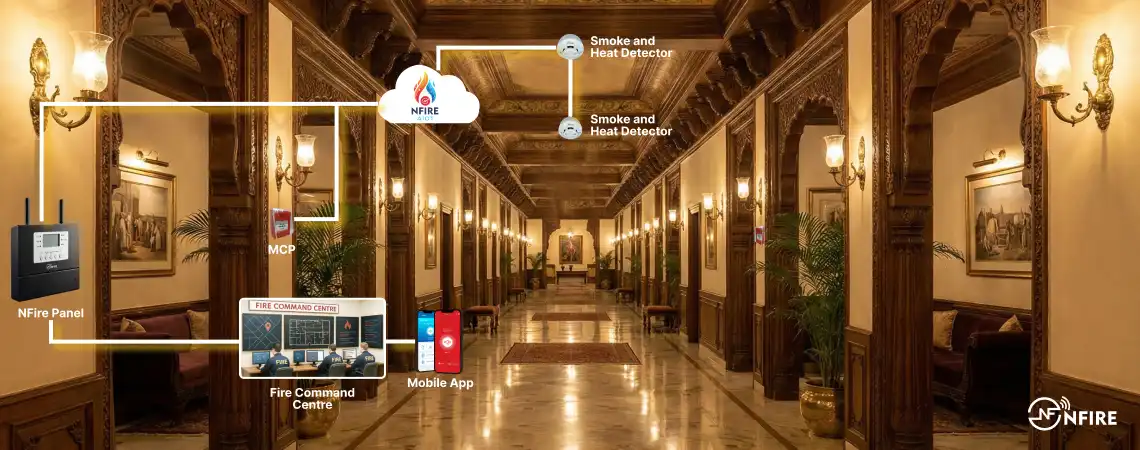
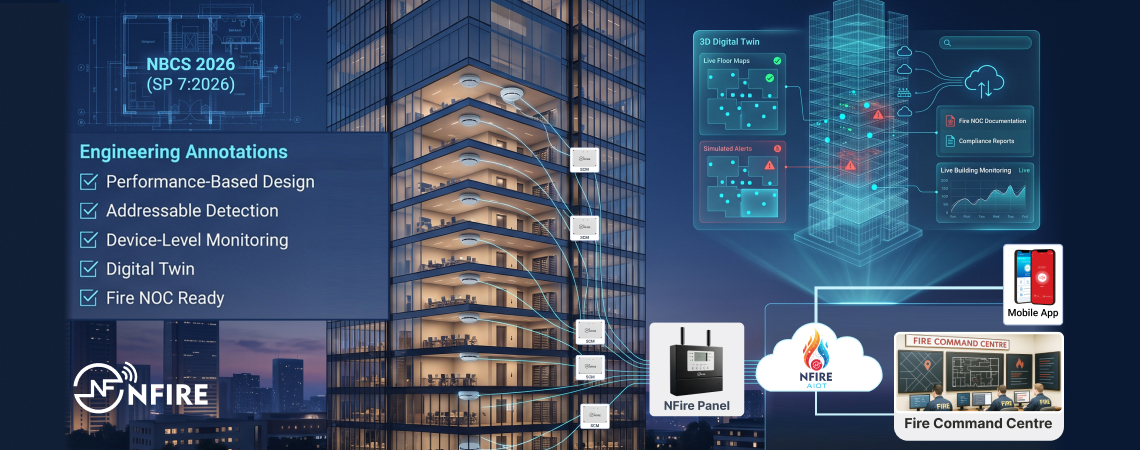
This is the gap NFire was built to fill. Developed by Atigo Enterprises Limited — and positioned as India’s first wireless addressable AIoT fire alarm system — NFire keeps full device-level addressability without the cable runs that make detection upgrades so painful in occupied, operational or heritage buildings.
It matters to specify this correctly, because the architecture is frequently mis-described. NFire uses direct sensor-to-SCM connectivity — each detector communicates directly with a Sensor Control Module, not via a detector-to-detector mesh. Two SCM variants give the designer routing flexibility: the wireless SCM, where detectors connect over a secured wireless link, and the hybrid HSCM with its Power Distribution Unit, which delivers wired loop power to the detectors while the signalling itself remains wireless. The HSCM is a power-routing choice, not a retrofit into legacy detection wiring.
Above the SCMs sit the Fire Alarm Control Server and the Fire Alarm Display Panel, communicating over NFire’s RTNAP protocol, with the NFire Command Centre providing multi-user, real-time graphical monitoring and a 2D/3D Digital Twin of the protected estate. The NFire Connect mobile app extends incident coordination and remote oversight, and the platform secures its links with AES-256 encryption and TLS 1.3. For the specifier, that adds up to addressable detection, a defensible monitoring record, and an install that does not fight the building.
“Is wireless robust enough?” and “what about cyber risk?” are fair questions to put in any spec. The answers belong in the submission: supervised wireless links with monitored device health, battery and signal status surfaced continuously, and transport secured with AES-256 and TLS 1.3. Specify the evidence you want to see, and require the manufacturer to demonstrate it.
Whatever system you ultimately select, NBCS 2026’s performance framing rewards specifications that name outcomes and demand evidence rather than listing part numbers. The following items keep a detection specification — and the consultant who signs it — on firm ground.
// adapt to project, occupancy and AHJ
Used this way, the standard’s shift from prescription to performance stops being a burden and becomes leverage. A specification built on named outcomes and evidence is harder to challenge, faster to clear through a Fire NOC, and far easier to defend if it is ever questioned. The detection layer is no longer a line item copied from a table — it is a design decision you own. Specify it so it holds up.
Book a technical walkthrough of NFire’s wireless addressable AIoT architecture, compliance documentation and Digital Twin monitoring — built for the alteration and retrofit work consultants face most.
NBCS 2026 was notified by BIS through the Gazette of India on 30 April 2026 and is in force as the national reference standard, replacing NBC 2016. However, it does not independently carry the force of law. Fire services and building bye-laws are constitutionally State and municipal subjects, so legal enforceability flows from each state adopting NBCS 2026 into its bye-laws and applying it through the Fire NOC process. Several states still reference NBC 2016 until they update, so confirm which framework your local authority currently applies.
Under Section 3.3 of NBCS 2026 Part F, an existing building generally need not comply with current requirements unless it is altered or judged a hazard. When alterations, additions, partitioning that affects travel distance, a change in occupancy typology, or densification occur over a floor area exceeding 1,000 sq m, the work requires the local fire authority’s approval and must conform to new-building safety requirements without lowering fire and life safety below the pre-existing level.
NBCS 2026 Part F continues to require automatic fire detection and alarm systems for applicable buildings and references addressable detection with components per IS 2189 for higher-risk and larger occupancies. The shift toward performance-oriented language means designers increasingly demonstrate that detection achieves the required life-safety outcome — which favours addressable systems that identify the exact device in alarm rather than a broad zone.
Under a performance-based regime the specifier must defend the detection design on outcomes. Addressable device-level location data, multi-criteria sensing, continuous monitoring and an auditable event record provide the documentation needed for Fire NOC submissions and design justification. A wireless approach also avoids cutting chases and re-cabling occupied buildings, lowering programme and structural risk on the Section 3.3 alteration projects consultants handle most.
NFire is described as compliant with IS/ISO 7240 and EN54. As good practice, request current test and compliance documentation from the manufacturer and confirm acceptance with the authority having jurisdiction before relying on any product in a design submission.