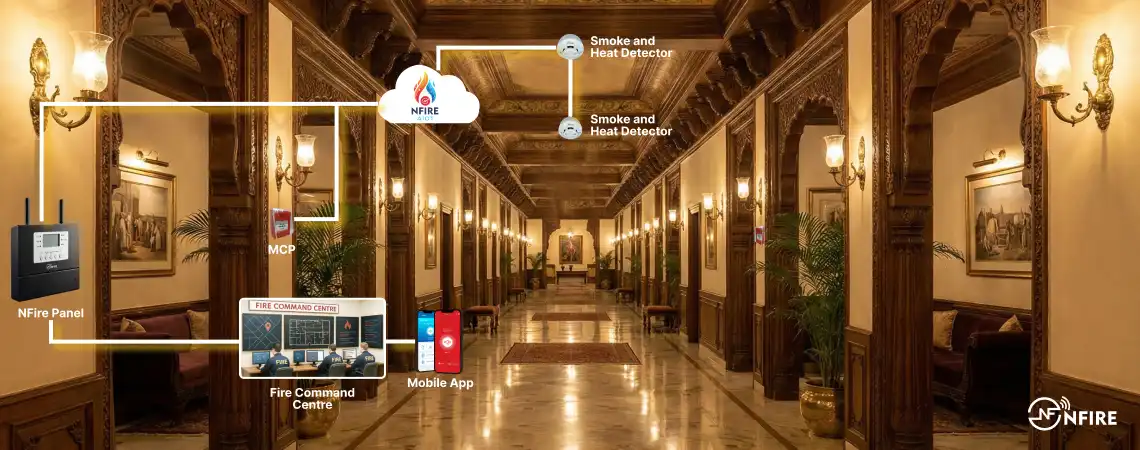


Retrofit fire projects don’t fail due to poor design—they fail because traditional fire alarm systems weren’t designed to accommodate the real-world constraints of retrofit projects.
This creates a critical challenge for MEP and fire consultants:
👉 How do you upgrade fire safety systems without disrupting the building?
AIoT Wireless fire alarm systems Like NFire.
Unlike new construction, retrofit projects come with constraints that directly impact system design and execution:
1. Structural Limitations
Routing cables requires breaking walls, ceilings, and finishes—often restricted in older or heritage buildings.
2. Operational Disruption
Facilities like hospitals and industrial plants cannot afford shutdowns for installation work.
3. Compliance Gaps
Legacy systems often fail to meet modern requirements like addressability, integration, and audit-ready monitoring.
4. Scalability Issues
Expanding wired systems later involves additional cabling, cost, and downtime.
5. Project Risk and Delays
Complex installations increase timelines, coordination challenges, and execution risk.
👉 The result: higher costs, compromised designs, and increased liability for consultants.
Wireless fire alarm systems are not simply “wire-free” versions of traditional systems.
They represent a fundamental shift in how fire safety systems are:
For consultants, this changes the approach from infrastructure-heavy deployment → AIot intelligent system specification.
Understanding the architecture helps consultants confidently specify wireless systems in retrofit projects.
Wireless systems use intelligent, addressable sensors such as:
Each device has a unique address, enabling precise location tracking and faster response.
Advanced platforms go beyond threshold detection, enabling pre-fire risk identification through continuous monitoring.
Instead of physical loops, devices communicate through secure wireless networks:
This allows non-invasive installation, especially in occupied or sensitive environments.
Wireless systems support multiple deployment strategies:
👉 Consultants can design zone-wise deployment strategies based on building constraints.
Alarm & Other Event Data.
This marks a shift from reactive alarms → predictive fire intelligence.
Modern AIot wireless systems Like Nfire don’t just detect—they act:
👉 Ensures faster, coordinated emergency response.
Advanced AIot platforms Like Nfire provide complete visibility through:
This enables audit-ready compliance and remote system management.
| Retrofit Challenge | Nfire AIoT Wireless Solution |
|---|---|
| No shutdown allowed | Non-invasive installation |
| Structural limitations | No drilling or cabling |
| Future expansion | Easy scalability |
| Compliance requirements | Meets NBCS 2026 standards |
👉 Wireless systems eliminate the biggest barriers to retrofit success.
NFire AIoT Safety Intelligence Platform is designed specifically for real-world retrofit challenges where traditional systems fail.
👉 For consultants, this means reduced design risk, faster execution, and future-proof system performance.
Hospitals
Upgrade fire systems without disrupting patient care; precise room-level detection enables targeted response.
Industrial Facilities
Protect machinery, conveyor belts, and cable trays without halting operations.
Heritage Buildings
Enable non-invasive installation while preserving architectural integrity.
Hotels
Room-level detection and Digital Twin visibility support safe, phased evacuations.
To see how NFire AIoT meets NBCS 2026, IS/ISO 7240, and EN54 requirements in full technical detail,
read our NFire AIoT Safety Intelligence Platform guide for MEP and fire consultants.
AIoT Wireless fire alarm systems combine:
For retrofit projects, this is not just an upgrade—it is a transformation of the building’s entire safety ecosystem.
Wireless fire alarm systems have evolved from an alternative option to the default strategy for retrofit projects.
For MEP engineers and fire consultants, the shift is clear:
Platforms like NFire AIoT Intelligence Platform don’t just meet compliance—they define the future of fire safety in modern buildings.
If your retrofit project cannot afford downtime, compliance gaps, or redesign delays, wireless AIoT fire alarm systems are no longer optional.
👉 Talk to our engineering team today to evaluate your project and design a future-ready fire safety system.
A wireless fire alarm system is an addressable fire detection system where sensors communicate with control panels using secure wireless protocols instead of physical cables. These systems enable faster installation, flexible deployment, and real-time monitoring.
Wireless systems are ideal for retrofit projects because they eliminate the need for drilling, cabling, and structural modifications. This allows installation in occupied buildings like hospitals, hotels, and factories without disrupting operations.
Yes, modern wireless fire alarm systems are designed to meet NBCS 2026 requirements, including addressable detection, remote monitoring, and integration with building systems such as HVAC and access control.
Wireless fire alarm systems use secure, redundant communication protocols such as mesh networks, ensuring high reliability. Many systems also support hybrid configurations with wired power and wireless communication for added fault tolerance.
Yes, advanced wireless systems support integration with MEP systems using protocols like BACnet/IP, Modbus, and TCP/IP. This enables automated responses such as HVAC shutdown, smoke control, and access control coordination during emergencies.
Hybrid systems provide additional reliability through loop fault monitoring while maintaining flexibility.
Yes, wireless systems are highly scalable and can cover large buildings, campuses, and industrial facilities. Additional devices can be added without rewiring, making them ideal for expanding infrastructure.