
In most buildings, a fire alarm signals people to act.
In hospitals, it’s different.
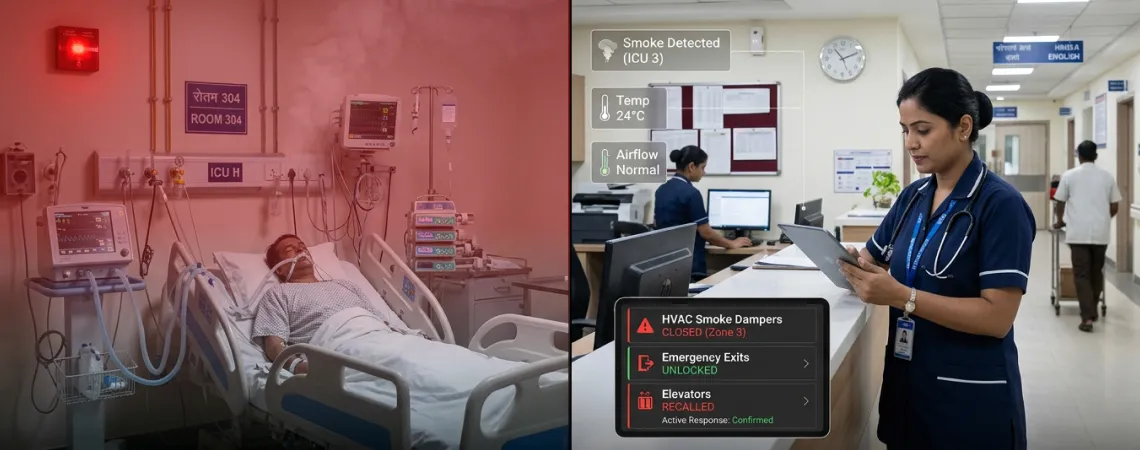
Patients in ICUs, operating theatres, and neonatal units often cannot move at all.
They don’t respond to alarms.
They depend entirely on systems—and people—to respond for them.
And that’s where traditional fire safety begins to fail.
Hospitals are among the most complex fire safety environments in the world.
Inside a single facility, you’ll find:
Evacuation is not always possible. In many cases, containment and response speed are the only ways to save lives.
Yet, most hospitals still rely on outdated fire alarm systems built around human intervention and delayed action
Between 2011 and 2024, nearly 180 patients lost their lives in major hospital fire incidents across India.
These tragedies reveal a pattern:
Despite differences in scale, these incidents share the same critical failures:
The issue isn’t just fire—it’s how slowly systems respond to it.
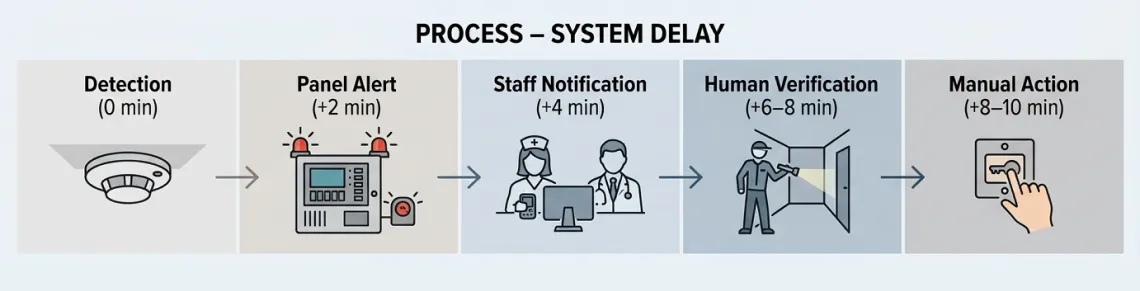
Detection → Panel alert → Staff notification → Human verification → Manual action
This process takes 8 to 10 minutes at minimum.
In a hospital environment, that delay allows smoke—the leading cause of fire deaths—to spread rapidly into patient areas.
Even when alarms are triggered:
Fire alarms operate in isolation instead of controlling the building.
Loud, facility-wide alarms:
The result is chaos—not control.
Upgrading traditional systems is equally challenging:
Maintenance remains reactive, with teams constantly responding to breakdowns instead of preventing them.
In a hospital fire, there is no buffer time.
A delay of even a minute can mean:
For non-ambulatory patients, there is no chance to escape.
Fire safety, therefore, cannot depend on how fast humans react.
It must depend on how fast systems act.
Modern hospital safety demands a fundamental shift:
Because in critical care environments:
A system that waits for human intervention is already too late.
This is where AIoT (Artificial Intelligence of Things) is redefining fire safety.
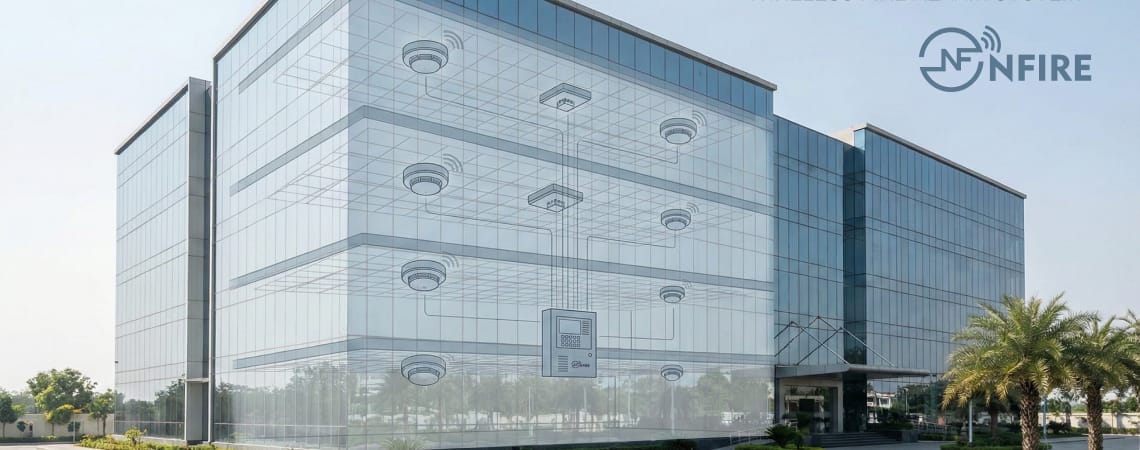
NFire replaces traditional alarms with a real-time decision engine, designed specifically for healthcare environments.
By combining multi-sensor detection, edge computing, and system integration, it transforms fire safety into an active protection mechanism.
The system processes data locally and executes response protocols within 60 seconds—without human intervention.
In the event of a genuine threat, it automatically:
This ensures that fire and smoke are contained before they can escalate.
NFire eliminates unnecessary chaos through silent alerting systems:
It also adapts to different hospital zones:
The result is accurate detection without false panic.
Meeting regulatory standards becomes seamless.
The system:
No manual paperwork. No last-minute audit stress.
Hospitals continue operating without interruption.
Zero-Disruption Installation
Using contextual intelligence, the system analyzes:
This reduces false alarms by up to 90%, eliminating unnecessary evacuations and operational disruption.
The platform continuously monitors system health:
Facility teams move from reactive firefighting to predictive control.
With AIoT, fire safety becomes:
Threats are detected earlier.
Responses happen instantly.
Risks are contained before they escalate.
Most importantly, patients remain protected without disruption to care.
Hospitals cannot rely on systems that wait.
Because in environments where patients cannot move,
fire safety must act faster than the fire itself.
Don’t rely on outdated systems that depend on human response time.
Take the next step today:
Upgrade your hospital from basic notification to intelligent, life-saving protection—without disrupting critical care.