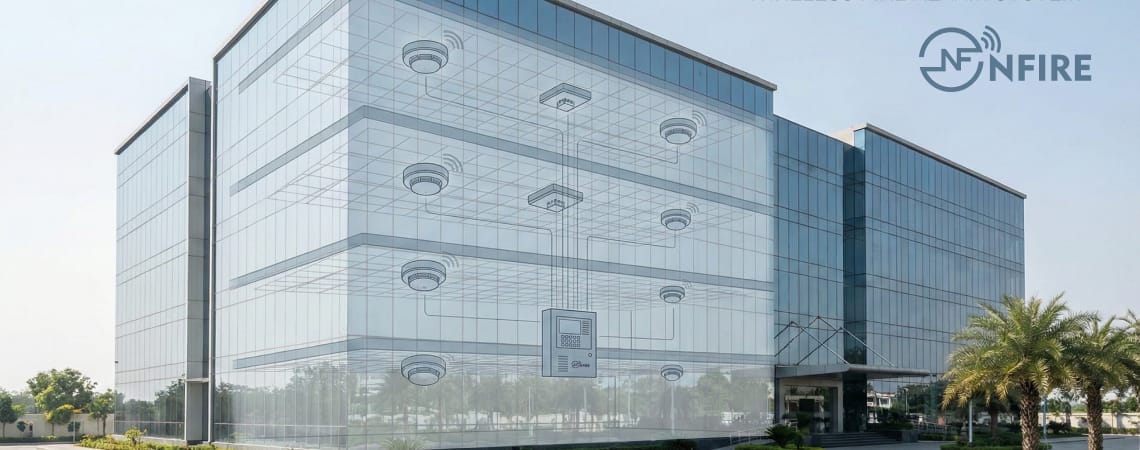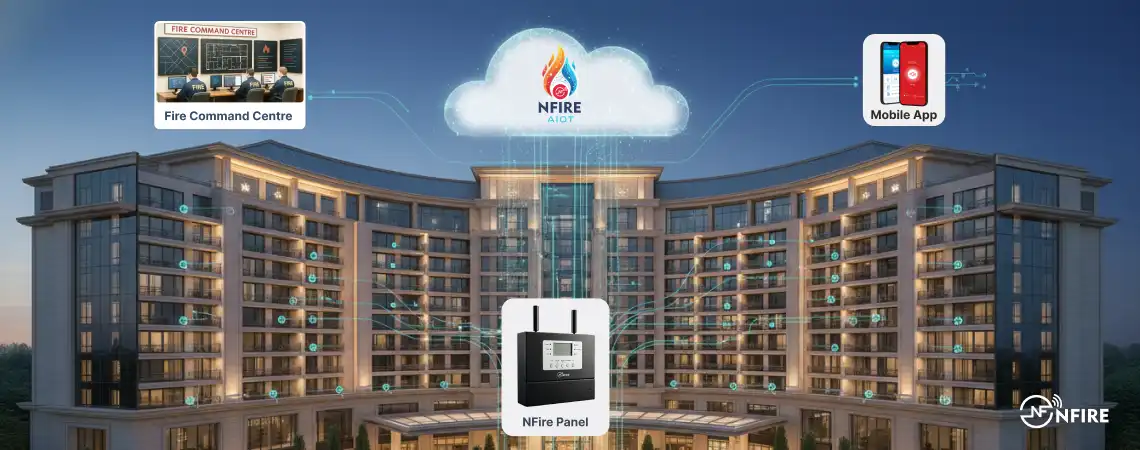

Quick Answer: Retrofitting a campus fire alarm system without disrupting operations is possible — and increasingly necessary. Wireless addressable fire alarm systems, using wireless detectors connected directly to Smart Communication Module (SCM) gateways, eliminate the need for new cabling infrastructure entirely. Paired with an AIoT cloud protection platform like NFire and a secure mobile app like NFire Connect, this architecture delivers IS/ISO 7240 and EN54 compliant, future-proof fire safety across multi-building campuses in India — with installation measured in hours, not weeks.

Imagine a sprawling university campus, a multi-block industrial park, or a hospital complex built a decade ago. The fire alarm system — once considered adequate — is now a patchwork of aging conventional zone panels, corroding cable runs hidden behind false ceilings, and detectors that nobody trusts. An upgrade decision triggers an immediate question: how do you transform safety infrastructure across dozens of buildings, occupied 24/7, without tearing apart walls, disrupting operations, and spending a fortune — only to end up with technology that is obsolete before it is even commissioned?
This is not a hypothetical. It is the lived reality of thousands of facility managers across India today — in hospitals, IT campuses, manufacturing plants, educational institutions, and smart city developments that inherited legacy fire safety systems from a different era. The good news is that the answer has arrived, and it does not involve a single metre of new conduit
India recorded 7,566 fire-related accidents in 2022, resulting in 7,435 deaths, according to National Crime Records Bureau (NCRB) data. Many of these tragedies occurred in buildings where fire detection systems either failed to trigger in time or were absent altogether. National Building Construction Standards (NBCS) of India 2016 and IS/ISO 7240 standards mandate robust automatic fire alarm systems for commercial, industrial, and institutional occupancies — yet a vast proportion of India’s existing building stock was constructed under earlier or less stringent codes and has never been properly upgraded.
Complex retrofitting in older buildings is recognised as a primary market restraint, even as the global fire alarm equipment market — valued at USD 7.02 billion in 2024 — is projected to reach USD 13.82 billion by 2034. That gap between market growth and actual installation rates represents millions of under-protected buildings globally, and in India the challenge is especially acute across aging institutional campuses, industrial estates, and multi-phase commercial developments.
When facility managers are asked why they have not upgraded, the answers are almost always the same: disruption, cost of cabling, aesthetics, and the fear of technology lock-in. These are legitimate concerns — and they are precisely the concerns that modern wireless addressable architecture is designed to eliminate.
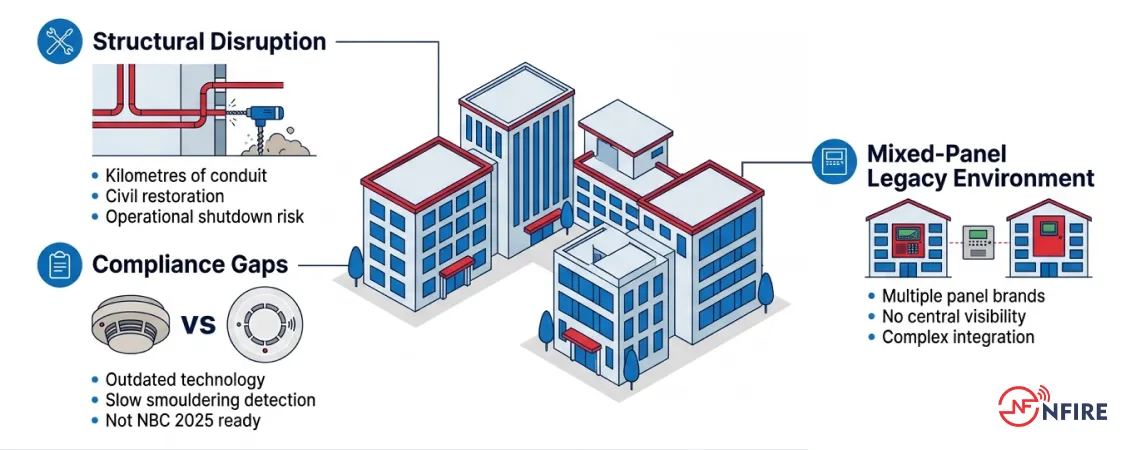
Retrofitting a fire alarm system across a multi-building campus is a fundamentally different challenge from installing one in a new construction. Understanding these challenges clearly is the first step to solving them.
A traditional wired addressable system requires dedicated conduit runs — often kilometres of them across a campus — through walls, floors, and ceilings. Retrofitting electrical infrastructure in occupied buildings is difficult at best; in buildings where exposed trunking is aesthetically unacceptable and concealed routes require extensive civil restoration, it becomes practically impossible at scale. Hospitals cannot shut wards. Factories cannot idle production lines. Universities cannot vacate classrooms for weeks on end.
Buildings added over time — each with its own fire alarm panel brand and infrastructure — are especially common in college campuses, municipal buildings, transportation hubs, and facilities where construction happened in phases. Integrating these disparate systems into a unified campus-wide network, without replacing every panel simultaneously, is a significant engineering and commercial challenge.
Older systems may use outdated detection technology that is no longer reliable or standards-compliant. Conventional ionization smoke detectors, for example, may respond 15 to 50 minutes slower to smouldering fires compared to modern photoelectric or multi-criteria detectors. IS/ISO 7240 and NBCS 2026-ready requirements impose specific standards on detector technology, addressability, and system response times — standards that legacy zone-based systems simply cannot meet without a fundamental technology change.
Facility managers who have watched previous upgrades become obsolete within five years are understandably reluctant to commit to another technology cycle that locks them into a proprietary ecosystem. The question they are really asking is not “what does this system do today?” but “will this investment still be relevant in 2035?”
Upgrading a multi-building campus doesn’t have to be a logistical nightmare. Before you commit to a technology, audit your current infrastructure against the latest IS/ISO 7240 and NBCS 2026 safety standards.
Download our Essential Fire Safety Retrofit Checklist to identify compliance gaps and plan your wireless transition without breaking a single wall.
The introduction of fully wireless addressable fire alarm systems — designed specifically for campus-scale deployments — addresses every one of these challenges simultaneously, without compromising detection quality or regulatory compliance.
Wireless detectors — smoke, heat, gas, CO, and multi-sensor types — are battery-operated, self-addressing devices that communicate over dedicated, interference-managed radio frequencies. They can be installed in any location: false ceilings, open plant areas, heritage corridors, server rooms. Wireless alarm systems are the ideal solution for high-rise and multi-building campuses, as multiple buildings and levels can be brought under a unified system without hazardous cable runs or civil restoration works.
A wireless detector installation typically takes minutes per device. An entire floor can be equipped and commissioned in a single working day. For a hospital that cannot vacate a critical care unit or a factory that cannot stop a production shift, this is not a convenience — it is a prerequisite.
Addressable fire alarm systems assign a unique electronic identity to every device on the network. The fire alarm panel knows not just that “Zone 3 has activated” but precisely that “Smoke Detector 47, Server Room B, Building 4, First Floor” has reached alarm threshold. This granularity is what IS/ISO 7240 demands and what saves the critical response minutes that determine whether a fire is contained or catastrophic.
Adding a new building, floor, or wing to a campus wireless system requires no cable pulling, no panel reconfiguration, and no disruption to the existing network. New wireless detectors are paired to the system and appear on the monitoring dashboard within minutes — making the system inherently future-ready for campus expansion.
| Factor | Traditional Wired Addressable | NFire Wireless Addressable |
|---|---|---|
| Installation method | Dedicated cable conduit through structure | Battery-powered detectors, no cabling |
| Installation time (per floor) | Days to weeks (civil works required) | Hours (no civil works) |
| Operational disruption | High — areas must be vacated | Minimal — live commissioning |
| Scalability | Complex — new cable runs required | Simple — pair and commission |
| Legacy system integration | Difficult — panel replacement usually needed | Hybrid-ready via Modbus/BACnet/IP |
| IS/ISO 7240 compliance | Yes (when correctly installed) | Yes — with addressable precision |
| EN54 compliance | Varies by manufacturer | Yes (NFire) |
| AIoT / cloud capability | Rarely native | Native (NFire AIoT platform) |
| Remote monitoring | Panel-dependent, on-site | Cloud + mobile, anywhere |
| Cost of retrofit in existing building | High (civil + material + labour) | Significantly lower (devices + commissioning) |
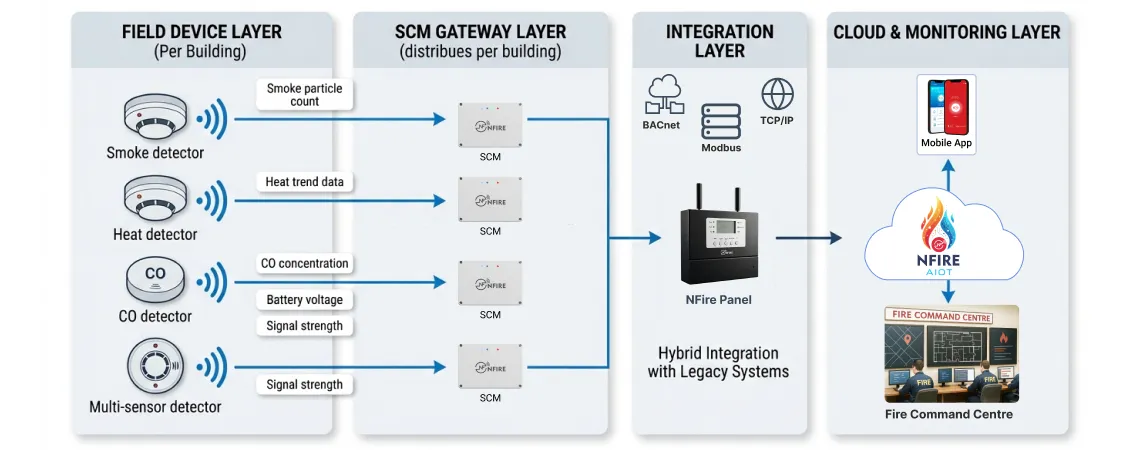
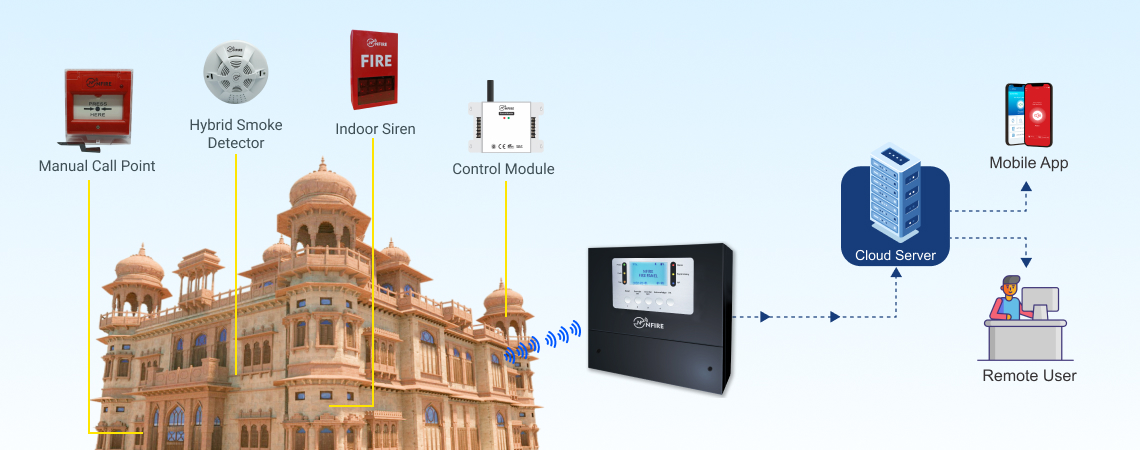
The Smart Communication Module (SCM) Gateway is the core architectural component that makes campus-scale wireless fire alarm deployment practical. It is the direct bridge between field-level wireless detectors and the fire alarm panel or cloud monitoring infrastructure — and understanding how it works clarifies why this architecture is so well suited to retrofitting.
Think of the SCM as a zone-level wireless controller. In a campus deployment, multiple SCM gateways are distributed across buildings and zones. Each SCM manages a cluster of wireless detectors within its radio coverage area, continuously collecting real-time sensor data — smoke particle counts, heat trends, CO concentration, battery voltage, signal quality — and transmitting structured telemetry upstream to the fire alarm panel and the NFire AIoT Cloud platform simultaneously.
Each SCM gateway with its associated wireless detectors forms a self-contained zone that can be installed and commissioned independently. A campus with 20 buildings can be retrofitted building-by-building, with each completed zone going live on the central monitoring platform immediately — rather than waiting for the entire campus to be complete before any protection is active.
Each wireless detector in the NFire architecture communicates directly and exclusively with its designated SCM gateway — not through intermediate hops. This direct connectivity model ensures every detector’s data reaches the gateway on a clean, dedicated channel, eliminating latency variability and potential interference that can occur in multi-hop network topologies. For a life-safety application, consistent and predictable communication performance is non-negotiable.
SCM gateways supporting Modbus, BACnet/IP, and TCP/IP can interface with existing legacy panels in parallel — enabling a hybrid approach where the new wireless system operates alongside old infrastructure during the transition, rather than requiring an immediate hard cutover. For large campuses where a phased multi-year upgrade is the only financially viable path, this interoperability is critical.
A fire alarm system commissioned in 2025 must remain compliant, effective, and supported through at least 2035. Technology choices made today must account for how fire safety standards, building management systems, and detection science will evolve over the next decade. Four principles should guide every decision.
IS/ISO 7240 is the Indian and international standard governing fire detection and alarm systems, specifying requirements for system design, device performance, and installation. EN54 is the European standard series for fire detection components — widely regarded as one of the most rigorous performance benchmarks globally. Systems compliant with both standards offer a meaningful quality guarantee beyond domestic certification alone, and are positioned for operation in multinational campuses and joint-venture facilities where both standards may be contractually required.
India’s National Building Code is increasingly aligned with international best practice on fire detection response times, addressability, and monitoring requirements. Systems that are NBCS 2026-ready are not just compliant today — they are positioned to remain compliant through the next revision cycle, removing the risk of costly retrofit-of-a-retrofit scenarios.
Proprietary systems that cannot communicate with building management systems (BMS), HVAC controllers, access control, or CCTV platforms become isolated safety islands. Systems built on open protocols — Modbus, BACnet/IP, TCP/IP — can participate in the evolving smart building ecosystem, allowing fire events to automatically trigger ventilation shutdown, elevator recall, access door release, and emergency lighting activation without bespoke integration engineering.
The most future-proof fire safety architecture is one where intelligence operates at multiple levels simultaneously: at the detector (environmental compensation, multi-criteria sensing), at the gateway (local decision logic, edge analytics), and in the cloud (longitudinal trend analysis, predictive maintenance, multi-site fleet management). This layered design ensures the system remains operational and protective even during internet outages, while delivering the full power of AI-driven analytics when cloud connectivity is available.
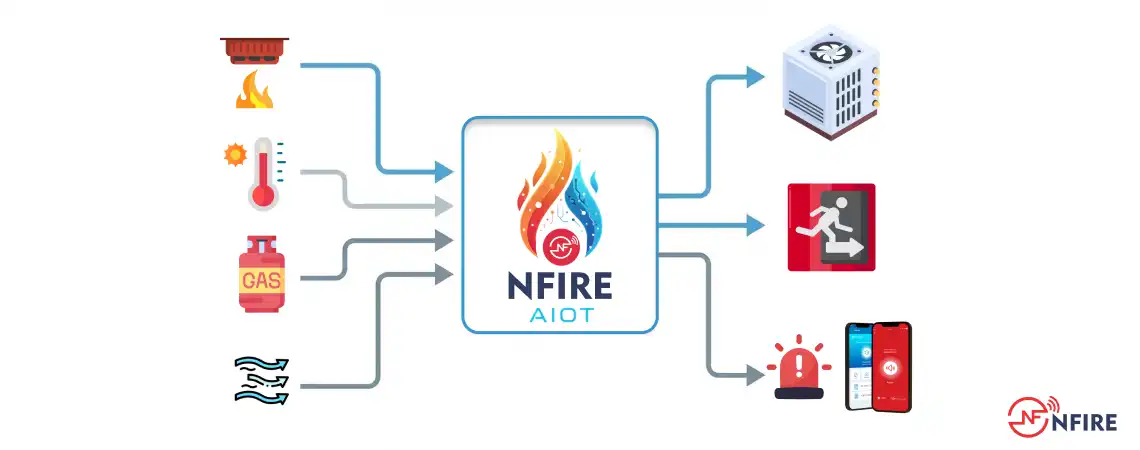
NFire — India’s first wireless addressable fire alarm system, developed by Atigo — is not simply a wireless replacement for a wired system. It is a cloud-native AIoT (Artificial Intelligence + Internet of Things) platform where the fire alarm system becomes an intelligent, continuously learning, remotely managed safety infrastructure, compliant with both IS/ISO 7240 and EN54.
Rather than comparing instantaneous sensor readings against fixed alarm thresholds — the approach of every conventional system — the NFire AI Core analyses longitudinal sensor data streams: the rate of change of smoke particle density, ambient temperature drift patterns, CO concentration trends relative to time of day and occupancy schedules, battery voltage decay curves, and wireless signal quality histories. This multi-dimensional analysis enables the system to identify fire precursor signatures — the early thermochemical indicators of a developing fire — before any single parameter crosses a conventional alarm threshold. The shift, in practical terms, is from fire detection to fire prediction.
The NFire Command Centre provides real-time graphical monitoring with 2D and 3D campus mapping, including Digital Twin visualisation of building layouts. Facility managers can see — at a glance — the live status of every detector, gateway, panel, and zone across the entire campus on a single unified dashboard. Event histories, diagnostic logs, and predictive maintenance alerts are all accessible from the same interface, replacing the siloed, per-building panel management that characterises conventional fire alarm systems.
Sensor telemetry, alarm events, and system configurations are transmitted and stored using AES-256 encryption and TLS 1.3 — the same standards used in enterprise banking and defence systems. For campuses in healthcare, finance, defence, or higher education — sectors where data security is as critical as physical safety — this is not an optional feature. It is a fundamental requirement.
NFire integrates natively with existing BMS, SCADA, HVAC, and security platforms via Modbus, BACnet/IP, and TCP/IP — making the fire safety system a first-class participant in the smart building ecosystem rather than an isolated panel-dependent silo.
Transitioning to an AIoT-enabled wireless system is the smartest way to protect your investment for the next decade. Skip the messy wiring and get a custom-engineered safety roadmap from the experts at NFire.
The final dimension of a future-proof campus fire safety infrastructure is the human interface — ensuring the right people receive the right information at the right moment, wherever they physically are.
NFire Connect delivers real-time, role-based fire alarm monitoring and incident coordination to authorised personnel on their smartphones. For campus environments where a security head, facility manager, fire safety officer, and building head may all be in different buildings at the moment an alert triggers, this is the difference between a coordinated response and a chaotic one.
Consider this scenario: a campus security head is in Building 7 when a predictive alert triggers in Building 3’s server room. Without mobile connectivity, they must physically return to the main control room, interpret the panel display, and communicate the situation by radio or phone. With NFire Connect, the alert reaches them within seconds — with precise device identification, building location, current sensor readings, escalation status, and recommended actions already populated. Every second saved in pre-alarm recognition and response coordination directly reduces the probability of a fire event reaching destructive scale.
The app supports multi-user concurrent access, meaning the facility manager, fire safety officer, building head, and remote monitoring centre can all observe the same live incident view simultaneously — enabling coordinated response without the communication bottlenecks that characterise conventional alarm-only systems. Access is controlled through authenticated role-based permissions, ensuring real-time safety data — including building layouts, occupancy information, and alarm histories — reaches only authorised personnel.
For facility managers considering a campus fire alarm system upgrade in India, the transition to wireless addressable AIoT architecture is more structured and less disruptive than most assume.
The process begins with a comprehensive site survey — mapping existing system infrastructure, identifying structural constraints, assessing radio coverage requirements, and determining integration requirements with legacy panels or BMS systems. From this survey, a phased deployment plan is developed: typically building-by-building or zone-by-zone, with each completed phase going live on the NFire Cloud platform independently.
Wireless detectors and SCM gateways are installed without civil works in the vast majority of campus environments. NFire fire alarm panels — the N7, N70, N700, or N707 depending on zone count — are commissioned and connected to the NFire AIoT Cloud platform, enabling remote monitoring from day one of each phase. NFire Connect is provisioned for all designated personnel simultaneously.
As each phase goes live, the campus transitions from a fragmented, panel-dependent monitoring model to a unified, cloud-native, AI-enhanced fire safety ecosystem — building by building, at a pace governed by operational requirements and budget cycles rather than cabling logistics.
India’s fire safety imperative is real, urgent, and backed by the hard data of thousands of preventable tragedies. The NBCS 2026’s evolving requirements, IS/ISO 7240 compliance mandates, and growing awareness among building owners, insurers, and regulators are converging to make the question not whether to upgrade, but how to do it intelligently.
For any multi-building campus, the answer is a wireless addressable architecture supported by SCM gateways, governed by a cloud-native AIoT platform like NFire, and made operationally immediate through mobile monitoring tools like NFire Connect. This combination eliminates the civil disruption and cost barriers of traditional retrofits, delivers the addressable precision that IS/ISO 7240 and EN54 demand, and future-proofs the investment with open-protocol, cloud-native architecture that will scale and evolve alongside your campus for the next decade and beyond.
Fire safety has moved from detection to prediction. Your campus fire alarm system should too.
To explore how NFire’s wireless addressable AIoT system can be deployed across your campus with minimal disruption and maximum compliance, visit www.nfire.in or book a site assessment today
Yes — in the vast majority of cases. Wireless addressable detectors are battery-powered and communicate over dedicated radio frequencies to SCM gateways, requiring no new conduit, cable trays, or concealed wiring routes. Installation is typically non-invasive and can proceed in occupied buildings without requiring the evacuation of any area. This makes wireless systems the preferred choice for fire alarm system upgrades in India across hospitals, factories, campuses, and heritage buildings.
A Smart Communication Module (SCM) Gateway is the zone-level controller in a wireless addressable fire alarm architecture. Each SCM manages a cluster of wireless detectors within its radio coverage area, collecting real-time sensor data — smoke, heat, CO, battery status, signal quality — and transmitting it to the fire alarm panel and cloud monitoring platform simultaneously. In a campus deployment, multiple SCMs are distributed across buildings, enabling phased installation and independent zone commissioning.
IS/ISO 7240 is the Indian and international standard governing fire detection and alarm systems — covering system design, device performance, and installation requirements. EN54 is the European standard series for fire detection components and is widely regarded as one of the most rigorous performance benchmarks globally. A fire alarm system that is compliant with both IS/ISO 7240 and EN54 offers a higher assurance of quality and is suitable for deployment in Indian facilities with international compliance requirements.
Timelines vary by campus size and complexity, but wireless systems dramatically compress installation schedules compared to wired alternatives. A single building floor can typically be equipped and commissioned in one working day. A phased campus deployment — using the SCM gateway architecture — allows each completed building to go live on the cloud monitoring platform independently, so protection and compliance begin accruing immediately rather than waiting for full campus completion.
Yes — and in several respects more so for campus environments. NFire’s wireless detectors communicate directly with their designated SCM gateway over dedicated, interference-managed radio channels, providing consistent and deterministic data delivery without dependence on physical cable integrity. Unlike wired systems, wireless architectures are not vulnerable to cable damage from rodents, civil works, or corrosion — a particularly relevant concern in India’s industrial and coastal environments.
Yes. NFire SCM gateways support Modbus, BACnet/IP, and TCP/IP protocols, enabling integration with legacy fire alarm panels and existing BMS, SCADA, HVAC, and security platforms. This means a campus can adopt a hybrid approach — running the new wireless system alongside legacy infrastructure during transition — without requiring an immediate full system replacement.
NFire Connect is the secure mobile application for real-time, role-based fire alarm monitoring and incident coordination. It is designed for facility managers, campus security heads, fire safety officers, building heads, and remote monitoring centre operators. The app delivers live alarm alerts, device-level event details, campus map overlays, and escalation coordination to authorised personnel on their smartphones — anywhere, at any time. Access is controlled through authenticated role-based permissions with enterprise-grade security.
Yes. NFire’s cloud platform uses AES-256 encryption and TLS 1.3 — the same standards applied in enterprise banking and defence systems — for all sensor telemetry, alarm event data, and system configuration transmission and storage. This makes it suitable for deployment in data-sensitive environments including hospitals, financial institutions, government facilities, and defence-related campuses.
India’s fire safety compliance gap in existing buildings is urgent — NCRB data shows 7,435 fire deaths in 2022 alone.
Traditional wired retrofits are disruptive, expensive, and often impractical in occupied campus environments across India.
Wireless addressable architecture using battery-powered detectors connected directly to SCM gateways eliminates civil works, enables phased zone-by-zone deployment, and delivers full addressability per IS/ISO 7240.
The NFire AIoT Cloud Platform transforms fire detection into fire prediction through AI-driven longitudinal sensor analysis, 2D/3D Digital Twin campus dashboards, and open-protocol BMS integration.
The NFire Connect Mobile App delivers real-time, role-based, secure incident coordination to all authorised campus personnel — wherever they are.
Future-proofing requires dual IS/ISO 7240 and EN54 compliance, open protocols (Modbus, BACnet/IP, TCP/IP), cloud-native architecture, and NBCS 2026 alignment.
NFire has achieved zero fire fatalities across 10,000+ monitored installations in India — a proven record of AIoT-first fire protection.