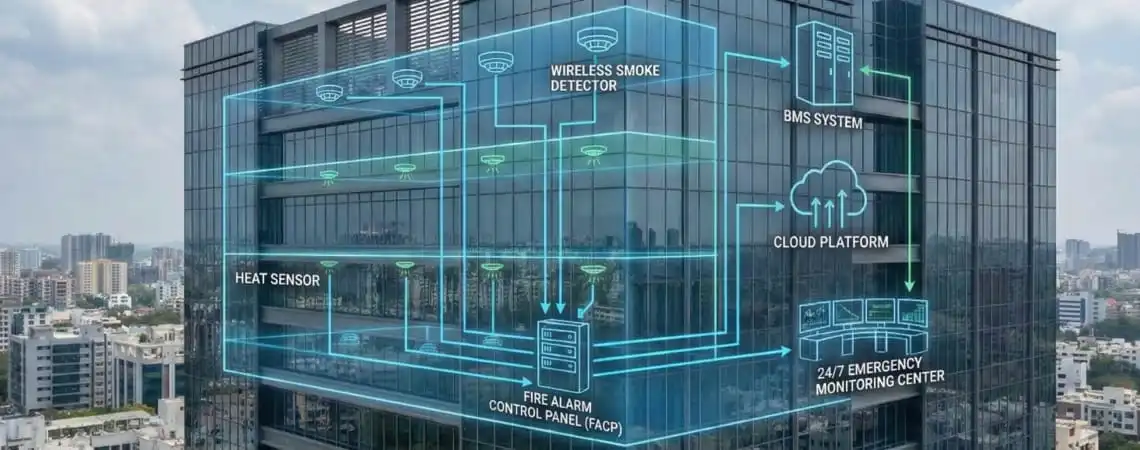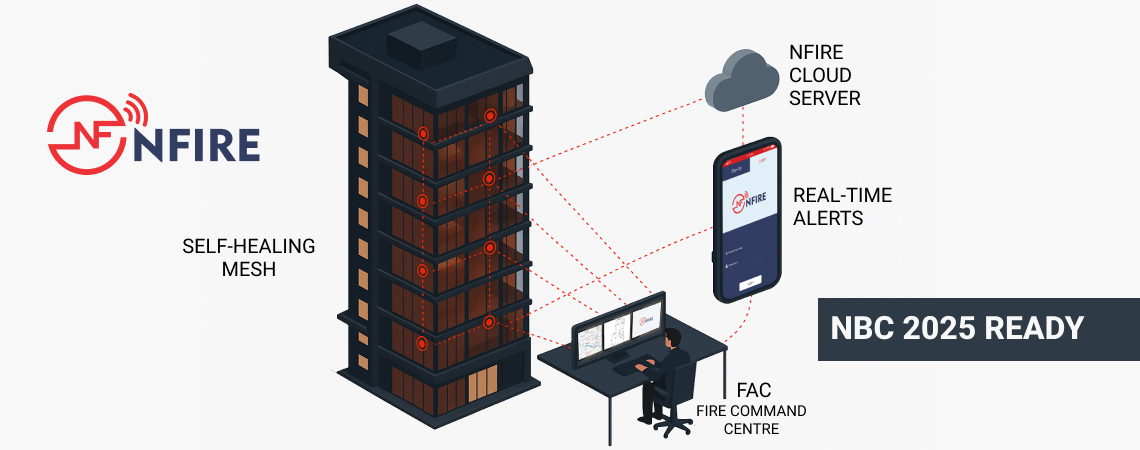

The forthcoming NBCS revision widely referred to as NBCS 2026 proposes to raise the bar significantly: every building above 15m in India is expected to require addressable, IoT-enabled fire alarm systems, and older conventional systems are unlikely to meet the new standard. For fire consultants, MEP engineers, and architects, this guide covers exactly what is required, at each height threshold, and how the NFire AIoT platform fulfils those requirements while delivering earlier detection and safer egress than any conventional system can.

Every building above 15 metres in India is set to come under significantly stricter fire alarm requirements as the Bureau of Indian Standards advances its revision of the National Building Code. The draft revision commonly referred to as NBCS 2026 proposes to make addressable detection systems, IoT-enabled alert connectivity, and automatic coordination with emergency services a baseline requirement rather than a premium specification. While the revised code is still progressing through the official BIS publication process, the direction of travel is unambiguous, and leading fire consultants, MEP engineers, and architects are already specifying to the anticipated new standard to future-proof their projects. On 24 September 2025, a short-circuit fire in a high-rise society in Noida’s Sector 107 provided a stark reminder of what is at stake when fire alarm systems fail to perform: fire in a tall building is a categorically different emergency from fire in a low-rise structure, and every metre of height compresses the time available to detect, alert, and evacuate.
The Bureau of Indian Standards’ forthcoming revision of the National Building Code — Part IV: Fire and Life Safety (the draft of which was released for stakeholder comment in 2025) proposes specific system requirements at defined height thresholds and references IS/ISO 7240 as the performance baseline. This article provides a structured reference to those requirements — and explains how AIoT-enabled wireless addressable platforms such as NFire not only meet every mandatory requirement but go significantly further, predicting fires before they fully develop and extending the safe egress window that high-rise occupants depend on.
Whether you are preparing a fire safety design basis report, writing a performance specification for tender, or advising a client on aligning with the anticipated requirements, this guide covers what you need to know including how to specify systems that already meet the proposed thresholds today.
The Bureau of Indian Standards released draft chapters of the forthcoming National Building Code revision — referred to throughout this article as the NBC draft 2025 — for public and stakeholder comment during 2025. While the revised code is not yet officially gazetted, its provisions represent the direction that fire safety regulation in India is clearly taking, and local authorities in several states have already begun referencing the draft thresholds in Fire NOC assessments. The proposed revision goes significantly further than NBCS 2026 in several important dimensions relevant to buildings above 15 metres.
| Building Height | Key Mandatory Requirements | Status |
|---|---|---|
| 15 m and above | Addressable fire detection & alarm system; IoT-enabled alerts to emergency services; Fire NOC mandatory before Occupancy Certificate; automatic sprinklers; wet-riser systems | Proposed — NBCS Draft 2026 |
| Above 24 m | Smoke extraction shafts in non-ventilated lobbies and corridors; staircase width ≥ 1.25 m; residential buildings require full fire alarm coverage | Proposed — NBCS Draft 2026 |
| Above 30 m | Dedicated fire evacuation lift (min. 1.4 m² floor area, 545 kg capacity, fire-rated doors, battery backup, 2-hour fire resistance); refuge areas every 24 m for buildings above 50 m | Proposed — NBC Draft 2025 |
| Above 45 m | Mid-level gravity-fed water tanks (not solely reliant on rooftop storage) | Proposed — NBCS Draft 2026 |
| Above 50 m | Helipad on terrace (approved by authority); structural audit mandatory; Building Management System integration for fire safety increasingly expected by state governments | Proposed — NBCS Draft 2026 |
At the state level, existing requirements already compound the picture, and many align with the proposed NBCS thresholds. Under the Maharashtra Fire Prevention and Life Safety Measures Act 2006, all buildings above 15 metres require a Fire Prevention and Life Safety (FPLS) certificate before occupation. The Delhi Fire Service Act 2007 mandates annual fire safety audits for all commercial buildings and high-rise residential complexes. Several states now require integration of fire systems with a Building Management System (BMS) for real-time monitoring — a requirement that conventional, non-addressable systems structurally cannot meet.
The compliance standard underpinning detection and alarm system design is IS/ISO 7240, the Indian adoption of the international fire detection and alarm standard series. Systems supplied to India’s high-rise market that also carry EN54 certification provide dual-standard assurance — IS/ISO 7240 for domestic compliance and EN54 for component-level performance benchmarking against European testing protocols.
Safe Egress Time (SET) is the interval between the moment hazardous fire conditions begin to develop and the moment those conditions become unsurvivable anywhere on an egress route. In a low-rise building, the SET budget is generous. In a building above 15 metres and increasingly so as height grows it is not.
The factors that erode SET in taller buildings are well-established in fire engineering literature. Smoke rises through stair shafts, lift lobbies, and service ducts at speeds that vastly outpace human movement. Heat stratifies unpredictably. Occupant density per floor is often high. Panic — particularly in complex building geometries where exit routes are unfamiliar — reduces movement speeds below model assumptions. And in India’s rapid-urbanisation context, many high-rise buildings host populations with varying mobility levels, further lengthening required egress time.
An empirical study of a 12-storey residential building in Wuhan, China, published in April 2025 in Buildings (MDPI), demonstrated that an IoT-integrated fire safety framework combining real-time temperature, smoke, and carbon monoxide sensor data with adaptive evacuation modelling achieved a 30 % reduction in fire detection intervals and a 25 % decrease in evacuation timeframes compared to conventional systems. Detection accuracy reached 95.2 % with a 40 % reduction in the need for manual inspections.
Research published in 2025 in the International Journal of Metrology and Quality Engineering (Brunel University London / North University of China) found that IoT-integrated systems using artificial neural networks achieved over 95 % accuracy in fire prediction while simultaneously providing optimised evacuation route guidance — functionality that is structurally impossible for a traditional threshold-based alarm panel to replicate.
Reduction in fire detection intervals with IoT integration (MDPI, 2025)
Decrease in evacuation timeframes vs. conventional systems (MDPI, 2025)
Fire prediction accuracy in AI-neural-network systems (IJMQE, 2025)
Reduction in manual inspection needs with IoT monitoring (MDPI, 2025)
The implication for design professionals is direct: the choice of fire detection system is not a procurement decision that happens after the design is fixed. It is an integral input to egress design, compartmentation strategy, and BMS integration — decisions made at concept stage. Specifying a system capable of early prediction rather than late-stage alarm is the difference between a building that gives occupants time to act and one that does not.
Learn how to specify an AIoT-enabled wireless addressable fire alarm system that meets NBCS 2026, IS/ISO 7240, and EN54 — with design checklists, SCM micro-bubble zone planning guidance, and hybrid wired/wireless selection criteria.

NFire India’s first wireless addressable fire alarm system, launched in 2018 by Atigo as part of a ₹250 crore investment MoU with the Gujarat Government and Nivid UK has evolved from detection to prediction. The platform combines three distinct technology layers that work together to compress the time between a fire’s earliest signs and an occupant’s first informed step toward an exit.
The NFire ecosystem deploys a range of sensors smoke, heat, gas, CO, and multi-sensor units each individually addressed and each connected to a Sensor Control Module (SCM). The SCM functions as an edge controller, managing its assigned sensors as a discrete, self-contained micro bubble. Rather than all sensors communicating directly to a central panel, the SCM handles local supervision, status reporting, and — critically — continues to operate independently even if its uplink to the panel is momentarily degraded. This ensures maximum coverage and system survivability across every zone of the building at all times.
What makes NFire’s architecture uniquely adaptable for demanding high-rise projects is a hybrid sensor option: sensors capable of operating simultaneously on both wireless and wired signal paths. The wired loop is not used for communication in the traditional sense — instead, it delivers power to distributed Power Distribution Units (PDUs) that are integrated directly with each SCM. The result is a dual-path architecture where wireless handles all addressable signalling with the flexibility and speed of deployment that modern projects require, while the wired loop maintains continuous power distribution to the SCM ecosystem regardless of radio conditions. Each modality backs up the other: the best of both worlds in a single, cohesive system.
For MEP engineers specifying systems for complex high-rise environments — buildings with reinforced concrete cores, plantrooms with dense metalwork, or mixed-use floors with unpredictable RF environments — this hybrid capability directly addresses the question of worst-case coverage. Signalling continues wirelessly; power continuity is maintained through the loop; and the SCM micro-bubble keeps operating at the edge. Unlike conventional zoned systems that can only report “a detector somewhere in Zone 3 has triggered,” each NFire sensor reports its precise identity and location through its SCM to the panel. The system supports fire alarm panels ranging from the compact N7 to the large-site N707, scalable to the full building footprint. For architects working on occupied retrofits or heritage structures where full cabling is destructive or prohibited, the hybrid approach allows a surgical wired backbone for power with fully wireless addressable detection — dramatically reducing civil works without compromising redundancy.
At the heart of the platform sits the NFire AI Core, a machine-learning engine that continuously ingests real-time IoT sensor data and cross-references it against learned zone thresholds, environmental memory, and multi-parameter input matrices. Rather than waiting for a sensor to cross a single threshold — the fundamental mechanism of every conventional panel built since the 1970s — the AI Core identifies the pattern of environmental change that precedes a fire: a subtle, sustained rise in particulate density combined with a temperature gradient that deviates from the zone’s learned baseline, for example.
The output is a tiered alert architecture: a predictive alert at the incipient stage (before visible flame or dense smoke), a confirmed fire alert with precise device identification, and automated actions — door holders releasing, suppression systems activating, BMS notifications firing — without waiting for human acknowledgement at the panel. In a building above 15 metres, where a fire on Floor 12 may give occupants on Floor 15 less than two minutes before conditions deteriorate, those pre-alarm seconds are the margin between orderly evacuation and crisis.
Design-stage implication for fire consultants: The NFire AI Core’s zone threshold learning requires accurate zone configuration during commissioning — an MEP-level activity, not a post-handover afterthought. Engaging the NFire system design at tender stage allows zone boundaries to reflect actual occupancy patterns, ventilation zones, and fire compartmentation — producing a smarter system from Day One.
Detection intelligence is only valuable if notification reaches the right people, at the right level of detail, in real time. The NFire Command Centre provides multi-user, real-time graphical monitoring with 2D and 3D Digital Twin visualisations of the building. Security personnel, facility managers, and first responders see not a cryptic panel code but a live map of the building with the affected zone illuminated, the device type identified, and the alert severity classified.
The NFire Connect mobile application extends this situational awareness to building owners and safety officers off-site, enabling remote incident coordination and decision-making from the first moment of alert. Simultaneous auto-actions — from triggering suppression to coordinating evacuation lifts — reduce the cognitive load on personnel during the high-stress first minutes of a fire event, when human decision-making is most likely to introduce delay.
All communications are secured with AES-256 encryption over TLS 1.3 — a level of data security that meets the expectations of large commercial, healthcare, and government building operators who are increasingly scrutinising the cybersecurity posture of IoT-connected building systems.

AI Core detects incipient-stage fire conditions before visible flame expanding the SET window when occupants need it most.

Addressable architecture identifies the exact sensor — floor, zone, device — eliminating ambiguity in multi-storey evacuation decisions.

Simultaneous alerts to panels, NFire Command Centre, NFire Connect app, and auto-actions — no single point of notification failure.

Sensors can operate on both signal paths simultaneously. Loop power feeds PDUs integrated with each SCM — wireless handles signalling, wired guarantees power. Maximum redundancy, minimum civil works.

Hours to install, not weeks. No conduit required for signalling. Ideal for occupied retrofits, heritage buildings, phased commissioning, and sites where full cabling is impractical.

Multi-parameter AI analysis eliminates nuisance alarms from cooking, dust, or humidity — preserving occupant trust in the system.

AES-256 + TLS 1.3 encryption. IoT-connected fire safety that satisfies both IT security teams and fire safety regulators.
The most common concern raised by fire consultants encountering wireless addressable technology for the first time is reliability: if cable failure can impair a wired system, what prevents radio interference from impairing a wireless one? It is a legitimate engineering question, and it deserves a direct answer rooted in NFire’s actual system architecture.
NFire does not rely on a mesh radio topology. Instead, the platform is built around Sensor Control Modules (SCMs) — dedicated edge controllers that sit between the fire alarm panel and the sensors assigned to them. Each sensor connects directly to its SCM, and the SCM manages its group of devices as an independent, self-contained micro bubble. Think of each SCM as a localised intelligence hub: it maintains full supervisory oversight of every sensor within its bubble, processes status continuously at the edge, and communicates upward to the panel.
This micro-bubble architecture delivers a critical resilience property: if communication between one SCM and the panel is temporarily degraded, that bubble continues to operate autonomously. Sensors within it remain supervised, alerts are retained, and the SCM picks up communication the moment the link is restored — without any data loss and without affecting adjacent bubbles.
For projects where even that level of resilience must be exceeded — large commercial complexes, hospitals, data centres, and high-occupancy residential towers — NFire offers a hybrid sensor option that takes redundancy a step further. Hybrid sensors operate on both wireless and wired signal paths simultaneously. The wired element is not a full conventional loop in the traditional sense; rather, it powers distributed Power Distribution Units (PDUs) integrated directly with each SCM, delivering continuous loop power to the edge-controller ecosystem. Wireless handles all addressable signalling with full flexibility; the wired loop guarantees power continuity to the SCMs regardless of radio conditions; and each path backs up the other. The result is a system that can withstand simultaneous radio degradation and power disruption to individual nodes without losing supervision of a single sensor — a level of fault tolerance that purely wired or purely wireless systems cannot match.
The system is STQC-tested (Standardisation Testing and Quality Certification, Government of India) and carries EN54 compliance, the European standard specifying stringent performance requirements for fire detection components including range, interference immunity, battery life, and supervision interval. All NFire sensors self-supervise and report communication faults to the panel via the SCM, providing the same fault visibility that specifiers expect from a wired loop — with the installation flexibility of a fully wireless system.
The operational evidence is equally clear: across a large number of active installations nationwide, NFire has recorded zero fire fatalities at monitored sites and has prevented or mitigated over 500 emergencies. This is not a laboratory metric — it is a field-performance record across the full range of India’s building types, climates, and occupancy conditions.
Indian adoption of the international fire detection & alarm standard — the primary compliance reference for NBCS 2026 design submissions
European component-level certification providing independent performance verification alongside IS/ISO compliance
Draft revision of the national building code proposing addressable, IoT-enabled fire detection in all buildings ≥ 15 m — currently in BIS stakeholder review
Government of India quality certification validating NFire hardware performance in Indian field conditions
India recorded a 10 % increase in fire incidents in Delhi in 2025 alone, with the majority occurring in residential complexes. Nationally, thousands of fire incidents occur annually in structures that technically carry a Fire NOC — proof that compliance on paper and safety in practice are not the same thing when the underlying detection technology cannot deliver early enough warning.
The fire safety profession has a phrase for this gap: the difference between a compliant building and a safe building. A building is compliant when it meets the minimum requirements of the applicable code at the time of inspection. It is safe when its occupants have a realistic chance of escaping any credible fire scenario unharmed. In a building above 15 metres, achieving safety rather than mere compliance requires a detection system that acts well before the alarm threshold is crossed — not at it.
AIoT platforms represent the technology that closes this gap. The NFire platform’s shift from detection to prediction — from a system that reacts to one that anticipates — is not a marketing claim. It is the application of the same pattern-recognition mathematics that AI uses in every other safety-critical domain: aviation, nuclear power, autonomous vehicles. Fire safety in buildings is simply the most recent discipline to benefit from it.
For fire consultants preparing design basis reports, for MEP engineers writing performance specifications, and for architects integrating life safety into building design from the outset, the selection of an AIoT-capable wireless addressable system is no longer a premium option for sophisticated clients. It is the baseline standard that NBCS 2026 anticipates, that building insurers are beginning to price into risk models, and that building occupants — increasingly informed about fire safety — will come to expect.
Zero loss of life and property due to fire is not an aspirational target. With the right detection platform, specified correctly at design stage and commissioned to the highest standards, it is an engineering outcome.
The NBCS draft 2026 proposes addressable, IoT-enabled fire detection as a baseline requirement in all buildings above 15 metres. While the revision is progressing through the BIS publication process, leading authorities are already applying these thresholds — specifying to the draft standard now protects projects from compliance gaps at handover.
Safe Egress Time shrinks with height. Early prediction — not threshold-based alarm — is the only mechanism that preserves the SET window in multi-storey structures.
Wireless addressable systems are fully compliant with IS/ISO 7240 and EN54, STQC-tested, and operationally proven across a large and growing number of installations nationwide.
AI-powered detection reduces detection intervals by up to 30 % and evacuation timeframes by up to 25 % compared to conventional systems (peer-reviewed, 2025 data).
Specify at concept stage, not post-tender. Zone configuration, BMS integration, and Digital Twin commissioning are design activities — NFire supports MEP engineers through the full design cycle.
Dual-standard compliance (IS/ISO 7240 + EN54) provides the evidentiary base needed for RERA submissions, insurance risk assessments, and international-standard project briefs.
Our technical team works directly with fire consultants, MEP engineers, and architects to develop compliant, future-proof fire safety designs. From single-building specifications to multi-site roll-outs, NFire provides full design support, compliance documentation, and commissioning services.
For design professionals evaluating system options, the following comparison captures the principal differences between a conventional fire alarm system, a wired addressable system, and an AIoT-enabled wireless addressable platform such as NFire — across the criteria that matter most to a project.
| Criterion | Conventional (Zone-Based) | Wired Addressable | NFire AIoT Wireless Addressable |
|---|---|---|---|
| Detection mode | Threshold alarm — triggers only when sensor exceeds a fixed value | Threshold alarm with precise device ID | Predictive — AI Core identifies pre-fire patterns before threshold is crossed |
| Location identification | Zone only (e.g. "Floor 3 — Zone B") | Exact device address | Exact device address + 2D/3D Digital Twin visualisation |
| False alarm management | No intelligence — prone to nuisance alarms | Limited — single parameter | Multi-parameter AI analysis; environmental compensation; significantly reduced false alarms |
| Installation time | Weeks (full cabling required) | Weeks (full addressable loop cabling) | Hours to days — 100% wireless signalling; optional hybrid PDU power loop |
| Retrofit suitability | Highly disruptive; major civil works | Disruptive; significant cabling | Minimal disruption; no signalling conduit; ideal for occupied and heritage buildings |
| Remote monitoring | None | Limited (panel-level, on-site) | Real-time via NFire Command Centre + NFire Connect mobile app; cloud-based |
| BMS integration | Not supported | Partial — requires gateway hardware | Native IoT integration; auto-actions (suppression, lifts, door holders) |
| System survivability | Single loop failure = zone blind spot | Class A wiring provides redundancy | SCM micro-bubble independence; hybrid PDU power backup; degraded-mode operation |
| NBCS draft 2026 readiness | Does not meet addressable / IoT requirements | Meets addressable; limited IoT capability | Fully aligned — addressable, IoT, AI, IS/ISO 7240 & EN54 |
No — the draft does not mandate wireless technology as such. It requires addressable fire detection systems with IoT-enabled notification capability and precise device-level location identification. Wireless addressable systems satisfy all of these requirements and bring significant additional benefits in installation speed, retrofit flexibility, and cost. That said, a wired addressable system meeting IS/ISO 7240 and delivering IoT notification would also technically comply. The NFire platform supports both fully wireless and hybrid wired/wireless configurations, allowing the right architecture to be selected for each project.
IS 2189 (Bureau of Indian Standards, latest edition 2008) is India’s own Code of Practice for the selection, installation, and maintenance of automatic fire detection and alarm systems. It is the working document that fire consultants and MEP engineers use for system layout, detector spacing, wiring class requirements, and commissioning protocols in short, how to design and install a system. IS/ISO 7240 is India’s adoption of the international ISO 7240 series, which defines component performance requirements and test methods it specifies what the equipment must do and how its performance is independently verified. IS 2189 references IS/ISO 7240-compliant components as the expected hardware. Together, they form the full technical compliance framework: IS 2189 governs design practice; IS/ISO 7240 governs equipment performance. Both are referenced by NBC, and NFire is compliant with IS/ISO 7240 across its sensor and panel range.
Under the proposed NBC draft 2025 and consistent with the existing requirements of many state fire authorities, buildings above 15 metres require an addressable fire detection and alarm system capable of identifying the precise device location of any alarm, integrated with IoT-enabled notification to emergency services, and compliant with IS/ISO 7240. Conventional zone-based systems are not considered adequate for buildings at this height. State-specific regulations (Maharashtra FPLS, Delhi Fire Service Act) may add further obligations. A Fire NOC from the local fire authority is mandatory before an Occupancy Certificate can be issued.
es when the system is built on the right architecture. NFire uses Sensor Control Modules (SCMs) as edge controllers, each managing a group of sensors as an independent micro bubble. If uplink communication is temporarily degraded, the SCM continues operating autonomously — no data loss, no blind spots. For projects requiring additional redundancy, the hybrid wired/wireless option delivers loop power to PDUs integrated with each SCM, ensuring power continuity regardless of radio conditions. NFire is STQC-tested, EN54-compliant, and secured with AES-256 encryption over TLS 1.3.
1. Bureau of Indian Standards — National Building Code of India — Revision Draft 2025, Part IV: Fire and Life Safety (BIS, 2025; draft for stakeholder comment)
2. Ministry of Housing and Urban Affairs — Chapter 7: Fire Protection and Fire Safety Requirements
3. 99acres.com, “Fire Safety Norms for High-Rise Residential Buildings (2026)” — citing NBCS 2026 draft provisions, September 2026
4. IS 2189:2008, Bureau of Indian Standards — Selection, Installation and Maintenance of Automatic Fire Detection and Alarm System — Code of Practice
5. ISO 7240 series — Fire Detection and Alarm Systems (ISO 7240-14:2013), International Organization for Standardization
6. Sun Q. et al., “Integrating IoT Technology for Fire Risk Monitoring and Assessment in Residential Building Design,” Buildings 15(8), 1346, MDPI, April 2025 — 30% detection interval reduction; 25% evacuation time reduction; 95.2% accuracy
7. Pan G., Xie Y., Yang Q., “IoT-based cloud monitoring system for building fires,” International Journal of Metrology and Quality Engineering 16, 1 (2025) — >95% fire prediction accuracy (Brunel University London / North University of China)
8. NASSCOM — Draft NBCS India Part 8: Building Services — ICT Installations, BIS draft released March 2025
9. NFire by Atigo — Product documentation, ecosystem specifications, and performance data (nfire.in, 2025)
10. Directorate General Fire Services, Civil Defence & Home Guards — Ministry of Home Affairs, Government of India