

In April and May 2025, India witnessed two devastating hotel fires—one at Kolkata’s Mechua Market claiming 14 lives and another at Ajmer’s Diggi Bazaar resulting in four deaths. Both tragedies shared a common thread: inadequate fire safety infrastructure and single-exit configurations that trapped guests. With India’s fire mortality rate standing at 5.4 per 100,000 people—nearly three times the global average—and commercial buildings accounting for 330 fire deaths annually, the hospitality industry faces an urgent mandate: modernize fire safety systems without compromising guest experience or operational continuity.
For hotel and resort owners across India, this presents a complex challenge. Traditional fire alarm retrofits demand weeks of invasive installation work, drilling through walls, guest room closures, and operational disruptions that directly impact revenue. Meanwhile, regulatory compliance pressures mount with stringent requirements from the National Building Code 2016, IS/ISO 7240 standards, and state fire departments demanding NOC renewals backed by functioning, certified systems.
Enter the new generation of fire safety technology: AIoT wireless addressable fire alarm systems. Combining Artificial Intelligence, Internet of Things connectivity, and wireless addressable architecture, these intelligent systems are revolutionizing how India’s hospitality sector approaches fire protection. NFire’s solution stands at the forefront of this transformation, purpose-built for Indian hotels and resorts facing the unique intersection of heritage architecture, 24/7 operations, and international safety standards.
Indian hotels face mounting compliance pressures and fire safety challenges
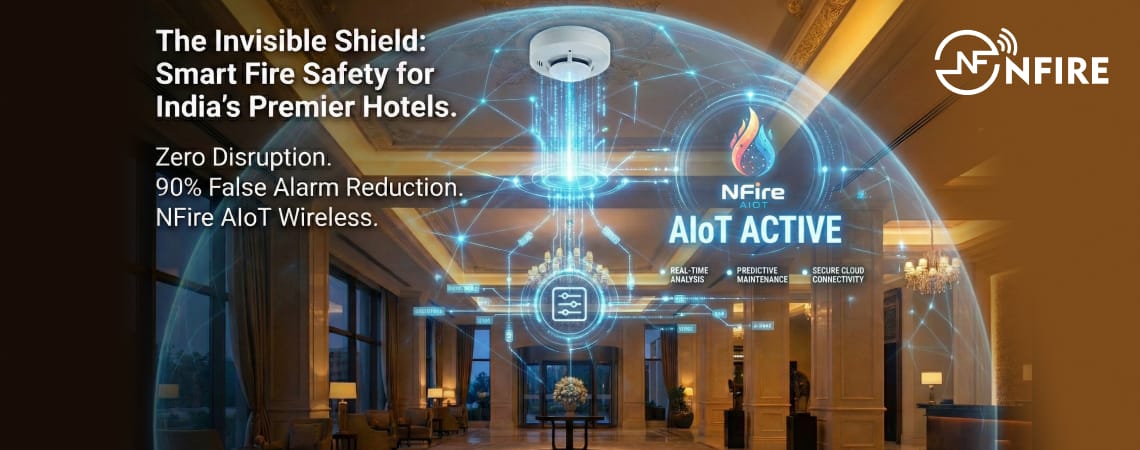
India’s hotel industry operates under extraordinary pressure. Guest safety is paramount, yet facilities managers must balance fire protection with seamless operations, aesthetic preservation, and budget constraints. According to the National Crime Records Bureau (NCRB), 7,435 people died in over 7,500 fire accidents across India in 2022—with commercial buildings representing a significant portion of these incidents.
Round-the-Clock Operations with Unfamiliar Occupants: Unlike office buildings or factories with trained staff, hotels host hundreds of guests who may be asleep, unfamiliar with evacuation routes, or unable to understand local language emergency instructions. Every minute counts during evacuation, yet conventional fire alarm systems often fail to provide precise location information.
False Alarm Economics: A single false alarm triggering a 2 AM evacuation can result in refund requests, negative online reviews, and lasting reputational damage. Research indicates that IoT-enabled smart sensors can reduce false alarms by 15-25%, translating to significant savings in both direct costs and guest satisfaction metrics.
Compliance Complexity: Hotels must navigate multiple regulatory frameworks including IS/ISO 7240 (fire alarm standards), EN54 (European compliance for international credibility), National Building Code 2016, and IS 13716:1993 specifically addressing fire safety in hotels. Fire NOC renewals require documented evidence of functioning systems—a process that becomes increasingly challenging with aging infrastructure.
Heritage Property Constraints: Many of India’s premier hotels and resorts occupy heritage buildings or feature distinctive architecture where drilling, cable routing, and invasive installation work is either prohibited or would compromise aesthetic value. The Tourism Ministry reports that hoteliers in destinations like Kasauli face specific challenges implementing fire safety norms in decades-old structures, with infrastructure modifications requiring multi-department permissions.
For decades, hotels relied on conventional or wired addressable fire alarm systems. While these technologies served their purpose, they introduce operational challenges that directly conflict with hospitality best practices:
Conventional fire alarms operate on a zone-based model—they can identify which floor has triggered an alarm but cannot pinpoint the specific room or device. In a 200-room hotel, “fire detected on third floor” provides insufficient information for rapid response. Security teams waste precious minutes investigating every room in the zone while smoke spreads.
Traditional wired addressable systems offer precise device-level identification but at a steep operational cost. Installation requires:
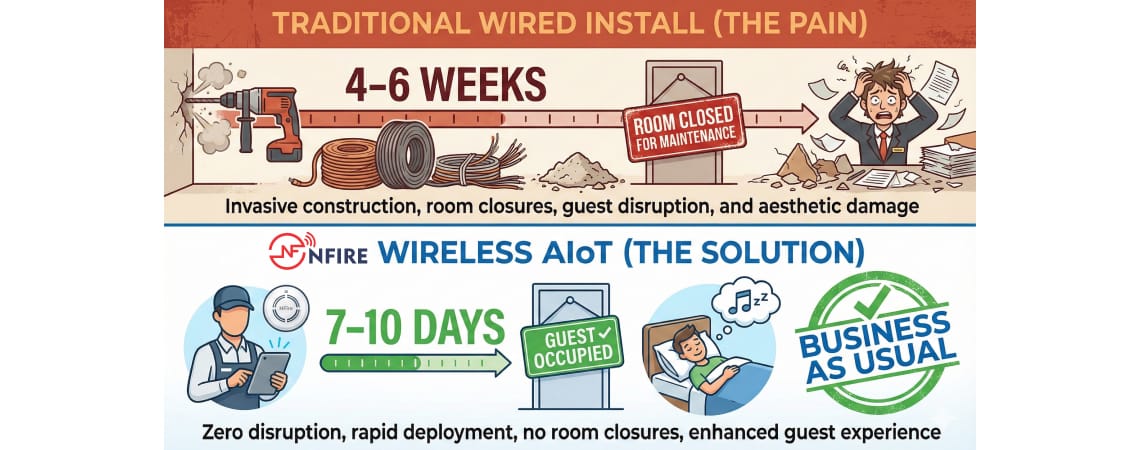
Industry data shows that for a 100-room hotel property, hardwired fire alarm installation can take upward of 4-6 weeks with a two-person team, compared to just 7-10 days for wireless systems—while maintaining guest operations throughout.
Basic smoke and heat detectors lack environmental intelligence. Cooking steam from in-room kitchenettes, bathroom humidity, cigarette smoke (in permitted areas), or dust from renovations all trigger nuisance alarms. Hotels operating with basic detection systems often experience unnecessary evacuations that:
NFire has engineered an end-to-end fire safety platform that addresses every challenge the hospitality sector faces. By integrating three critical technologies—wireless infrastructure, addressable intelligence, and AIoT capabilities—NFire delivers what was previously impossible: enterprise-grade fire protection without operational disruption.
NFire’s integrated AIoT architecture combines wireless technology, addressable intelligence, and cloud analytics
NFire’s enterprise-grade wireless system eliminates the cabling nightmare entirely:
Zero Masonry Work: No drilling, no wall cutting, no trenching between buildings. Ideal for heritage properties where structural modifications require Archaeological Survey of India permissions or would violate preservation guidelines.
Floor-by-Floor Retrofit: Properties can upgrade incrementally—perhaps starting with high-risk areas like kitchens and laundries—without shutting down entire wings. Guest-occupied rooms can be retrofitted during standard checkout-to-checkin turnover windows.
Campus-Style Flexibility: Resort properties with multiple buildings separated by landscaped grounds avoid expensive underground cable trenching. Wireless communication between structures eliminates the single greatest installation cost driver in multi-building campuses.
Dust-Free Implementation: No construction debris means no additional housekeeping costs or guest complaints about renovation noise and dust during their stay.
Case studies from international hospitality implementations demonstrate this advantage. London’s Portobello Hotel—a luxury boutique establishment in heritage Notting Hill—completed its NFire wireless upgrade in just 3-5 days without closing the hotel. Installers worked after-hours, and when rooms were occupied, installation was simply postponed to the next day when guests checked out.
Unlike conventional zone-based systems, every NFire device carries a unique digital address. When smoke is detected in Room 307, the system identifies “Smoke Detector SD-307-A” with precision. This specificity delivers critical operational advantages:
Faster Emergency Response: Security personnel receive alerts with exact location information—room number, corridor, back-of-house area—enabling immediate verification and response without searching entire floors.
Detailed Incident Documentation: Compliance officers and insurance investigators receive comprehensive logs showing which device triggered, at what time, and what actions were taken. This documentation proves invaluable during fire NOC renewals and regulatory audits.
Intelligent Escalation: The system can differentiate between a single detector activation (requiring verification) versus multiple devices in adjacent areas (indicating spreading fire requiring immediate full evacuation).
Maintenance Precision: When a device reports low battery or requires servicing, technicians know exactly which unit needs attention—no need to inspect dozens of devices hunting for the fault.
This is where NFire separates itself from every competitor in the market. The integration of Artificial Intelligence and Internet of Things connectivity transforms fire detection from reactive alerting to proactive protection:
90%+ False Alarm Reduction: NFire’s AI-driven analytics examine multiple data streams simultaneously—smoke density, temperature rise, rate of change, environmental conditions, and historical patterns for that specific location. The system distinguishes between harmless cooking steam and actual fire smoke, eliminating the nuisance alarms that plague basic detection systems. Research confirms that AI-powered fire alarm systems can reduce false alarms by up to 90%, protecting both guest experience and operational efficiency.
Predictive Maintenance: IoT sensors continuously monitor device health, battery status, communication pathway integrity, and sensor sensitivity. When a smoke detector begins showing drift or a battery approaches end-of-life, the system automatically flags it for service before it fails. Studies show IoT sensors with predictive maintenance alerts deliver 15-25% savings on maintenance costs through early problem detection.
Real-Time Remote Monitoring: Hotel managers, corporate safety directors, and facility teams access live system status via the NFire Connect mobile app and web dashboards. Multi-property hospitality groups can monitor all locations from a centralized operations center, regardless of geographic distribution.
Environmental Compensation: Advanced algorithms adjust detection sensitivity based on ambient conditions. A detector in a kitchen corridor adjacent to cooking areas automatically compensates for expected steam and heat, while maintaining full sensitivity to actual fire signatures.
Integration with Building Systems: NFire interfaces seamlessly with Building Management Systems (BMS), Public Address systems, access control, and elevator controls using standard protocols (BACnet, Modbus, API). During a fire event, the system can automatically:
Incident Analytics and Drill Management: NFire’s platform maintains comprehensive records of every event—real fires, false alarms, drills, maintenance actions. This data proves invaluable for compliance reporting, insurance documentation, and continuous safety improvement.
| Feature | Conventional System | Wired Addressable | Wireless Addressable (NFire) |
|---|---|---|---|
| Installation Time | 2-3 weeks | 4-6 weeks | 7-10 days |
| Device Identification | Zone only | Exact device | Exact device |
| False Alarm Rate | High | Medium | 90% reduction |
| Retrofit Difficulty | Moderate | Very High | Low |
| Guest Disruption | High | Very High | Minimal |
| Maintenance Cost | Medium | High | 15-25% lower |
| Remote Monitoring | No | Limited | Full (app-based) |
| BMS Integration | No | Limited | Complete |
| Compliance | Basic | IS/ISO 7240 | IS/ISO 7240 + EN54 |
Fewer false alarms mean guests sleep through the night without unnecessary evacuations. When real emergencies occur, precise location information and automated floor-specific announcements guide evacuation efficiently without panic. Smart hotels recognize that visible safety infrastructure—including modern fire detection—signals professionalism and care to increasingly safety-conscious travelers.
Every day of installation disruption represents lost room nights. NFire’s 7-10 day installation window versus 4-6 weeks for wired systems means properties remain operational and revenue-generating throughout the safety upgrade.
In the age of instant online reviews, a single false-alarm midnight evacuation can generate dozens of negative TripAdvisor and Google reviews. NFire’s false alarm reduction protects your brand reputation while demonstrating commitment to guest safety through cutting-edge technology.
Hospitality groups operating multiple properties gain centralized visibility and standardized safety protocols across their portfolio. Corporate safety directors can monitor fire system health for 10, 20, or 50 properties from a single dashboard, ensuring consistent protection standards.
NFire systems are engineered for dual compliance—meeting both Indian standards (IS/ISO 7240) and European requirements (EN54)—ensuring your property satisfies domestic regulations while maintaining international credibility for global hotel chains and foreign guests.
IS/ISO 7240 Compliance: India’s Bureau of Indian Standards has adopted the ISO 7240 series covering all aspects of fire detection and alarm systems. NFire’s components meet these specifications for control and indicating equipment, smoke detectors, heat detectors, manual call points, power supply equipment, and system design and installation.
EN54 Certification: The European standard EN54 provides internationally recognized third-party verification of fire alarm equipment performance. NFire’s EN54 certification demonstrates quality assurance that satisfies insurance underwriters, international hotel brands, and discerning guests.
National Building Code 2016 Alignment: NBC Part 4 addresses “Fire and Life Safety” requirements for building design and fire protection systems. NFire’s addressable architecture satisfies NBC requirements for means of egress, fire detection and suppression, and emergency evacuation protocols.
IS 13716:1993 (Hotel-Specific Code): This Bureau of Indian Standards code specifically addresses fire safety practices for hotels and hospitality establishments. NFire’s comprehensive solution aligns with requirements for detection coverage, alarm audibility, emergency communication, and system maintenance.
Fire NOC Renewal Support: State fire departments require periodic NOC renewals with documented evidence of functioning fire alarm systems. NFire’s automated compliance reporting generates the maintenance logs, test records, and system health documentation fire officers require—eliminating the scramble to compile paperwork during renewal periods.
NFire systems are certified to both Indian (IS/ISO 7240) and European (EN54) standards
NFire has refined a deployment methodology specifically designed for operational hotels and resorts:
Phase 1: Wireless Site Survey (1-2 Days)
Engineering teams conduct comprehensive RF (radio frequency) surveys to map wireless coverage, identify any potential interference sources, and determine optimal placement for wireless translators and repeaters. Advanced survey tools ensure reliable communication pathways before any device is installed.
Phase 2: Off-Site Programming (Parallel to Survey)
NFire devices can be programmed, configured, and pre-tested off-site before arriving at your property. This dramatically reduces on-site installation time and allows precise equipment requirements and costs to be calculated in advance.
Phase 3: Phased Installation (5-7 Days)
Installation proceeds floor-by-floor or wing-by-wing based on occupancy patterns. Guest-occupied rooms are simply skipped and addressed the following day. Back-of-house areas, public spaces, and amenities are addressed during low-traffic periods. No room closures required.
Phase 4: Integration and Testing (1-2 Days)
System integration with existing BMS, PA systems, and building controls is executed and thoroughly tested. Fire drill scenarios validate alarm response, communication protocols, and staff procedures.
Phase 5: Staff Training and Handover (1 Day)
Comprehensive training ensures hotel staff understand system operation, alarm response protocols, and basic troubleshooting. The NFire Connect mobile app is deployed to management teams for ongoing monitoring.
Phase 6: Ongoing Support
NFire provides remote diagnostics, predictive maintenance alerts, compliance reporting, and 24/7 technical support. Software updates and system health monitoring happen automatically without disrupting operations.
NFire’s phased installation allows hotels to remain fully operational throughout the upgrade
NFire’s scalability means system expansion during renovations or additions requires simply adding wireless devices to the existing network—no infrastructure overhaul necessary. As AI and machine learning capabilities advance, NFire’s cloud-connected platform receives software updates that enhance detection algorithms without hardware replacement.
The hospitality industry is evolving toward smart building integration, where fire safety becomes one component of a comprehensive building intelligence ecosystem. NFire’s open architecture and standard communication protocols ensure your fire alarm investment remains relevant as your property adopts smart guest room controls, energy management systems, advanced security integration, IoT occupancy sensors, and predictive maintenance platforms across all building systems.
NFire is India’s first and most advanced wireless addressable fire alarm system, designed and manufactured in India specifically for Indian market conditions while meeting international quality standards. Developed by Atigo Enterprises Limited—a leading electronics manufacturer specializing exclusively in wireless safety solutions—NFire understands the unique challenges Indian hotels face:
Yet NFire maintains international credibility through EN54 certification and compatibility with global hotel brand safety standards, ensuring properties can satisfy both domestic regulations and international franchise requirements.
NFire is manufactured in India by Atigo Enterprises Limited with R&D facilities at IIT Gandhinagar
A: Wireless fire alarm systems like NFire can be fully installed and tested in 7-10 days for a typical 100-room hotel property. This is dramatically faster than traditional wired addressable systems which require 4-6 weeks of installation work. The wireless approach eliminates extensive cabling, trenching, and masonry work. Hotels can remain fully operational during installation, with guest rooms retrofitted during standard turnover periods between checkout and check-in.
A: Yes, absolutely. NFire’s wireless installation methodology is specifically designed for operational hotels. Installation proceeds floor-by-floor or wing-by-wing based on occupancy patterns. Occupied rooms are simply bypassed and addressed the following day after guest checkout. Most device installations take less than 15 minutes per room—faster than standard housekeeping turnover. This zero-disruption approach means hotels maintain full occupancy and revenue throughout the safety upgrade.
A: Yes, wireless systems are ideal for heritage properties and historically significant buildings. Unlike traditional systems requiring extensive drilling, cable routing, and structural modifications, wireless fire alarms mount with minimal invasive work. This preserves architectural integrity, decorative plasterwork, and heritage features. Properties requiring Archaeological Survey of India permissions or conservation approvals find wireless systems the only practical option for fire safety modernization.
A: NFire follows a five-phase implementation process: (1) Wireless site survey to map RF coverage and determine optimal device placement (1-2 days), (2) Off-site programming of devices before arrival at your property, (3) Phased installation working around guest occupancy (5-7 days), (4) System integration with existing BMS, PA, and building controls with comprehensive testing (1-2 days), and (5) Staff training on system operation and alarm response protocols (1 day). Total timeline is typically 7-10 days from start to handover.
Yes. Enterprise-grade wireless fire alarm systems like NFire use encrypted radio frequency (RF) communication with enterprise security (AES-256 encryption and TLS 1.3) and comply with the same rigorous standards as wired systems—IS/ISO 7240 and EN54. The systems include redundant communication pathways, continuous self-diagnostics, and battery backup. Wireless technology has matured significantly; modern systems are deployed in critical applications including hospitals, airports, and high-rise commercial buildings worldwide. Studies show properly designed wireless systems achieve 99.9%+ uptime reliability.
A: NFire systems employ mesh network architecture with built-in redundancy. If one communication path is blocked, signals automatically reroute through alternate pathways. The system continuously monitors communication integrity and immediately alerts facility managers if any device loses connectivity. Wireless translators and repeaters are strategically placed during the initial RF survey to ensure reliable coverage throughout the property, even through thick walls, multiple floors, and challenging RF environments.
A: Professional wireless fire alarm systems operate on dedicated frequencies separate from WiFi, Bluetooth, and consumer wireless devices. NFire uses licensed or carefully selected frequency bands specifically engineered for critical safety applications. Advanced frequency-hopping and error-correction protocols prevent interference. During the pre-installation wireless survey, engineers test for potential interference sources and optimize system design to ensure reliable operation regardless of other wireless systems in the building.
A: False alarms carry significant direct and indirect costs for hotels. Direct costs include potential fire brigade response fees (ranging from ₹5,000-₹50,000 depending on locality), security team overtime during late-night evacuations, and operational disruptions. Indirect costs are more substantial: guest refund requests (₹5,000-₹15,000 per affected room), negative online reviews that impact future bookings, staff desensitization to alarms creating real emergency risks, and brand reputation damage. A single false alarm triggering a 2 AM evacuation can generate dozens of negative TripAdvisor and Google reviews. Hotels with high false alarm rates report annual costs exceeding ₹5-10 lakhs when all factors are considered.
A: AIoT (Artificial Intelligence + Internet of Things) fire alarms analyze multiple data streams simultaneously rather than relying on single-sensor thresholds. NFire’s AI algorithms examine smoke density, temperature, rate of temperature rise, humidity levels, historical patterns for that specific location, and contextual data from building systems. The system distinguishes between harmless events (cooking steam, bathroom humidity, dust from cleaning) and actual fire signatures (rapid temperature increase with smoke, specific combustion particle patterns). This multi-criteria analysis reduces false alarms by over 90% compared to basic smoke detectors. The system “learns” normal environmental patterns for each zone, becoming more accurate over time.
A: Conventional fire alarm systems organize devices into zones—typically covering an entire floor or building section. When an alarm triggers, the panel indicates “fire in Zone 3” but cannot identify which specific device activated. Security staff must physically search every room in that zone to locate the fire. Addressable fire alarm systems assign each device a unique digital “address” (like Room 307 Smoke Detector SD-307-A). When that device triggers, the control panel and monitoring dashboards show the exact location instantly. This precision enables faster verification, quicker emergency response, and more efficient maintenance. For hotels, addressable systems mean security can immediately dispatch staff to the exact room rather than searching an entire floor while guests evacuate.
A: Yes. Advanced multi-criteria detectors combined with AI analytics can distinguish between different smoke types. Cigarette smoke produces relatively low volumes of smoke without rapid temperature increase. Actual fires generate larger smoke volumes, rising temperatures, and specific combustion byproducts. The AI analyzes smoke density, rate of smoke accumulation, temperature patterns, and duration. While the system prioritizes safety (any smoke in a non-smoking room triggers investigation), it can adjust alarm thresholds and escalation protocols based on smoke characteristics, reducing unnecessary full-building evacuations while maintaining guest safety.
A: Indian hotels must comply with multiple regulatory frameworks: IS/ISO 7240 (fire detection and alarm systems—adopted by Bureau of Indian Standards), EN54 (European standard providing international credibility), National Building Code of India 2016 (NBC Part 4 addresses fire and life safety), and IS 13716:1993 (specific code of practice for fire safety of hotels). Additionally, state fire departments enforce local regulations and require periodic Fire NOC (No Objection Certificate) renewals with documented evidence of functioning fire alarm systems. Hotels in special categories (heritage properties, high-rise buildings, large occupancy) face additional requirements. Multi-story hotels typically need addressable systems under NBC guidelines.
A: Fire NOC renewal requirements vary by state but typically occur every 1-2 years. Renewal requires documentation proving fire alarm systems are operational, properly maintained, and compliant with current standards. Hotels must provide maintenance logs, test records, system health reports, and proof of defect correction. NFire’s automated compliance reporting generates all required documentation continuously, eliminating the scramble to compile paperwork during renewal periods. The system maintains digital audit trails of every alarm, test, and maintenance action, making NOC renewals straightforward.
A: Yes, EN54 certification is increasingly important for Indian hotels, especially those part of international chains, seeking global brand partnerships, or serving international clientele. EN54 is the European standard for fire detection and alarm equipment, providing third-party verification of performance and reliability. International hotel brands (Marriott, IHG, Accor, Hyatt) often require EN54 compliance in their fire safety standards. EN54 certification also satisfies insurance underwriters and provides competitive differentiation. For Indian hotels, dual certification (IS/ISO 7240 + EN54) demonstrates commitment to international safety standards while meeting domestic regulatory requirements.
A: Wireless fire alarm system costs vary based on property size, coverage requirements, device count, and integration needs. As a general guideline, complete wireless addressable AIoT systems range from ₹40,000-₹80,000 per room for full replacement including control panels, detectors, sounders, manual call points, installation, programming, and testing. This is comparable to wired addressable systems for equipment costs, but wireless systems deliver substantial savings in installation labor (50-70% reduction in installation time), reduced business disruption (hotels maintain occupancy during installation), and lower long-term maintenance costs (15-25% savings through predictive maintenance). ROI typically occurs within 2-3 years when factoring installation efficiency, false alarm reduction, and maintenance savings.
A: Yes. Hotels with modern, certified fire detection systems often qualify for insurance premium reductions of 10-15%. Insurance underwriters recognize that addressable systems with AIoT capabilities significantly reduce fire risk through faster detection, precise location identification, and lower false alarm rates. Wireless systems with predictive maintenance ensure higher system uptime and reliability. When requesting premium reductions, provide insurance carriers with: IS/ISO 7240 and EN54 certification documentation, system design and coverage maps, maintenance and testing schedules, and audit trail capabilities. Many insurers offer additional discounts for integration with automatic suppression systems and remote monitoring.
A: Wireless fire alarm systems typically require lower maintenance costs than wired systems. NFire’s predictive maintenance capabilities automatically monitor device health, battery status, and sensor functionality, alerting facility managers before failures occur. This prevents emergency service calls and extends device lifecycles. Research shows IoT-enabled fire alarm systems reduce maintenance costs by 15-25% through early problem detection. Typical annual maintenance costs include: quarterly system testing and inspection (₹25,000-₹50,000 annually depending on property size), battery replacement every 2-5 years (₹500-₹1,500 per device), and annual compliance audits and documentation (₹15,000-₹35,000). NFire’s remote diagnostics reduce on-site technician visits, lowering overall maintenance expenses.
A: Yes. NFire is designed for seamless integration with hotel technology ecosystems using standard communication protocols including BACnet, Modbus, and API interfaces. The system can interface with: Building Management Systems (BMS) for coordinated HVAC and lighting control during emergencies, Public Address (PA) systems for automated voice evacuation announcements, Access control systems to lock/unlock doors during emergencies, Elevator controls for automatic ground floor recall, Energy management systems, and Property Management Systems (PMS). This integration enables automated emergency protocols—when fire is detected, the system can simultaneously trigger building-wide responses without manual intervention.
A: Absolutely. NFire provides native integration with major BMS platforms through open protocols (BACnet/IP, Modbus TCP/IP). During a fire event, NFire communicates with the BMS to execute coordinated responses: HVAC systems switch to smoke control mode (pressurizing stairwells, shutting down air handling in affected zones), elevators automatically recall to ground floor and enter fire service mode, emergency lighting activates, and access control unlocks exit doors while securing other areas. This integration transforms individual building systems into a coordinated life safety platform. For hotels, BMS integration also enables energy optimization during normal operations by coordinating fire system status with HVAC scheduling.
A: Yes. NFire’s cloud-based architecture enables centralized monitoring for hotel groups operating multiple properties. Corporate safety directors, regional managers, and corporate security teams access a unified dashboard showing real-time status for all properties regardless of geographic location. The NFire Connect platform provides: live alarm status across all locations, system health monitoring, maintenance scheduling and compliance tracking, incident reporting and analytics, and centralized configuration management. Multi-property monitoring reduces staffing costs, ensures consistent safety protocols across your portfolio, enables corporate-level compliance oversight, and facilitates rapid emergency response coordination.
A: NFire provides comprehensive training programs tailored to hotel operations. Training includes: (1) Management Training covering system overview, NFire Connect app operation, alarm interpretation and escalation protocols, compliance and reporting features, (2) Security Team Training on alarm response procedures, control panel operation, emergency communication protocols, incident documentation, (3) Engineering/Maintenance Training covering basic troubleshooting, device testing procedures, system health monitoring, maintenance scheduling, and (4) Front Office Orientation on guest communication during alarms, evacuation procedures, and emergency contact protocols. Training materials include video tutorials, quick reference guides, and 24/7 technical support access. Refresher training is provided annually and during system updates.
A: NFire provides multi-tier technical support: (1) 24/7 Remote Monitoring with automatic system health alerts sent to facility managers via the NFire Connect app, (2) Remote Diagnostics where technical teams can troubleshoot most issues without on-site visits, reducing response time and costs, (3) Helpdesk Support available via phone, email, and mobile app for immediate assistance, (4) Scheduled Maintenance with certified technicians for quarterly inspections and annual compliance audits, (5) Emergency On-Site Response for critical system issues requiring physical intervention, and (6) Software Updates delivered remotely to enhance detection algorithms and system features. SLA (Service Level Agreement) options are available guaranteeing response times based on severity.
A: Yes. NFire’s wireless architecture makes expansion extraordinarily simple. Adding new wings, floors, or buildings requires only installing additional wireless devices—no infrastructure upgrades or cable routing necessary. Devices are programmed, added to the wireless network, and immediately integrated into the overall system. This scalability is particularly valuable for: phased hotel renovations (add protection as each phase completes), seasonal expansions (temporary structures for peak season), and property acquisitions (quickly standardize fire safety across newly acquired properties). The NFire Command Centre automatically discovers new devices and incorporates them into monitoring dashboards, floor plans, and alarm protocols.
A: NFire wireless fire alarm systems are designed for 10-15+ year lifecycles with proper maintenance. Key components have the following typical lifespans: control panels and translators (10-15 years), smoke and heat detectors (10 years, per manufacturer recommendations and standards), manual call points and sounders (10-15 years), and wireless device batteries (2-5 years, automatically monitored). The modular wireless architecture means individual components can be replaced without system-wide disruption. Software updates delivered via cloud connectivity continuously enhance system capabilities without hardware replacement. This longevity, combined with lower installation and maintenance costs, provides excellent total cost of ownership.
Fire safety cannot be an afterthought in the hospitality industry—it’s a fundamental responsibility that directly impacts lives, operations, and business continuity. The question is not whether to upgrade fire detection systems, but how to implement modern safety standards without disrupting the guest experience that defines your brand.
NFire’s AIoT wireless addressable fire alarm system solves this dilemma completely. You get enterprise-grade fire protection with 90%+ false alarm reduction, precise device-level detection, predictive maintenance, and full IS/ISO 7240 and EN54 compliance—all deployed in 7-10 days without closing a single room or disrupting a single guest.
Whether you operate a heritage boutique hotel in Rajasthan, a business hotel in Mumbai, a mountain resort in Himachal Pradesh, or a beach property in Goa, NFire delivers the intelligent fire safety infrastructure your property deserves.
Visit NFire Hotels & Resorts Solutions to explore how wireless addressable AIoT technology can protect your property without operational disruption.
Schedule a complimentary wireless site survey and discover why India’s leading hotels are choosing NFire for zero-disruption fire safety upgrades. Your guests trust you with their safety—trust NFire to deliver the intelligent protection infrastructure that modern hospitality demands.