

How smart fire safety systems are eliminating false alarms and delivering 1,000%+ ROI for India’s technology campuses
When the fire alarm rings at a major IT park in Bengaluru at 3 PM, what happens next costs exactly ₹56 lakhs—even if it’s a false alarm.
Sound impossible? Here’s the math that most IT park managers have never calculated
Cost Breakdown of a Single False Alarm
Total damage: ₹56 lakhs per false alarm
With traditional fire systems averaging 10 false alarms annually, a typical IT park loses ₹5.6 crores every year to false fire emergencies.
Traditional fire detection systems were designed for simple office buildings, not complex technology campuses with:
The Business Impact
Beyond immediate productivity loss, false alarms create:
Want to calculate your specific false alarm costs? Use our ROI Calculator to assess your current annual losses.
Real-world deployments across Indian IT parks show:
Most IT parks discover that NFire pays for itself through false alarm savings alone:
Traditional System Impact | NFire AIoT Impact | Annual Savings |
10 false alarms annually | 1.5 false alarms annually | ₹4.76 crores |
₹5.6 crores productivity loss | ₹84 lakhs productivity loss | 85% reduction |
High insurance premiums | 10-15% premium discounts | Additional savings |
Manual compliance reporting | Automated audit reports | 40+ hours saved monthly |
While imported fire systems may appear attractive initially, they include:
Quicker Evacuation: When every second counts, early detection gives occupants maximum time to evacuate safely. The system can trigger automated evacuation protocols including activating emergency lighting and exit signs, broadcasting evacuation instructions in multiple languages, displaying escape routes on digital signage, sending evacuation alerts with floor-specific instructions to mobile devices, and coordinating with elevators to return to ground floors and shut down. In high-rise buildings where evacuation can takes longer time, even a few minutes of additional warning time can mean the difference between an orderly evacuation and a chaotic, dangerous rush.
Challenge: 15-building campus with 12,000 employees experiencing 14 false alarms annually
NFire Solution: AIoT implementation with centralized monitoring and AI-powered detection
Results:
Total Value: Over 2,000% ROI in first year alone
IT parks implementing AI-powered fire detection gain:
Future readiness for smart building evolution
1. Answers to the most common questions from IT park decision makers
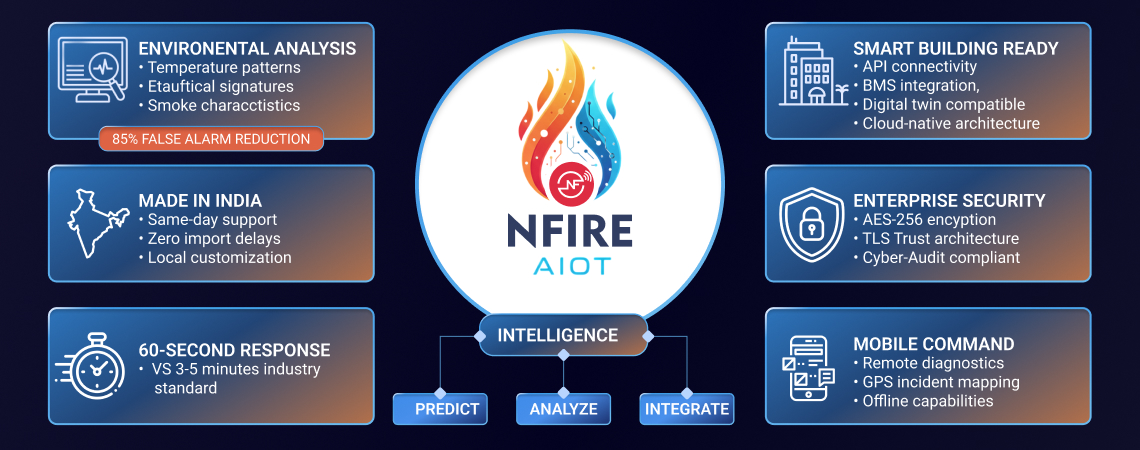
NFire uses artificial intelligence to analyze multiple environmental factors in real-time: temperature patterns, air quality changes, electrical signatures, and smoke particle characteristics. The AI distinguishes between actual fire conditions and harmless triggers like cooking fumes, dust, or AC condensation. This intelligent analysis reduces false alarms by 85% compared to traditional systems.
Yes, NFire features API-ready architecture that integrates seamlessly with most building management systems including HVAC, access control, CCTV, and lighting systems. The system supports standard protocols and can connect to smart building platforms, digital twin applications, and ESG reporting systems. Integration typically takes 2-3 weeks during implementation.
NFire operates independently during network disruptions. The system includes offline capability for critical functions, local processing at device level, battery backup for 72+ hours, and mesh network redundancy for wireless components. When connectivity is restored, all data synchronizes automatically.
Implementation typically takes 6-8 weeks for a mid-size IT park (5-10 buildings), including: Week 1-2: Site assessment and planning, Week 3-4: Device installation with minimal disruption, Week 5-6: System integration and testing, Week 7-8: Staff training and final commissioning. Phased deployment minimizes operational impact.
A single false fire alarm costs approximately ₹56 lakhs for a large IT park (8,000+ employees). This includes ₹32 lakhs in lost productivity during 45-minute evacuation, ₹1.5 lakhs in emergency response costs, ₹10-20 lakhs in potential client SLA penalties, and ₹12 lakhs in recovery/restart time. Most IT parks experience 8-12 false alarms annually, resulting in ₹5.6 crores in annual productivity losses.
Most IT parks achieve 1,000%+ ROI within the first year through false alarm reduction alone. NFire typically reduces false alarms by 85%, saving ₹4.76 crores annually for a typical IT park. The payback period is usually 3-6 months.
While specific pricing varies by campus size and complexity, NFire typically delivers superior total value due to: no import duties (15-20% savings), faster local support response, built-in Indian compliance, and dramatically lower false alarm costs. Annual productivity savings alone often exceed the total system investment by 5-10x. Contact your authorized NFire partner for site-specific cost analysis.
Yes, NFire provides multiple financial benefits: 10-15% insurance premium discounts due to superior fire protection, automated compliance reporting saves 40+ hours monthly, reduced security team overtime from false emergency responses, elimination of client SLA penalties during evacuations, and potential tax benefits for Made in India technology adoption.
Yes, NFire is certified to all major international and Indian standards: EN54 European Standard for global compliance, IS/ISO 7240 Indian Standard for local requirements, CE Certification for European markets, STQC Testing for Government of India approval, and ISO 9001 for quality management systems.
Absolutely. NFire’s certifications are recognized globally by international corporations, government agencies, and insurance providers. The system automatically generates compliance reports for audits, maintains complete event logs for forensic analysis, and provides documentation required for ISO 45001, SOX compliance, and ESG reporting.
NFire implements enterprise-grade cybersecurity: AES-256 encryption for all communications, TLS 1.2 secure protocols for data transmission, Zero Trust architecture with device identity verification, network segmentation for isolated fire safety network, secure over-the-air firmware updates, and complete audit trail logging for cybersecurity compliance.
NFire provides same-day support response across all major Indian cities (4-6 hours typical response time vs. 48-72 hours for imported systems). Support includes 24×7 monitoring from our Emergency Monitoring Center in Gujarat, remote diagnostics and troubleshooting, on-site technical support when needed, and preventive maintenance scheduling
NFire requires minimal maintenance due to intelligent design: quarterly remote system health checks, annual on-site preventive maintenance, automatic software updates via secure OTA, predictive maintenance alerts before issues occur, and 5+ year device lifespan with modular replacement options.
NFire’s modular architecture makes expansion simple: wireless devices can be added without rewiring, centralized monitoring automatically detects new devices, cloud-based management scales with your campus, and pay-as-you-grow pricing for additional zones. System expansion typically takes days, not weeks.
NFire offers unique advantages for Indian IT parks: Made in India manufacturing eliminates import delays and duties, local support network across major cities, optimized for Indian environmental conditions, built-in compliance with Indian standards, and proven track record protecting 50+ major Indian IT parks with 90% customer retention rate.
Traditional systems are reactive (detect after fire starts) while NFire is predictive (prevents incidents). Key differences: 85% fewer false alarms vs. traditional systems, 50-second response time vs. 3-5 minutes industry standard, cloud-native architecture vs. legacy hardware, smart building integration vs. standalone operation, and local support vs. international dependency.
While initial costs might appear lower, total value favors NFire: superior false alarm reduction (85% vs. 20-30% for basic local systems), international certifications vs. limited compliance, enterprise-grade cybersecurity vs. basic protection, smart building integration capability vs. standalone operation, and proven performance at scale vs. limited track record.
NFire is designed and manufactured in India by Atigo Security, protecting the country’s leading IT parks since 2013. With certifications including EN54, IS/ISO 7240, CE, and STQC, NFire delivers international-standard fire protection optimized for Indian operating conditions.